



Article
Is Outsourcing Good or Bad? Pros, Cons, When It Fits
Whether outsourcing is good or bad for a business has no single answer. The same move can work for one function and fail for another. The outcome turns on what is outsourced, how it is governed, and who the partner is.
In customer service, outsourcing works when the provider shares the risk and owns the result. It turns bad when communication and ownership break down. That is why the partner who runs the customer support operations matters more than the decision to outsource itself.
For chief operating officers and customer experience (CX) leaders in the US and the UK, the question is how to find such a partner. Simply Contact can be paid per resolved contact at an agreed quality level. The safest start is small. Ellina Bronnikova, our Chief Commercial Officer, advises a pilot of 1 to 10 agents, or 30 to 50 for enterprise projects.
What makes outsourcing work for a business?
Outsourcing works for a business when the provider’s revenue moves with the client’s results. Outcome-based pricing builds that in: the provider is paid per resolved contact rather than pure headcount, so it has something to lose.

Partnership mentality is what makes a client stay. That means continuous improvement, new initiatives, and working toward the client's unique goals together. We stay flexible instead of selling a one-size-fits-all solution. Sharing risk, such as outcome-based pricing per resolution, is also deeply valued. That is what makes an outsourcing provider a true partner that stays.
That shared risk can be written down. We’re ready to be paid per resolved call, chat or email at an agreed quality level, with that written into the contract. Before signing, we study the process, volumes and seasonality. If our analysis is wrong, we pay for it. Our guide to how per-resolved-contact pricing works covers the cost side.
Outsourcing partnerships that worked
At Bolt, our team used root-cause analysis and refined scripts to cut recurring complaints by 70%. That is this partnership in practice.
For Ditto Music, support was split between internal teams and several vendors. We consolidated it into one centralized model with clear ownership, running live chat in English, Spanish, and French.
What businesses fear most about outsourcing
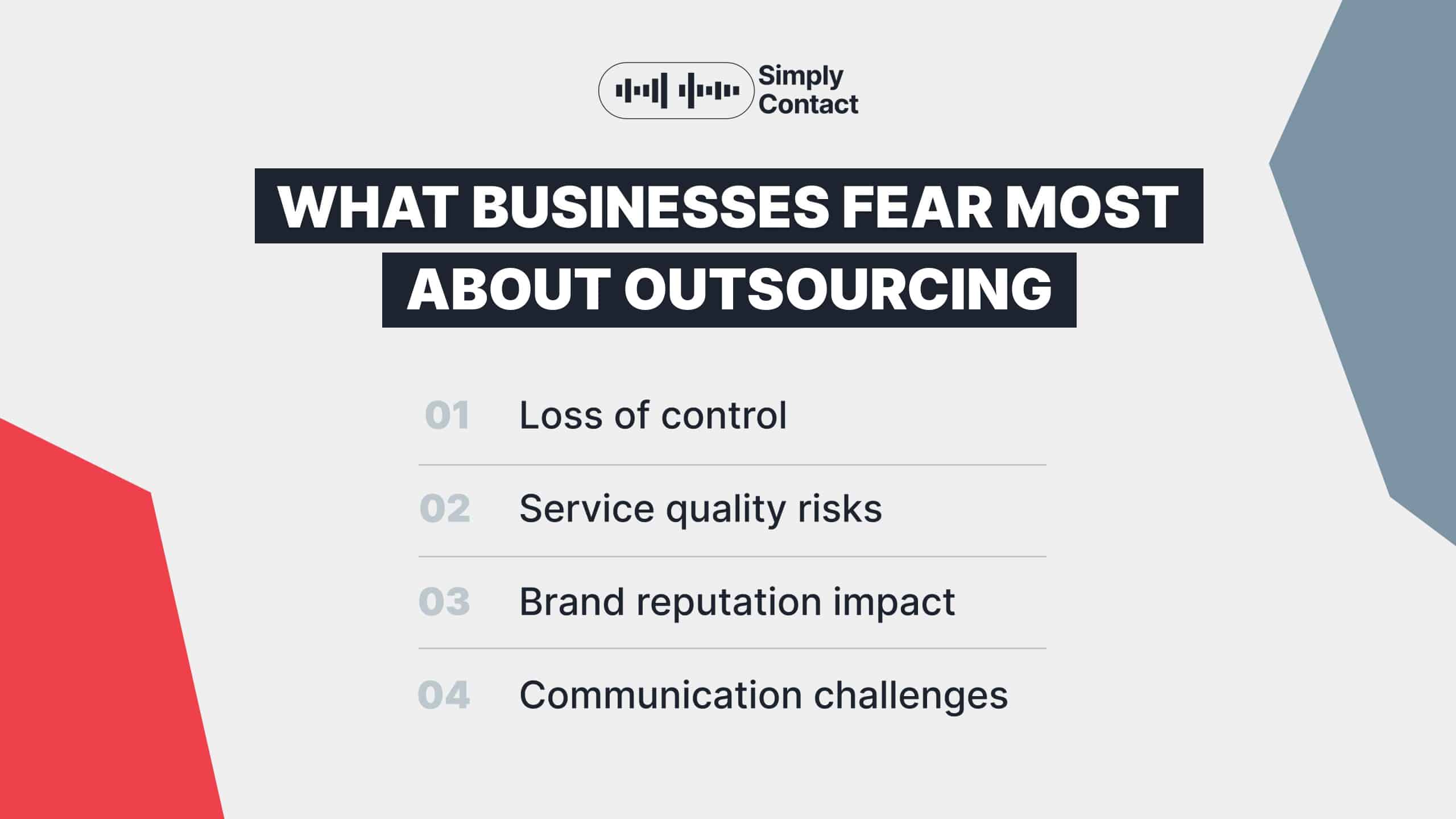
Four fears come up before a business outsources: losing control, a drop in service quality, brand damage, and poor communication. These fears come before any contract is signed, so they are about trust in an unknown partner. Each one can be checked at the selection stage.
Loss of control
Outsourcing hands day-to-day execution to an external team. Leaders then worry about how decisions get made and how quality is checked once the work leaves the building. Write into the contract who approves process changes and how often the client receives quality data. Outsourcing doesn’t mean giving up control: the client sets the standards and sees the quality data the provider manages by.
A drop in service quality
The worry is that an external team won’t hold the standard the in-house agents set, because training, culture, and targets differ between companies. Ask each shortlisted provider to show how it trains and coaches agents on a new account. On our UK patient transport account, for example, team leads coach agents live on difficult calls, and every agent has an individual improvement plan. Keep complex, high-touch contacts in-house until the provider’s quality scorecards show the standard holds.
Brand damage
Customers judge a brand by every answer they get, and they don’t see who gave it. The concern is strongest for brands that compete on premium service. During selection, ask how the provider learns the brand’s tone of voice and who signs off reply templates. Anonymized call recordings from a comparable account then show how its agents handle pressure.
Poor communication
Teams new to outsourcing worry that language and time zone gaps will slow every decision. In Ellina Bronnikova’s experience, communication issues are one of the two main reasons clients leave a previous provider. Settle this during selection: agree on a working language, overlapping hours, and a named contact on each side. If a provider can’t name its contact at the proposal stage, keep looking.
Common outsourcing myths
Several fears about outsourcing come from myths rather than from how partnerships run in practice:
- Myth: outsourcing means losing control. The client keeps the goals and the quality data; the provider runs the daily work to targets written into the contract.
- Myth: it only suits large companies. A small team can outsource one function, such as after-hours support or one language, and add more once it works.
- Myth: outsourcing lowers quality. Quality depends on the provider’s training and oversight.
- Myth: it is only about cutting costs. Extra capacity and language coverage are reasons in their own right; the cost case holds only when quality holds too.
- Myth: outsourced means offshore. A provider can work onshore, nearshore, or offshore, and our guide to nearshore and offshore delivery compared sets out the differences.
Why is outsourcing bad? Disadvantages of outsourcing to plan for
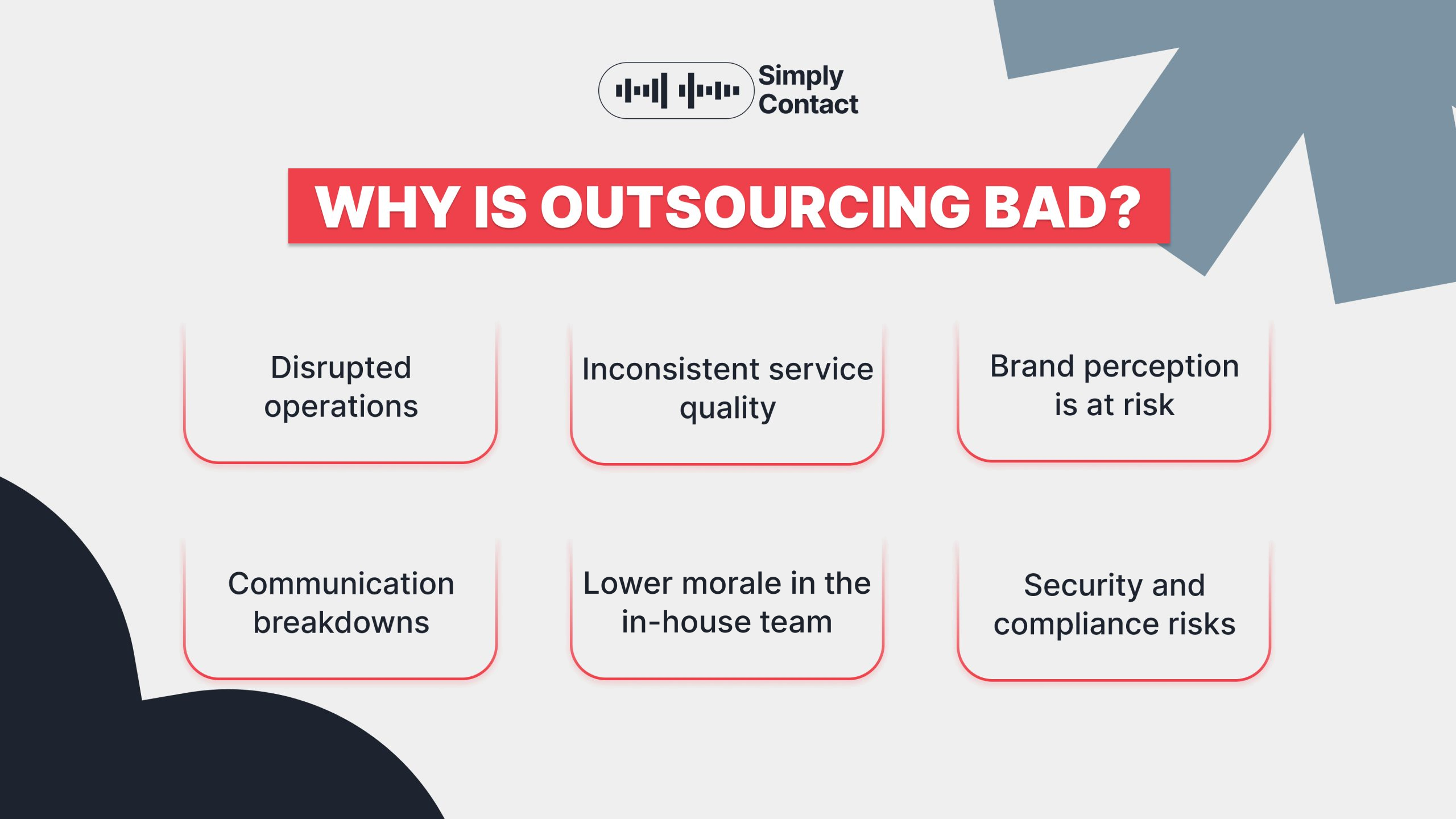
Outsourcing goes wrong when the partner is weak or the contract and oversight are loose. The disadvantages of outsourcing then show up as disrupted operations, uneven service quality, brand damage, communication breakdowns, lower team morale, and security risks. In Ellina Bronnikova's experience, the top reasons clients switch providers are communication issues and a lack of ownership of the project.
Pricing per resolved contact builds that ownership into the contract.
Disruption during the transition
Operations stall during the move to a new provider when the knowledge base and system access aren’t handed over in a planned transition. Disruption also follows when the provider changes a process without agreeing to it with the client first. In the first weeks, rising wait times and repeat contacts usually point to a gap in the handover. Close it in a joint review of open issues rather than waiting for the monthly report.
Inconsistent service quality
Once the work is live, quality slips when a provider cuts training or staffing to protect its margin. Agent turnover rises, while customers wait longer and have to repeat themselves. Track satisfaction scores, repeat contacts, and quality reviews by shift each month, and act as soon as one of them drops.
Brand perception is at risk
Once the partnership is live, the damage shows up in complaints and public reviews. Customers hold the company responsible for every interaction, and the provider is accountable to the company through the contract and its service levels. Watch reviews and complaints for signs such as scripted answers or repeated transfers. Pull the call samples behind them for the next quality review, and agree on the training fix with the provider.
Communication breakdowns
Language and time zone differences slow decisions when nobody owns communication on either side. Delays grow when escalation paths and reporting formats aren’t agreed up front. Name one owner on each side before launch, and agree on both in writing.
Lower morale in the in-house team
Outsourcing can unsettle the staff who stay. People may worry about their own job security, or feel that their work is valued less once part of it moves outside. Morale drops fastest when the decision is announced late or without a reason.
Tell the team early which work moves to the provider and how their roles change. Give in-house experts a defined part in onboarding and quality reviews, so both teams work to the same standards. That also keeps product knowledge inside the company while the new team learns.
Security and compliance risks
A data breach at a provider becomes the client’s breach in the eyes of customers and regulators. In the US, the Health Insurance Portability and Accountability Act (HIPAA) sets rules on business associates. A covered entity may let a business associate handle protected health information only if it obtains “satisfactory assurance” that the business associate will safeguard it. In the UK, a processor of customer data needs a binding contract with the controller under the UK General Data Protection Regulation (UK GDPR). The processor can also be held liable for non-compliance, according to the Information Commissioner’s Office (ICO).
Request current certifications and audit reports from every provider on the shortlist. Look for the Payment Card Industry Data Security Standard (PCI DSS) for payment data and ISO 27001 for information security. Simply Contact is ISO 27001 certified. Companies in healthcare and financial services should also check where data is stored and who can access it.
Why is outsourcing good? Weighing the pros and cons of outsourcing
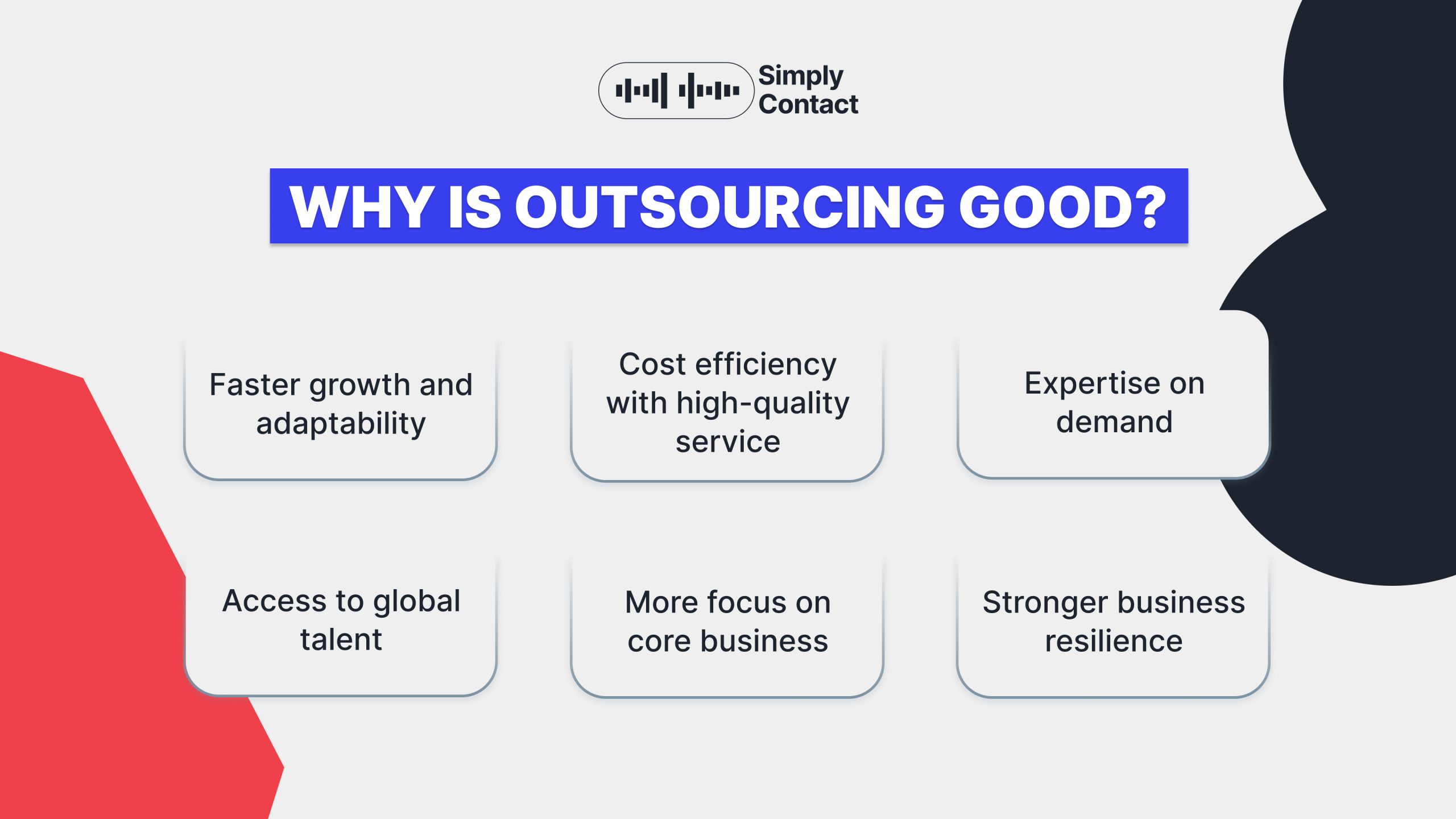
Outsourcing is good for a business when it adds capacity or skills faster than hiring can, at a cost that holds up alongside quality. At Simply Contact, recruitment, training design, IT support and quality assurance (QA) run end to end under our full operational ownership.
Faster growth and access to global talent
Business opportunities don’t wait for hiring cycles. Support teams can grow or shrink with contact volume, for example around holiday peaks in ecommerce or disruption days in travel. Hiring in one city means competing with every other local employer for the same candidates, which pushes up salaries and slows hiring. A provider with sites in several countries can recruit for the languages and shifts a local market can’t fill. Ask where the agents for the account will sit and how the provider tests their language skills. For low-volume languages, AI translation for customer service can widen coverage.
Cost efficiency only when quality holds
The cost advantage of outsourcing holds only when service quality stays the same or improves. Regional cost differences and scale matter less than how well the provider runs the work. Pricing per resolved contact ties the cost to the quality.
Regarding quality, I can speak from my own experience at Simply Contact: outsourcing improved quality every time. Dedicated quality controllers and a custom approach mean we cannot afford to overlook any aspect. That makes quality control (QC) a consistent practice that improves project quality over time, every time.
Expertise on demand
Building in-house capabilities for every function isn’t always practical. A specialist provider already runs channels such as help desk services, technical support, and social media support services for other clients. It arrives with trained agents and tested workflows. Compliance-heavy work should move only after the provider shows which channels it runs today and how it trains agents on a new product.
More focus on core business
Running support functions such as customer service, IT support, and back-office operations takes management time and budget away from product and growth work. An experienced provider takes over the daily running, so the company’s leaders can spend that time on what sets it apart.
The client’s team sets the goals and reviews the results. Options such as AI customer care can be added where they support those goals.
Stronger business resilience
Businesses that rely only on internal staff carry the full risk of limited language coverage and sudden demand spikes. A provider with several delivery sites can move work between them when one is disrupted.
A continuity plan counts only if it has been tested, so the date of the last test is worth checking before signing.
Is outsourcing good or bad for customer service?
Outsourcing is good for an organization when it fits the organization’s risk profile and its capacity to manage a partner. Cost is one motive, but rarely the only one. Deloitte’s 2024 Global Outsourcing Survey of more than 500 executives found organizations combining outsourcing with insourcing and global in-house centers instead of choosing one model.
The fit depends on the function and its demand pattern. A travel or ecommerce support team that needs weekend coverage in peak season or extra languages gains a lot from a partner. A team with steady volume in one language gains less.
Luxury and regulated brands can outsource safely when the provider works to their standards. That means agents trained on the brand’s tone of voice and quality scorecards agreed in advance. Payment data needs PCI DSS certified controls, and health data needs HIPAA compliant handling.
Sensitive support can stay high quality after outsourcing. For HATS Group, a UK patient transport provider, our team runs recruitment, training, quality, and analytics on calls with elderly and vulnerable patients. The Lot 1 quality score is 94.44% across 1,154 reviewed tickets. For a side-by-side view of cost and control, see our comparison of in-house vs outsourced call centers.
When does it make sense to outsource?
It makes sense to outsource when a function needs more capacity, languages, hours, or skills than the in-house team can staff at a steady quality. It makes less sense for work that defines the company’s product or needs its leaders’ input every day.
These signals show that a function is ready for a partner that works to written standards:
- Volume swings with seasons or product launches.
- Customers need languages or time zones the in-house team doesn’t cover.
- The business needs round-the-clock coverage without staffing night and weekend shifts in-house.
- The function handles regulated data, and a partner meets the rules, such as PCI DSS for payment data or HIPAA for health data.
- In-house cost per contact keeps rising while quality stays flat.
| Factor | Outsourcing fits | Keep in-house |
| Volume | Seasonal peaks or fast growth | Small and steady |
| Languages and hours | Several languages or round-the-clock coverage | One language in office hours |
| Type of work | Repeatable work that can be measured | Work that needs leaders’ judgment every day |
| Customer data | A partner meets the data rules, such as PCI DSS or HIPAA | No partner meets the company’s data controls |
Small businesses can run the same test on one function at a time. If only one signal applies, start with a small pilot.
How to reduce outsourcing risks and manage the partnership
Reduce the risks by choosing a partner on its controls and writing service levels into the contract. After launch, stay involved in the quality reviews.
- Start with a pilot. Hand over one channel or one shift first, and expand once it meets its targets. Ellina Bronnikova advises starting with a proof of concept in a certain market or line of business. That tests the waters and smooths the transition from an in-house team or a previous provider. A pilot shows how the provider handles real contacts before more volume moves over.
- Write service levels and key performance indicators (KPIs) into the contract. Set response times and customer satisfaction (CSAT) targets, and say what happens when they are missed. Our guide on how SLAs and KPIs differ helps set both.
- Plan the transition. Hand over the knowledge base and system access on a written schedule, with an escalation path agreed before launch. Keep in-house experts available during the first weeks.
- Keep access to quality data. Ask for call samples and QA scorecards every month, and review them with the provider. Agree on the scorecard criteria before launch, so both teams judge quality the same way. Between reviews, a dashboard gives both sides the same live numbers.
- Agree on exit terms. Set notice periods and data return before signing, so the client can change provider without losing records.
How we can help
Simply Contact provides outsourced customer services for companies in travel, fintech, healthcare, ecommerce, and SaaS, from front-line support to back-office operations.
Ellina Bronnikova sees two more reasons clients move to us. Some want to consolidate markets with one provider, and Simply Contact can offer one cohesive European team that speaks multiple languages. Others want to move from a large enterprise provider to a mid-size one for a tailored approach in both human and AI solutions.
We can review your contact volumes, languages, and quality targets with you before you decide.
Conclusion
Outsourcing is neither good nor bad on its own. It pays off when a function outgrows the in-house team and the partner shares the risk and owns the result. It goes wrong when the provider communicates poorly or takes no ownership of the project, the main reasons clients leave a provider. The safest start is a small proof of concept with one market or line of business, as Ellina Bronnikova advises. Before signing, ask any partner what it loses if the work is not good.
If outsourcing is on the table for your support operation, our team will be glad to look at it: talk to Simply Contact.

Newsletter
Subscribe
Subscribe to our newsletter to receive valuable industry insights and the latest research reports.