



Article
Customer Service Outsourcing Pricing: Full Cost Guide
"How much does it cost to outsource customer service?" is usually the first question in a vendor conversation, and the answer is rarely a single number. One provider quotes an hourly rate, another quotes per agent per month, a third wants to charge per resolved contact. Each proposal bundles different things into the price, which makes customer service outsourcing pricing slow to compare and easy to misread.
This guide is for CX, operations, and procurement leads in Western Europe building a business case. It covers what moves the price, how the main pricing models work from the buyer's side, what rates look like by delivery location, and where costs hide once a contract is signed. We've also included figures from one of our own client transitions, where a UK company moved support from an in-house team to an outsourced one. The aim is to help you go into vendor conversations knowing which numbers to question.
Customer service outsourcing pricing: The main cost drivers
Before comparing vendors, it helps to know which parts of your own operation push a quote up or down. Five levers explain most of the variation in customer service outsourcing pricing.
Volume and predictability
Contact volume decides how many agents you need, and the shape of that volume matters as much as the total. Steady monthly demand is cheaper to staff than the same number of contacts arriving in spikes, because peaks leave capacity sitting idle in between. Seasonal businesses in travel or retail usually pay more per contact unless the contract allows flexible scaling. If you can share a reliable forecast, the vendor can plan hiring around it and price with less of a safety margin.
Channel mix
Voice is the most expensive channel to staff. One agent handles one call at a time, and calls need real-time coverage. Chat agents can work several conversations at once, and email can be batched into quieter hours. A voice-heavy operation will cost more than an email-first one handling the same volume.
Language requirements
Widely spoken languages are easier and cheaper to staff. Rarer languages, or native-level fluency on voice, shrink the talent pool and raise rates. Covering several languages from one hub usually costs less than running a separate team for each market, because agents who speak two languages can cover both queues when one is quiet.
Agent seniority
Order tracking and password resets can be handled by newer agents after short training. Technical troubleshooting, claims or payment disputes need experienced people and longer onboarding, and the rate reflects that.
Compliance needs
Regulated sectors bring the General Data Protection Regulation (GDPR) for customer data, the Payment Card Industry Data Security Standard (PCI DSS) for payment data and the Digital Operational Resilience Act (DORA) for financial services firms and their outsourced providers, plus call recording, audit trails and background checks. A vendor that already has the certifications and infrastructure spreads that cost across clients. A vendor that has to build it for you will pass the cost on.
Put together, the cost of outsourcing customer service for a multilingual, voice-led fintech operation looks very different from an English-only email desk at similar volume.
Outsourcing pricing models compared
Vendors use one of four outsourcing pricing models, sometimes combining two. Each model decides who carries the risk when volume or efficiency changes.
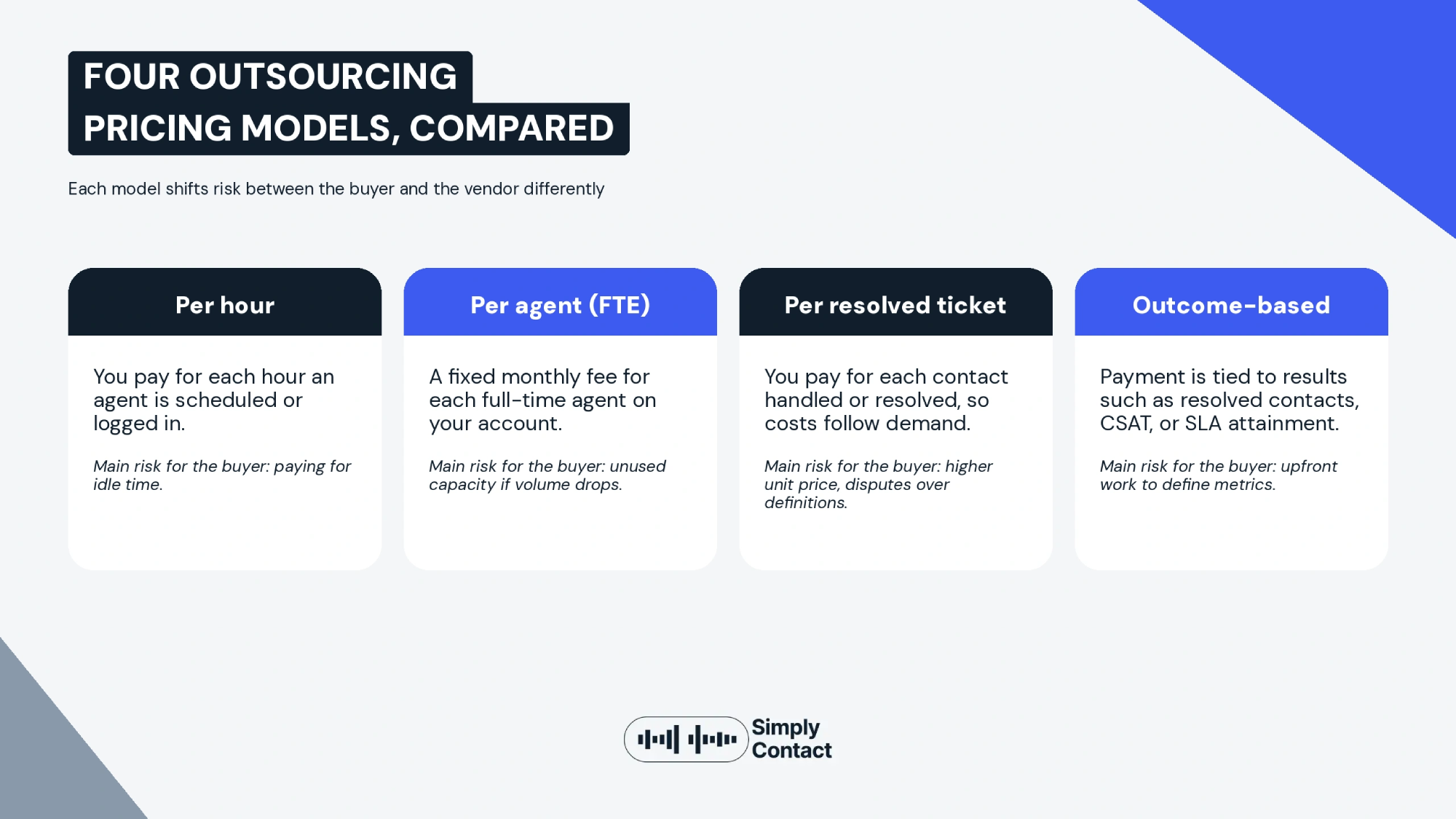
Per hour
You pay for each hour an agent is scheduled or logged in. It's simple and easy to benchmark. The drawback is paying for idle time in quiet periods, and 24/7 coverage adds up quickly. Check whether you're billed for scheduled hours or productive login hours, as the gap can be large. Also ask whether team leads, trainers and quality assurance (QA) are included in the hourly figure or billed on top.
Per agent (FTE)
A fixed monthly fee for each full-time equivalent (FTE) agent on your account. Budgets are predictable and a dedicated team builds deep product knowledge. You carry the utilization risk, though: if volume falls, you still pay for the seats. Some vendors let agents move between voice, chat and email as demand shifts, which keeps the same headcount busy across channels and lowers the effective cost per contact. For dedicated teams, this is the most common call center pricing model.
Per resolved ticket
You pay for each contact handled or resolved, so costs follow demand. Vendors build their own risk into the unit rate, which makes it higher, and definitions matter. Agree in writing what counts as resolved and how reopened tickets are treated. Per-ticket pricing also needs a fair way to handle long, complex contacts, otherwise the vendor has a reason to close them quickly.
Outcome-based
Payment is tied to results such as resolved contacts, customer satisfaction (CSAT), first contact resolution (FCR), or service level agreement (SLA) attainment. Incentives line up with yours, but the model needs clean data and clear metric definitions from the start.
Hybrids are common. A per-agent core team with per-ticket pricing for overflow, or an FTE contract with a bonus or penalty linked to SLAs, can give you predictable budgets with some protection against peaks.
| Model | Suits | Main risk for the buyer |
| Per hour | Short projects, changing scope | Paying for idle time |
| Per agent (FTE) | Stable volume, dedicated teams | Unused capacity if volume drops |
| Per resolved ticket | Seasonal or unpredictable volume | Higher unit price, disputes over definitions |
| Outcome-based | Operations with reliable baseline data | Upfront work to define metrics |
Outcome-based pricing and why more buyers ask for it
Under hourly or FTE contracts, the vendor is paid for supplying agents. Better training or a sharper knowledge base reduces the hours needed, which also reduces the vendor's revenue. The buyer ends up doing the oversight: reading productivity reports, auditing handle times, and pushing for improvements the contract gives the vendor little reason to make.
Paying per resolved contact changes the incentive. The vendor earns by resolving contacts well and gains nothing from extra hours, so QA, coaching, and workflow fixes become part of its own commercial interest.
At Simply Contact, we're prepared to be paid per resolved contact instead of pure headcount where the operation suits it. For clients, that means far less time spent checking whether the team is productive, and more attention on the results they report to their own board.
A few things to agree before signing:
- a written definition of a resolved contact, including how repeat contacts within a set window are counted.
- a baseline period so both sides agree on current performance.
- a quality floor, so speed doesn't come at the expense of CSAT.
- a review point to adjust unit rates once real data is in.
The model works best when contact types are well understood. For a new product or a support function with no historical data, a short FTE phase to build the baseline is often the sensible first step.
Cost of outsourcing customer service by delivery location
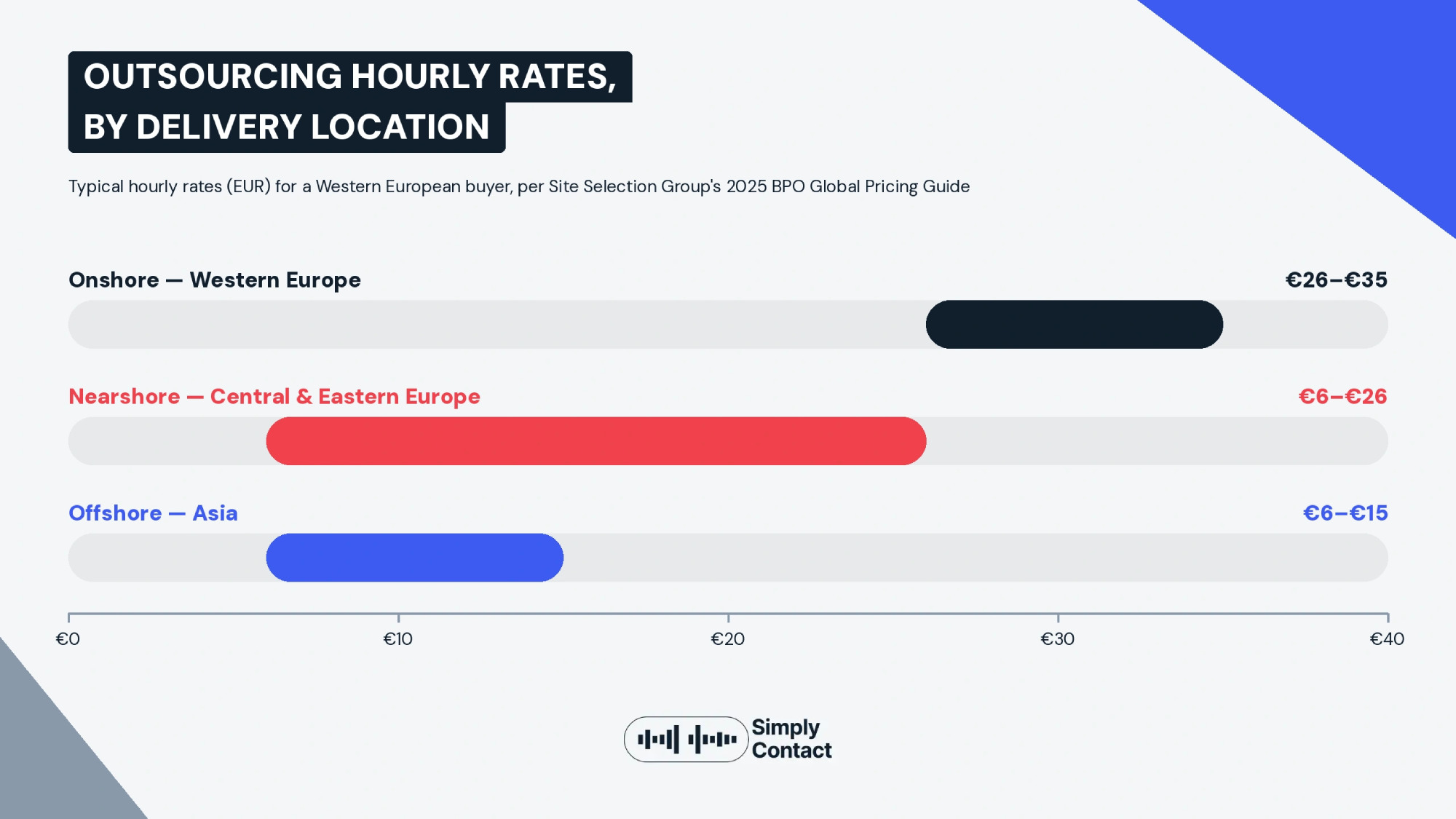
Location has the biggest single effect on hourly rates. Based on Site Selection Group's 2025 BPO Global Pricing Guide (converted to euros at September 2026 exchange rates) and our own delivery experience, typical hourly rates for a Western European buyer fall into these ranges:
| Delivery model | Region | Typical hourly rate (EUR) |
| Onshore | Western Europe | €26–€35 |
| Nearshore | Central and Eastern Europe | €6–€26 |
| Offshore | Asia | €6–€15 |
The nearshore range is wide because Central and Eastern Europe covers very different markets and service types. An English-only email desk lands near the bottom. Native-level German voice support with regulated-sector compliance lands near the top. Ranges also overlap because rates aren't always calculated the same way.
One vendor's figure may include team leads, QA, IT and facilities, while another quotes the agent's time and adds the rest as separate lines. Three factors explain the spread beyond labour cost.
Language coverage
CEE hubs can staff many European languages from one site, which matters if you support customers across several EU markets. Offshore locations are strong in English but often have to source European languages separately, at a higher rate.
Time zone
For Western European companies, nearshore teams work the same or neighboring hours as your customers. You get business-hours coverage without night shifts, and your in-house team can work alongside the vendor's in real time. Some companies combine locations to get 24/7 coverage without paying night premiums in one site.
Compliance infrastructure
Delivery inside the EU keeps customer data within GDPR's scope without extra transfer arrangements. Handling EU customer data offshore needs additional legal and technical safeguards, and that cost won't show up in the hourly rate.
When you compare locations, compare the rate for the service you'll actually receive: the right languages, at the right hours, with the compliance your sector requires.
In-house vs outsourced: The real cost comparison
The usual comparison puts an agent's salary next to a vendor's hourly rate. That undercounts the in-house side, because salary is only the most visible line. Salary also ignores how much of a paid shift an agent actually spends handling contacts. A realistic in-house figure includes:
- Recruitment: job ads, recruiter or agency fees, interview time, and background checks.
- Training: paid onboarding before agents are productive, plus trainers and materials.
- Attrition: every leaver restarts the recruitment and training cycle.
- Management overhead: team leads, workforce planning, QA analysts, and senior time spent managing the function.
- Tooling: telephony, helpdesk licenses, QA and workforce management software, hardware, and IT support.
- Facilities: office space, or the setup and security costs of remote working.
Once these are counted, working out how much it costs to outsource customer service against keeping it in-house becomes a total cost of ownership exercise, and the gap is usually wider than salaries suggest. To build the comparison, take a full year of in-house costs across every line above, divide by the contacts handled, and compare that cost per contact with each vendor's proposal at the same volume and service levels.
Both results came from one change, so the client, HATS Group, didn't have to trade quality for savings. Our team managed recruitment, training, speech quality, and analytics end to end, with QA scorecards tuned for tone and empathy with this group of callers.
Outsourcing won't be the cheaper option for every team. A small operation with simple, low-volume queries can sometimes operate efficiently in-house. Once support needs several channels, languages or extended hours, though, in-house overhead grows faster than headcount, and that's usually where the numbers move in favor of an outsourced team.
Hidden costs buyers often miss
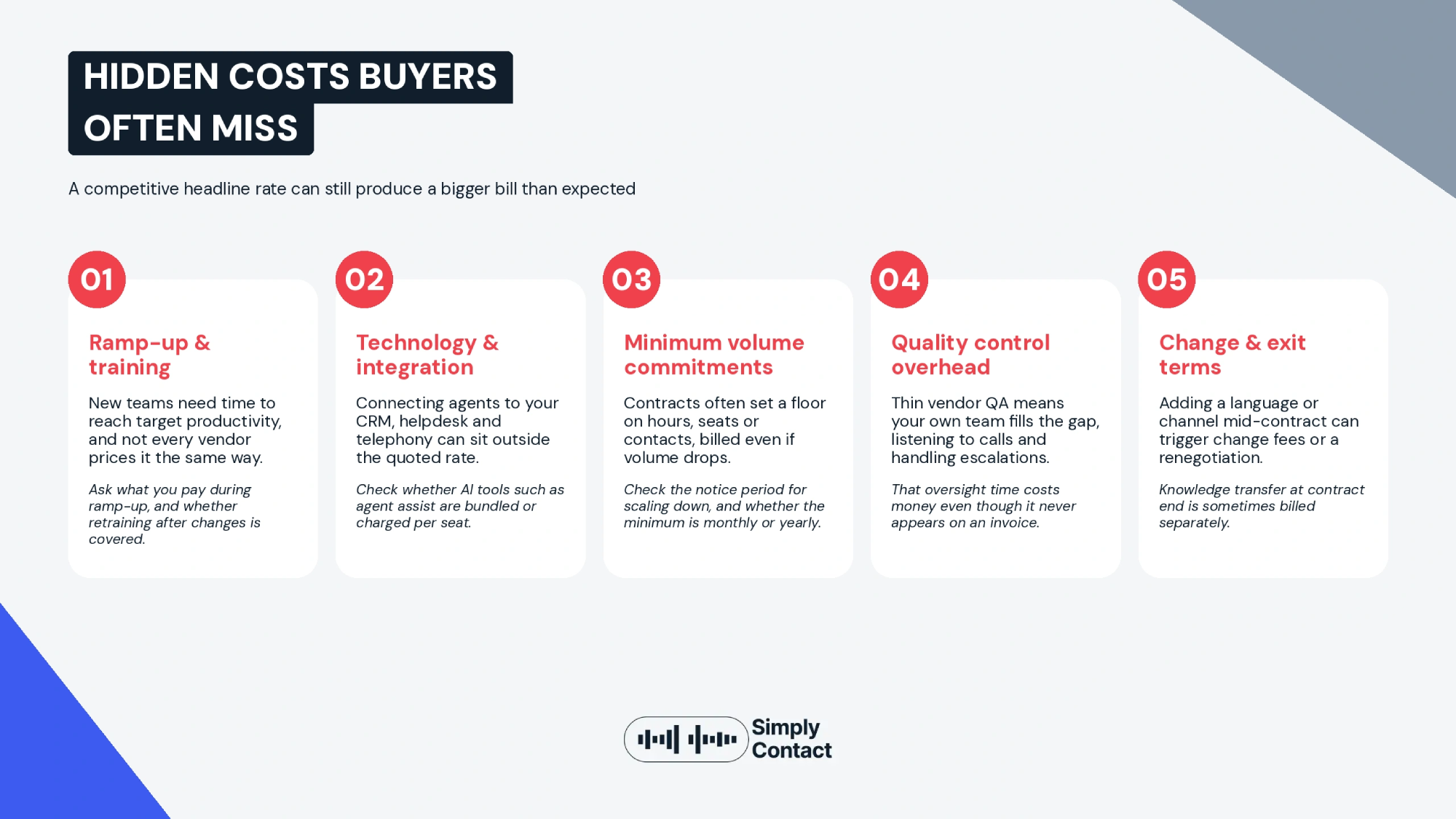
A headline rate can look competitive and still produce a bigger bill than expected. These are the parts of the cost of outsourcing customer service to ask about before you sign.
Ramp-up and training
New teams need time to reach target productivity. Some vendors bill full rates from the first training day, some charge a separate setup fee, and some include onboarding in the rate. Ask how long ramp-up takes, what you pay during it, and whether retraining after product changes is covered.
Technology and integration
Connecting agents to your CRM, helpdesk and telephony takes work. Your own license fees, the vendor's per-seat platform charges and one-off integration projects can all stay outside the quoted rate. If the vendor uses AI tools such as agent assist or automated QA, check whether they're bundled or charged per seat.
Minimum volume commitments
Contracts often set a floor on hours, seats or contacts. If volume drops below it, you pay the minimum anyway. Look at the notice period for scaling down and whether the minimum applies monthly or across the year.
Quality control overhead
If the vendor's QA is thin, your team fills the gap by listening to calls, reviewing tickets and handling escalations. That time costs money even though it never appears on an invoice. Ask what QA coverage is included, who handles calibration and what reporting you'll get.
Change and exit terms
Adding a language, a channel or a new product line mid-contract can trigger change fees or a renegotiation. At the other end, knowledge transfer and data handover when a contract ends are sometimes billed separately. Reading these clauses early costs far less than discovering them at renewal.
Choosing a call center pricing model for your business
The right call center pricing model depends on three questions.
How predictable is your volume?
Steady, forecastable demand suits per-agent pricing, because you'll use the capacity you pay for. Seasonal peaks or fast growth point towards per-ticket or outcome-based pricing, or a hybrid with a core FTE team and per-contact pricing for overflow.
How complex are your contacts?
Simple, repeatable queries are easy to price per ticket. Technical troubleshooting, insurance claims or payment disputes vary widely in handling time, so per-ticket rates get padded to cover the long ones. A dedicated FTE team usually serves these better, with a move to outcome-based pricing once the baseline is clear. Where a single operation has both types, splitting pricing by queue is often cleaner than forcing one model across everything.
How much oversight do you want to handle yourself?
Hourly and FTE models leave you monitoring productivity. Outcome-based models shift more of that responsibility to the vendor. If your internal CX team is small, the time saved on oversight can be worth more than a slightly lower unit rate.
Deal size is the other question mid-market buyers raise. A company that needs 100 agents may worry that a provider geared to very large programs will treat it as a minor account. We're comfortable managing 100–150 FTE engagements, which gives mid-market companies real capacity without an enterprise-scale commitment.
Getting an accurate quote
A vendor can only price what it can see. Bring these to the first conversation:
- monthly contact volume by channel, including seasonal peaks.
- languages and markets you support.
- coverage hours and response time targets.
- contact types and their complexity, ideally with current handling times.
- compliance requirements for your sector.
In return, ask for a quote that separates the agent rate from setup, technology, and management costs, states the pricing model and minimums clearly, and shows the assumptions behind the numbers. A vendor that can't explain its assumptions will struggle to hold the price once real volume arrives.
With that information, you'll get customer service outsourcing pricing that reflects your real operation and proposals you can compare side by side. If you'd like a quote built on your numbers, talk to our team.

Newsletter
Subscribe
Subscribe to our newsletter to receive valuable industry insights and the latest research reports.