



Article
Outsourced IT Support: Benefits, Models, and How to Choose
An IT team that spends its day on password resets has little time left for anything else. Outsourced IT support fits mid-market and enterprise companies whose help desk has too many requests, or that need night coverage the in-house team cannot staff. An outside team takes over user requests, system monitoring, and security work. Internal staff then have more time for planning and projects.
Companies often hold off because the contract looks all-or-nothing. The benefit shows when the team starts small and grows with demand. For Howly, an IT expert platform, billing support started with three agents and grew to 22 within the first year, with dedicated night coverage. Outsourced IT support services cover the staffing, shifts, and processes behind that kind of growth.
Outsourced IT support compared with in-house IT
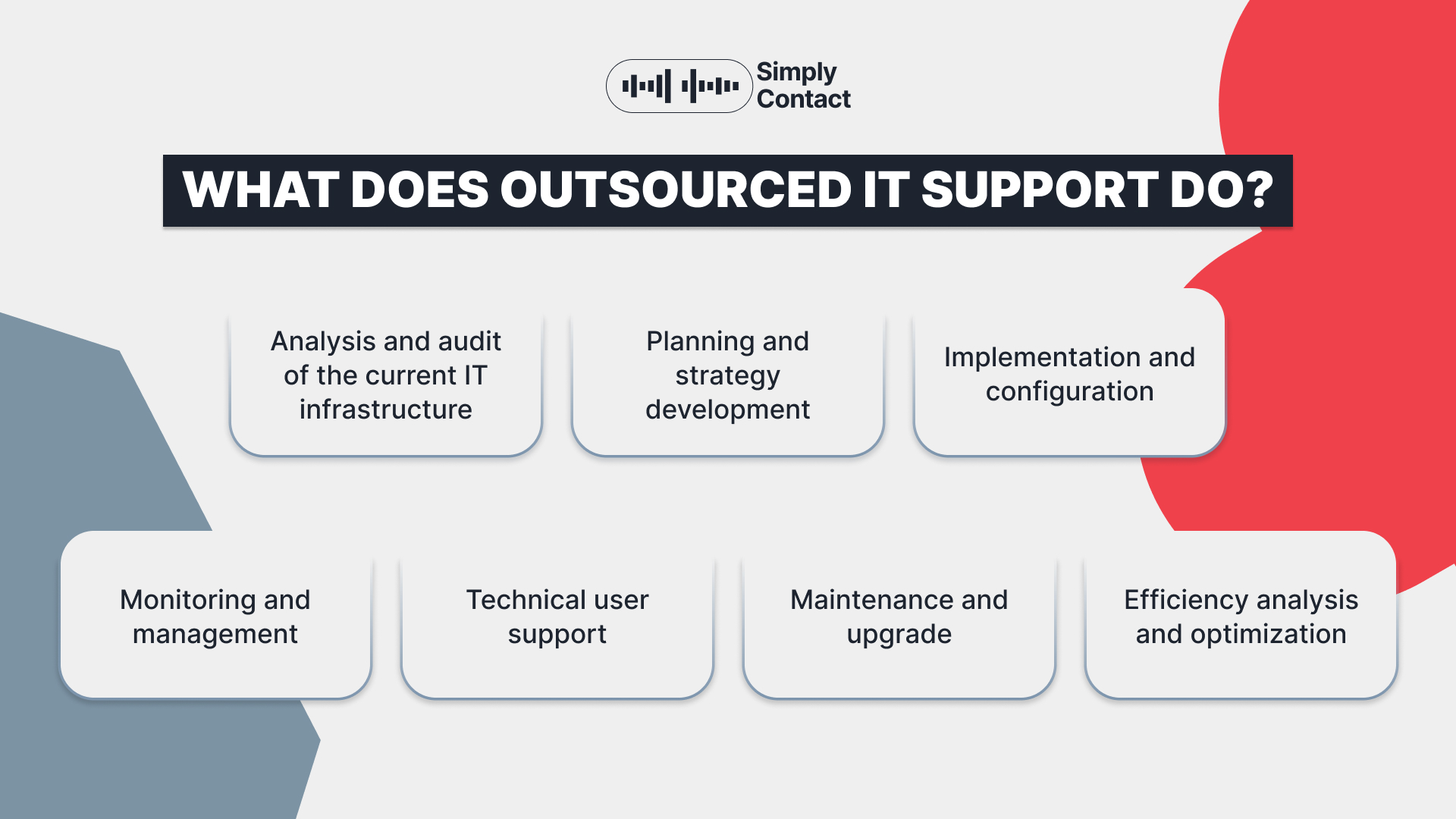
Outsourced IT support and in-house IT do the same work, but they split cost, control, coverage, scale, specialist access, and speed differently. An in-house team hires and staffs every shift. A provider takes on that staffing, and the client reviews results against SLAs, reports, and live dashboards.
| Dimension | In-house IT | Outsourced IT support |
| Cost | Salaries, recruitment, and turnover move with headcount. | A per-user fee, a fixed monthly fee, or pay per resolved contact, reviewed as total support cost. |
| Control | The company owns hiring, shift plans, and tools. | The client sets SLAs and reviews results; live dashboards stay visible. Simply Contact runs recruitment, training design, IT support, and QA end to end. |
| Coverage | Night and weekend cover depends on internal shifts. | Help desk coverage can include agreed evening and night shifts, with 99.99% business continuity across nearshore delivery centers in Central and Eastern Europe. |
| Scale | Each peak starts a new hiring round. | Capacity grows from a small line once volumes are agreed. Simply Contact also runs engagements of 100 to 150 FTE. |
| Access to specialist skills | A specialist hire can sit idle between incidents. | L2 specialists can join for complex tickets or short projects, then hand back to in-house Tier 3 owners. |
| Speed | Coverage waits on recruitment, training, and shift design. | A provider can open a staffed line once processes and volumes are agreed, then ramp against the SLA. |
The work itself is the same in both models: user requests, troubleshooting, system and network monitoring, access management, security, backups, and software updates. The difference is who staffs it and how the client keeps control.
A software subscription is a different purchase from outsourced IT support. A monitoring platform or a remote management tool is a product that a service depends on. Outsourced IT support adds the trained people and the processes, so incidents are logged, escalated, and resolved to a defined standard. Quotes for the two can look similar on paper, so check which one the quote covers. A tool license and a staffed service differ in both cost and what the client receives.
IT support outsourcing models: Fully managed, co-managed, and help desk only
IT support outsourcing is sold in three models: fully managed, co-managed, and help desk only. Mid-market and enterprise companies pick the model that matches the IT capacity they already have. The usual pain is ticket volume, night coverage, or a missing specialist tier. The result is a defined split of work, with SLAs and an escalation path into the remaining in-house team. Simply Contact runs these models for engagements of 100 to 150 FTE, not only for large deals.
Fully managed IT support
The provider takes complete responsibility for IT operations and infrastructure, along with the user-facing help desk, usually around the clock. Incidents are logged in the ticketing or ITSM process and worked against an SLA, including L1 and L2 escalation. It suits companies without an internal IT department, and those that want IT administration off management's desk. Oversight stays with the client through scheduled reports and service reviews.
Co-managed IT support
The internal team keeps ownership of strategy and core systems. The provider covers agreed tasks: overflow tickets, after-hours help desk cover, or specialist L2 skills the in-house team does not staff every day. Co-managed support adds capacity while existing staff keep their roles. We recommend writing the roles down early. Responsibilities overlap easily when two teams share one ticketing system.
IT help desk outsourcing
IT help desk outsourcing covers the user-facing side of IT: ticket intake, password resets, device and application troubleshooting, and escalation to specialists. Support is usually divided into tiers. Tier 0 is self-service and the knowledge base, and Tier 1 (L1) handles routine requests. Tier 2 (L2) covers deeper technical issues, and Tier 3 involves engineers and specialists.
A common split is to use outsourcing IT help desk services for Tiers 0 to 2 and keep Tier 3 in-house. We deliver this service through multilingual teams in nearshore delivery centers across Central and Eastern Europe, with 99.99% business continuity. Companies comparing IT help desk outsourcing companies can start their shortlist there.
| Model | Provider responsibility | Internal team role | Best for |
| Fully managed | User support and all IT operations | Business oversight | Companies without internal IT |
| Co-managed | Agreed tasks, overflow, after-hours cover | Strategy and core systems | Teams with in-house IT |
| Help desk only | Tier 0 to 2 user support | Projects, infrastructure, Tier 3 | Teams overloaded with tickets |
Help desk or technical support: Which tier should go first?
Help desk outsourcing answers volume. Technical support outsourcing answers complexity. The usual trigger is tickets at Tier 2 (L2) and Tier 3 growing faster than internal specialist capacity. Adding help desk headcount does not fix that bottleneck.
Another signal: product or engineering teams are pulled into customer-facing technical issues because no dedicated Tier 2 or Tier 3 function exists. A third: help desk SLAs are still met, but resolution time on complex tickets is slipping. Round-the-clock Tier 2 coverage can also be hard to staff as an in-house specialist shift.
Technical support outsourcing adds specialist coverage for that more complex tier, with a structured escalation path to in-house engineers. Tier 3 can follow once specialist demand justifies a wider hand-off.
Why do companies outsource IT support?
Companies outsource IT support to cover compliance, add help desk capacity, reach L2 specialists, and keep costs predictable. Each benefit below is a working outcome. A case is used only to show how that outcome looked in practice.
Compliance and security coverage
Regulated work needs written access control, incident-response procedures, and audit-ready records. Simply Contact delivery is ISO 27001 and ISO 27701 certified and GDPR compliant, and it is PCI DSS v4.0.1 certified. That set of controls matters for teams in fintech and healthcare, where a breach brings regulatory penalties and financial loss. Health data should be handled under HIPAA-compliant processes; HIPAA is not a certification.
Capacity that grows with demand
When ticket volume or night coverage rises, an in-house help desk has to hire, train, and plan shifts before it can keep the SLA. An outsourced help desk is contracted to cover agreed volumes, including evening and night shifts, and to escalate L1 and L2 requests on that SLA. That is the benefit: coverage can follow demand without a new internal hiring round for each peak.
The Howly billing support program shows that pattern. The team started in June 2023 with three agents and grew to 22 within the first year, with dedicated night coverage. Three team leads covered the shifts, one of them dedicated to nights. Agent productivity rose 43% within six months. The figures show a small start, a planned ramp, and later throughput, not an overnight jump to a large team.
Broader expertise
Specialist skills in networking, security, and cloud platforms are often needed only for short projects or escalated incidents. Hiring those skills in-house can leave them idle between peaks. An outsourced IT support team can bring the specialist in for the ticket or the project. The work then goes back to the in-house Tier 3 owners.
Predictable costs
In-house IT cost moves with salaries, recruitment, and turnover, which are hard to forecast when ticket volume shifts. Outsourced IT support is usually priced as a per-user or fixed monthly fee, or paid per resolved contact at an agreed quality level. Finance teams can then plan against an SLA, not against a hiring plan. The right comparison is total support cost, not the headline unit rate. The contract should state what happens when demand goes above the agreed volume. The guide to outsourcing pricing models sets out the options.
IT support outsourcing companies: Questions to ask before you sign
When comparing IT support outsourcing companies, check five areas:
- SLA response times: Ask for response and resolution targets for each priority level, plus the remedies if they are missed.
- Security standards: Look for ISO 27001 certification and GDPR compliance as the baseline. Card data may also call for PCI DSS v4.0.1, and health data for HIPAA-compliant processes.
- System integration: Check that the provider connects to the company's current ticketing or ITSM platform, identity directory, and remote-access tools.
- Multi-region delivery: Ask for the provider's service continuity figure, such as 99.99% business continuity. Ask how power, data, voice, and internet channels are backed up. Several delivery locations keep support going when one site is disrupted.
- Escalation paths: Confirm that each tier has named owners, defined hand-offs, and time limits.
Ask for references from clients of a similar size and sector, and find out how the provider handles staff turnover. Among outsourced IT support companies, stable teams matter because knowledge of the client's systems builds with tenure. At Simply Contact, every team lead started as an agent, which is how system knowledge stays on the account.
Ask whether the knowledge base is kept current, and whether CSAT, first call resolution (FCR), and resolution time are reviewed with the client. We also recommend a short pilot period, small enough for one manager to approve and easy to stop. The same questions apply when evaluating IT help desk outsourcing companies and any other IT support outsourcing services.
Conclusion
Outsourcing IT support works best when the model matches the company's existing capacity, in mid-market and enterprise teams alike. Fully managed support suits businesses without internal IT. Co-managed support extends a small team, and IT help desk outsourcing takes ticket volume off an overloaded team. A reliable partner commits to measurable SLAs and can show its certifications and a documented L1 and L2 escalation process.
We provide outsourced IT support services with multilingual teams in nearshore delivery centers across Central and Eastern Europe. Our delivery is ISO 27001 and ISO 27701 certified, GDPR compliant, and PCI DSS v4.0.1 certified. Start with one line, then grow as demand is proven.
Our team will be glad to walk through which model fits. Book a free consultation.

Newsletter
Subscribe
Subscribe to our newsletter to receive valuable industry insights and the latest research reports.