



Article
Nearshore BPO vs Offshore: Why UK & EU Companies Are Switching
The case for offshore outsourcing used to write itself: lower labour costs, large available talent pools, established contact centre infrastructure. For many UK and EU companies, it still looks attractive on paper until the operation is live and the real costs start to show.
This article covers the practical differences between nearshore and offshore outsourcing, where offshore arrangements create operational risk for UK and EU companies specifically, and what to look for in a nearshore BPO provider.
Key takeaways
- Nearshore outsourcing keeps teams within overlapping working hours, enabling real-time governance that offshore time zones prevent.
- GDPR imposes significant restrictions on personal data transfers outside the EEA, nearshore providers inside or adjacent to the EU reduce compliance overhead substantially.
- Cultural and language proximity in nearshore contact centers produces measurably better outcomes on complex interactions.
- The benefits of nearshore outsourcing compound over time: better retention, faster onboarding, stronger client relationships.
- Nearshore BPO is a different operational model suited to companies where quality, compliance, and control matter as much as cost.
Nearshore vs offshore outsourcing: the core differences
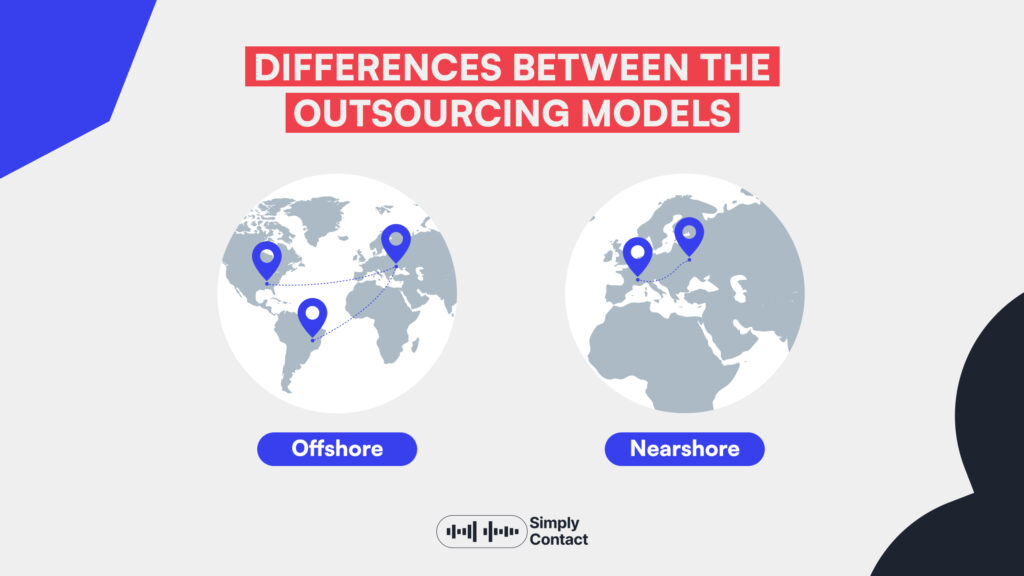
Nearshore vs offshore customer service outsourcing is often framed as a cost comparison. That framing misses most of what matters for UK and EU companies evaluating customer support models.
The real differences are operational. Time zone alignment determines whether a client's management team can interact with their outsourced operation during normal working hours or whether every escalation, training session, and QA review has to be scheduled around a 6-to-10-hour gap.
Cultural proximity determines whether agents share enough common reference points with European customers to handle nuanced conversations naturally. Regulatory proximity determines whether the legal framework governing data handling is compatible with GDPR without expensive additional structures.
| Criterion | Nearshore BPO | Offshore BPO |
| Time zone overlap | 1–3 hours from UK/EU: real-time collaboration during standard working hours | 6–10 hours: escalations, training, and QA reviews require out-of-hours scheduling |
| GDPR compliance | EEA-adjacent or inside EEA: data stays within compatible legal frameworks | Requires SCCs, BCRs, or adequacy decisions: significant legal overhead and ongoing risk |
| Language proximity | European language coverage from native or near-native speakers with EU cultural context | English typically strong; European languages often covered by non-native speakers |
| Cultural alignment | Shared European cultural references: lower friction on complex, empathy-dependent interactions | Cultural distance creates additional training overhead and misalignment risk on nuanced calls |
| Operational governance | Management can oversee operations in real time, run live sessions, join calls | Governance is largely asynchronous: problems surface in reports rather than in real time |
| Travel and on-site access | 2–3 hour flight from most UK/EU cities: practical for regular visits | 10–18 hour journey: on-site oversight is infrequent and expensive |
These differences compound. A company that can run a live calibration session with its nearshore contact center at 10am without anyone losing a working day gets better outcomes over time than one communicating primarily through weekly async reports.
Why offshore BPO creates operational risk for UK and EU companies
Offshore outsourcing is not inherently problematic. For certain use cases (back-office processing, non-voice digital channels, functions that don't require real-time oversight), it can work well.
The problems arise when offshore models are applied to complex, voice-heavy, compliance-sensitive, or brand-critical customer support operations for European companies.
Advantages of nearshore BPO
Nearshore Business Process Outsourcing (BPO) has become a strategic solution for companies seeking cost efficiency, operational flexibility, and improved collaboration. By outsourcing business functions to neighboring or nearby countries with similar time zones and cultural alignment, organizations can maintain high-quality service while reducing operational complexities. Unlike offshore outsourcing, nearshore BPO enables smoother communication, faster response times, and better oversight, making it an attractive option for businesses aiming to scale efficiently without compromising productivity or customer experience.
GDPR cross-border data transfer constraints
GDPR Article 44 restricts the transfer of personal data to countries outside the European Economic Area unless specific conditions are met. For offshore BPO, this typically means relying on Standard Contractual Clauses (SCCs), Binding Corporate Rules, or an adequacy decision from the European Commission.
SCCs are not straightforward. Following the Schrems II ruling in 2020, organisations must conduct Transfer Impact Assessments to evaluate whether the destination country's surveillance laws undermine the protections SCCs are meant to provide. For countries commonly used in offshore BPO (the Philippines, India, certain parts of Southeast Asia) this assessment is not academic. It requires legal resources, ongoing monitoring, and real exposure to regulatory action if the assessment is wrong.
A nearshore outsourcing arrangement within the EEA, or in a country with an adequacy decision, removes this problem entirely. The data stays within a compatible legal framework from the start.
Time zone gaps on voice-critical channels
Phone support doesn't operate on an async model. When a call centre is handling high-volume voice traffic for a UK or EU client and something goes wrong (a system failure, an unusual spike, a quality issue on a specific contact type) the client needs to reach their operational counterpart immediately.
With an offshore provider 8 hours behind or 6 hours ahead, "immediately" means 6am or 10pm. Most operational problems don't politely wait for business hours. The time zone gap is not an inconvenience. It is a governance gap.
Cultural misalignment on complex interactions
The interactions that matter most to brand perception. Complaints, escalations, emotionally charged contacts, nuanced product questions: these are where cultural alignment has the most impact. An agent who shares cultural context with the customer doesn't just communicate the right words. They read tone, adjust register, and handle silences in ways that match the customer's expectations.
Agents operating from a nearshore contact center within European cultural proximity bring this naturally. Agents 8,000 miles away need extensive cultural training that partially compensates but rarely fully closes the gap.
Quality collapse at scale
Offshore operations often perform well in pilots and early phases, when client attention is high and sample sizes are small. At scale, with hundreds of agents across multiple shifts, the coordination overhead grows and the quality variance widens.
Time zone limitations mean QA issues identified at end of day don't reach the operation until the next morning by which point hundreds more contacts have been handled.
Key advantages of nearshore BPO for European businesses
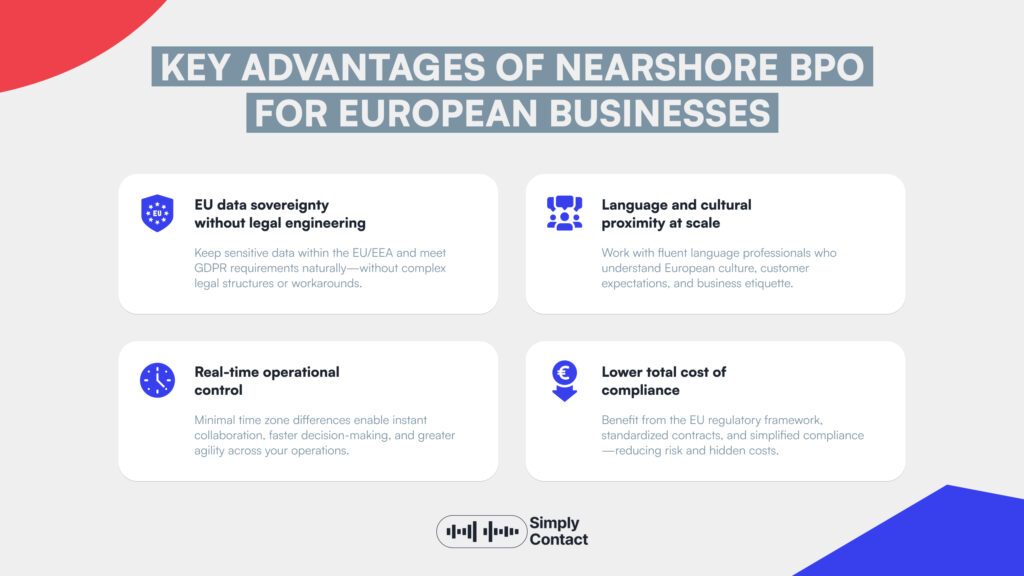
The benefits of nearshore outsourcing for UK and EU companies are not primarily about cost, though cost is part of the picture. They are about operational architecture, what becomes possible when the structural disadvantages of offshore are removed.
EU data sovereignty without legal engineering
A nearshore BPO operating within or adjacent to the EEA handles personal data under the same legal framework as the client. There are no adequacy assessments, no SCCs to maintain, no Transfer Impact Assessments to update when legislation changes. For companies in regulated sectors (fintech, healthcare, insurance) this is not a minor convenience. It removes a whole category of compliance risk.
Real-time operational control
Nearshore outsourcing advantages show up most clearly in day-to-day governance. When a client's Head of CX can join a live call monitoring session at 2pm on a Tuesday without either party losing part of their working day, the quality of operational oversight differs from what async reporting allows.
HATS Group, a UK non-emergency patient transport company, launched with Simply Contact and described the experience as smooth from day one. A year later, the same team was in place, KPIs were strong, and the relationship had expanded from a core contact centre to night control 365 days a year and additional functions. That kind of organic growth within a partnership happens when operational communication is easy due to the high level of professionalism.
Language and cultural proximity at scale
Nearshore outsourcing companies with European delivery centres cover major European languages from agents for whom those languages are native. French from French or Belgian agents. German from German or Austrian agents. Polish from Polish agents. Not from accent-reduced training programmes applied to non-native speakers.
The practical impact shows in customer satisfaction scores and in the speed at which agents can handle volume. Ditto Music partnered with Simply Contact and moved CSAT from 51% to 88% after rebuilding their support team with agents who genuinely understood the customer's world, in their case, actual musicians supporting music distribution artists. The response rate per hour more than doubled, from 3.5 to 8. Language and cultural fit are not soft factors. They are productivity factors.
Lower total cost of compliance
Offshore outsourcing appears cheaper in a line-item comparison. When the cost of GDPR compliance structures, legal review of SCCs, Transfer Impact Assessments, and the overhead of managing an 8-hour time zone gap are included, the total cost picture changes. Nearshore BPO tends to have lower apparent cost savings than offshore, but a lower total operational cost when compliance and governance overhead are priced in correctly.
What makes a strong nearshore BPO provider
Not all nearshore outsourcing companies offer the same level of operational maturity. These are the criteria that distinguish providers who can deliver consistently from those who can handle a pilot but struggle at scale.
Certifications that reflect real infrastructure
ISO 27001 (information security management), ISO 27701 (privacy information management), PCI DSS, GDPR compliance, and HIPAA are not interchangeable box-ticks. Each requires a functioning management system, regular audits, and documented procedures. A provider who holds all of these has built compliance into the operation at process level.
For any UK or EU company handing over customer data to a nearshore BPO provider, these certifications are the minimum, not a differentiator.
Multi-location delivery for business continuity
A nearshore contact center operating from a single location has a single point of failure. Power outage, civil disruption, staffing shortfall in one geography, any of these can interrupt service. Providers with multiple delivery locations across the nearshore region can shift volume between sites when one is affected. For enterprise clients with 24/7 requirements, this is a structural requirement, not a nice-to-have.
Simply Contact maintained 24/7 service for the Cabinet of Ministers of Ukraine within one day of launch during wartime conditions, handling 2,000 calls per day from day one. That speed and resilience under pressure reflects an operational infrastructure built for continuity.
Vertical specialisation and domain experience
A nearshore BPO provider who has operated in your sector already has agent profiles, training frameworks, and QA processes calibrated to your type of contact. A travel technology company coming to a provider who already handles airline operations doesn't need to build the knowledge from scratch.
Wizz Air has worked with Simply Contact since 2020. The results (80% of calls answered within 35 seconds, 30% AHT reduction on key lines, 85% agent utilization maintained through both peak and off-peak season) are achievable partly because the team understands the operational patterns of airline customer support. That knowledge compounds year over year. It's part of why the partnership has lasted five years.
Governance model and client communication
How a provider reports, escalates, and communicates on a week-to-week basis determines whether the relationship generates insight or just data. Look for providers who give clients direct access to operational metrics in real time, not just weekly summaries. Ask how escalations are handled. Ask who the client speaks to when something goes wrong at 6pm on a Friday.
How Simply Contact operates as a European nearshore BPO
Simply Contact operates as a nearshore BPO provider with delivery centres in Ukraine, Poland, and across Eastern Europe, serving UK and EU clients across regulated and consumer-facing sectors. The operational model is built around European time zone alignment, multi-site redundancy, and a compliance infrastructure certified to ISO 27001, ISO 27701, PCI DSS, GDPR, and HIPAA standards.
The UK client roster covers regulated, specialist, and high-growth sectors.
- For Airportr, a UK luggage transportation company, Simply Contact handles 24/7 support across four communication channels in three languages with up to 15 part-time agents scaling with demand.
- For Howly, a UK IT expert platform, the team scaled from 3 to 22 agents within a year, handling 20,000 billing calls per month with a 43% increase in agent productivity.
For clients in sensitive or compliance-heavy sectors, the security infrastructure matters as much as the service model. Token.io needed a partner where operational continuity was guaranteed and quality scores were consistently above 99%, both delivered over an extended engagement with agent retention near 100%.
The approach to agent training uses AI call simulation that prepares agents for live interactions across 50+ languages before they handle a single real contact. This produces 30% faster onboarding and first contact resolution readiness that is 2x higher than traditional approaches. For clients scaling into new markets or managing seasonal demand spikes, both common patterns for European businesses, that ramp speed is a practical advantage.
For more on how the customer support outsourcing model works in practice, or to see how Simply Contact has been evaluated against other customer support outsourcing companies, the details are there. The short version: the nearshore model works when the provider has built real infrastructure around it, not just proximity.
Common mistakes when evaluating nearshore outsourcing companies
A few patterns come up repeatedly when UK and EU companies go through a nearshore BPO selection process and get it wrong.
| Common mistake | Why it’s a problem | What to check instead |
| Treating nearshore as geography instead of capability | Being based in Eastern Europe alone does not guarantee strong operational standards, governance, or compliance readiness for UK/EU clients. | Verify certifications, GDPR compliance infrastructure, governance processes, reporting standards, and time zone discipline. |
| Evaluating pilot performance instead of scale readiness | A provider that succeeds with a small pilot may fail when scaling to larger long-term operations. | Ask about their largest active client, multi-site redundancy, hiring capacity, and ability to manage sudden volume spikes. |
| Focusing only on headline cost savings | Offshore arrangements can create hidden costs through legal complexity, compliance management, and operational oversight. | Compare total operational cost, including governance, compliance, risk management, and escalation handling. |
| Skipping escalation protocol discussions | Weak or undefined escalation processes often signal poor operational governance. | Ask specific questions about incident response times, escalation ownership, weekend coverage, and crisis communication procedures. |
For a deeper look at how the in-house vs outsourced call center decision plays out in practice, or how offshoring customer support compares as a model, both pieces cover the structural tradeoffs in more detail.
Nearshore BPO is a different model
The companies that get the most out of nearshore BPO are the ones who understand what they're buying. Nearshore outsourcing is a different operational architecture, one where real-time governance is possible, compliance overhead is lower, cultural alignment is structural rather than trained, and agent retention tends to be higher because the working conditions are closer to those of a domestic team.
For UK and EU companies whose customer support is voice-heavy, compliance-sensitive, or brand-critical, that architecture is worth paying for. The cost difference between nearshore and offshore, properly accounted, is often smaller than it first appears. The quality difference, at scale and over time, tends to be larger.
Talk to our team about what a European nearshore BPO model looks like for your operation.

Newsletter
Subscribe
Subscribe to our newsletter to receive valuable industry insights and the latest research reports.