



Article
Customer Experience Trends 2027: Accountable AI, Human Judgment
Customer experience trends for 2027 share a common thread: AI has left the pilot stage and is starting to take real actions, while the business stays accountable for every one of them. In clearly defined cases it now changes bookings, issues refunds and opens claims across the whole journey, from the first marketing message to the last service contact. People keep the moments where judgment matters. That balance shapes what CX leaders plan for, what they measure and what they ask of the partners who run parts of the journey for them.
This article covers seven customer experience trends shaping 2027 and what each means for a CX leader setting next year's operating model, focusing on the end-to-end experience. Most of these shifts have already started. 2027 is when regulation, budgets and contracts catch up with them.
Why CX trends moved from AI pilots to accountable outcomes
The CX trends of the last two years were mostly about trying AI. Heading into 2027, finance teams want to know what it fixed. In August 2026, Gartner found that AI spending in customer service rose 38% while overall service budgets grew by 2%. Forrester's chief research officer Sharyn Leaver attached a warning to next year's budgets: "more budget won't drive better outcomes" on its own.
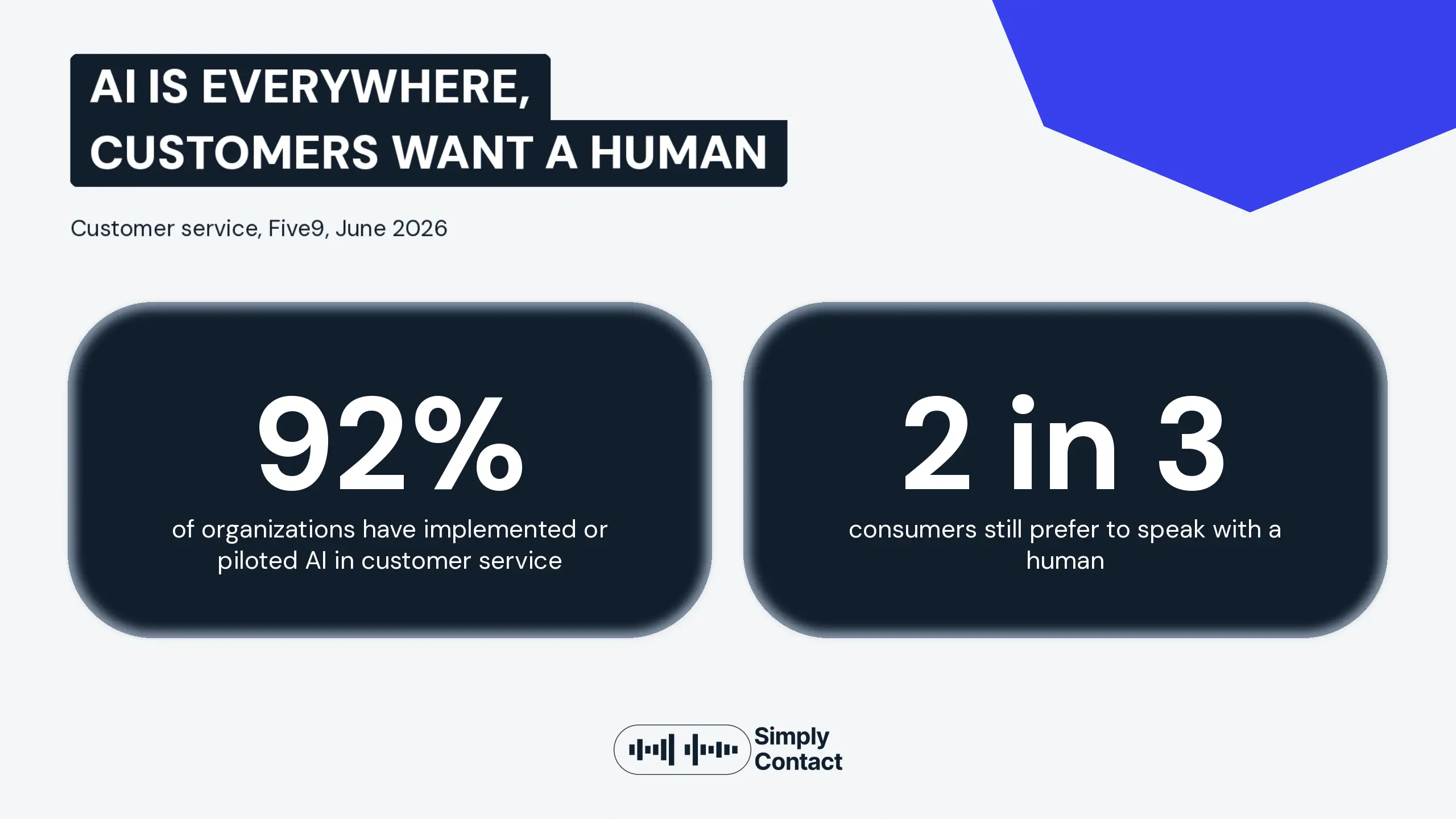
Customers apply a simpler test. They judge a brand on whether the problem got fixed and have no interest in which team or system owned the step that failed. June 2026 research from Five9, a contact center software vendor, found that 92% of organizations have implemented or piloted AI in customer service, while two-thirds of consumers still prefer to speak with a human. Loyalty leaks through that gap.
Ownership of CX has also widened. One journey now passes through marketing, sales, service and often an outsourcing partner, each with its own tools and targets. The customer experience trends below follow from that. For a comparison with where the conversation stood a year ago, see our customer service trends 2026 overview and the expert interviews in the Customer Experience in 2026 whitepaper.
Trend 1: AI in customer experience takes action with clear accountability
Until recently, AI in customer experience mostly answered questions. In 2027 it is starting to take the action itself in clearly defined cases: changing a booking, issuing a refund within policy, opening a claim, updating account details. Once AI acts, success depends on whether the order arrived, the claim was processed correctly and the customer had no reason to come back.
Three controls keep it accountable:
- Guardrails define what AI may do alone, such as refunds below a set value or rebookings within fare rules.
- Human override lets an agent or supervisor stop or reverse an action, and lets the customer ask for a person at any point.
- Audit samples AI decisions the same way human work is reviewed, with each error traced to a policy, a data gap or the model.
Each control needs a named owner who answers for its results. Audit is the one that breaks first at volume, because a manual sample reviews only a small share of interactions. At Simply Contact, QA covers nearly 100% of interactions, so AI decisions are checked the same way human work is. See how AI agents in customer service are set up and supervised.
Trend 2: Customer journeys start in AI assistants
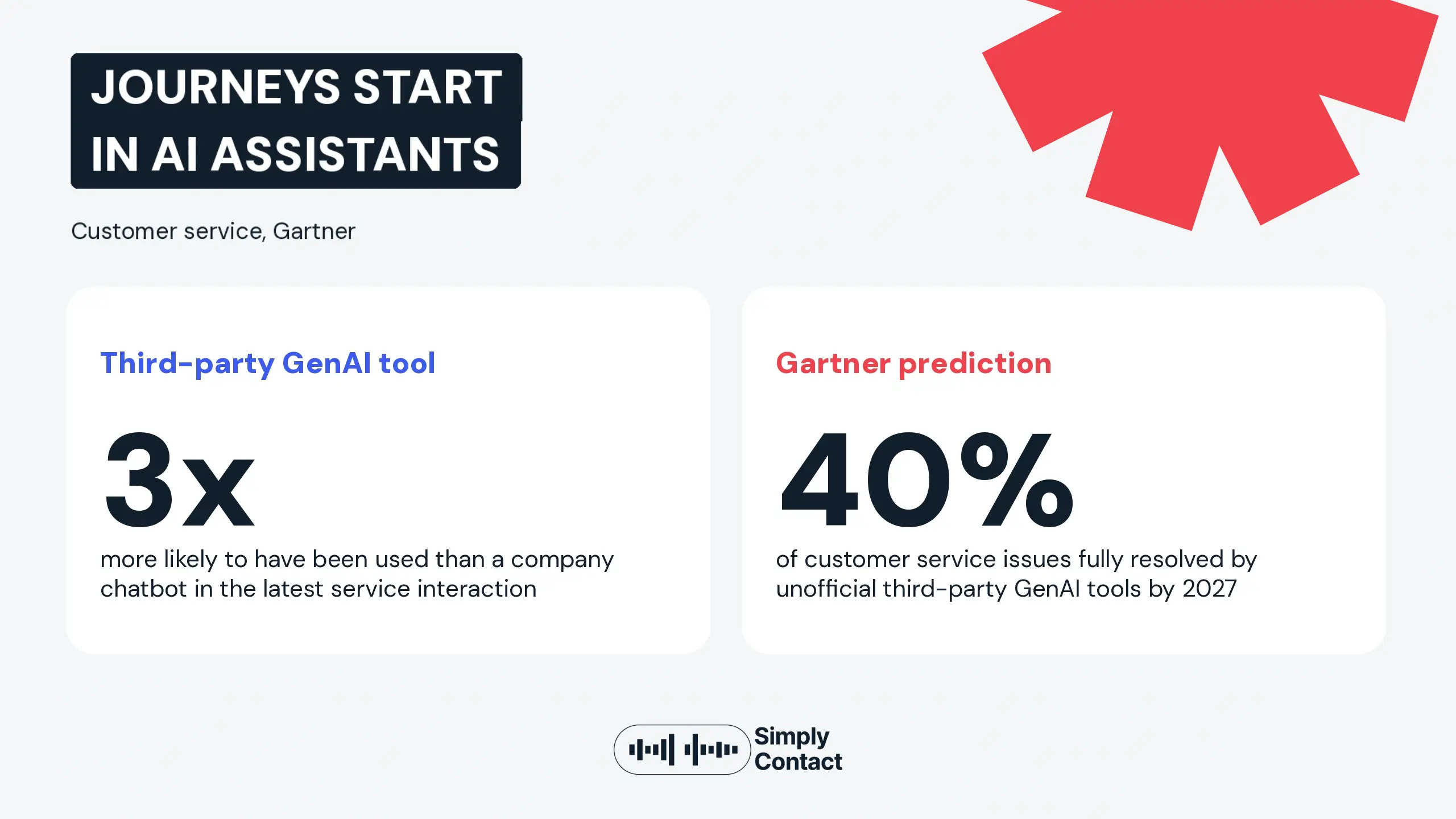
A growing share of journeys begins outside the brand's own channels. Customers ask ChatGPT-style assistants which airline has the fairer refund policy, or let an AI browser compare insurance quotes and fill in the form for them. In an August 2026 Gartner survey, customers were about three times more likely to have used a third-party GenAI tool than a company chatbot in their latest service interaction. Back in December 2024, Gartner predicted that by 2027, 40% of all customer service issues would be fully resolved by "unofficial third-party tools powered by GenAI." Agents that pay are already live: on March 27, 2026, Mastercard completed its first live agentic transaction in Hong Kong, in which an AI agent booked and paid for an airport ride.
Customer experience in the age of AI therefore depends on what those assistants can read about you. Policies, prices, service terms and eligibility rules need to be accurate, current and published in a structured form machines can parse. A quick check is to ask the main assistants ten questions your customers ask and score the answers. If an assistant quotes an outdated cancellation fee, the customer reaches your service team already convinced, and the agent opens the conversation in a dispute.
The second effect is customers who arrive mid-journey, sometimes after an agent has already acted for them. Service teams need a way to recognize that context, check what the assistant did and finish the task without starting again.
Trend 3: Digital customer experience trends point to one connected journey
Most digital customer experience trends of recent years added channels. The 2027 version is about what travels between them. A customer who asked a question on the website, received a marketing email, spoke to sales and then contacted support should meet one brand that knows all of that. In July 2026, Genesys, a CX platform provider, found that 48% of organizations do not automatically pass information between virtual and human agents, so customers repeat themselves at the moment they are most likely to be frustrated.
Solving this starts with ownership. Someone has to own the journey end to end, including the parts run by partners, and decide which context follows the customer: order history, open cases, what the AI already tried, consent preferences. Orchestration then routes each contact with that context attached, whether it lands with an AI agent, an in-house team or an outsourced one.
The groundwork pays off. A 2025 McKinsey analysis estimates that AI-driven next best experience can lift customer satisfaction by 15 to 20% and revenue by 5 to 8%, provided billing, CRM, web analytics and contact center data sit in one place. Put AI on top of fragmented data instead, and it gives wrong answers faster and more confidently.
A practical test for CX leaders is to map one high-volume journey and count how often the customer is asked for the same information. Each repeat marks a hand-off where context was lost. Omnichannel customer support built on shared context removes those repeats.
Trend 4: Human judgment becomes the premium layer of CX
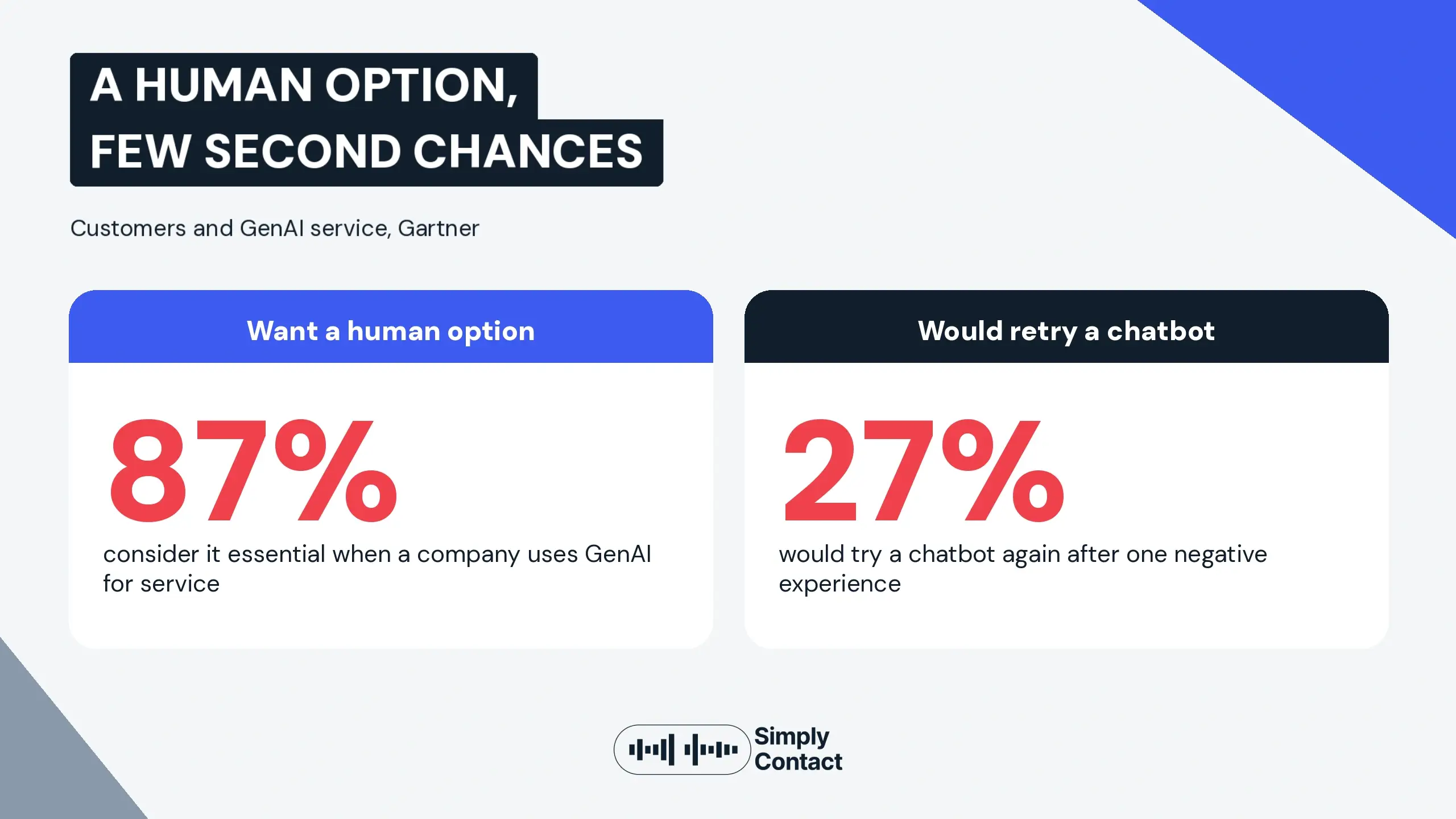
As AI takes on routine actions, the moments left with people are the ones customers remember: a canceled flight on the way to a wedding, a disputed claim, a vulnerable customer struggling with repayments, an expensive purchase that went wrong. Brands are now deciding in advance where people stay in the journey and designing the hand-off from AI so the customer arrives with their case already summarized. Gartner found that 87% of customers consider an option to reach a human agent essential when a company uses GenAI for service, and its analyst Eric Keller advises that service leaders "should not use GenAI as a mandatory first step for every issue."
One way to draw the line is to compare the cost of a wrong answer with the cost of a human minute. Above it sit disputes, outages, credit decisions and safety issues, which go to a person first. Track satisfaction on escalated cases separately, since a healthy overall CSAT can hide it.
This is a CX design decision, and it can be measured. One Simply Contact client, a taxi and food-delivery business, moved from fully local-language teams to a model where roughly 20–30% of agents are local speakers and 70–80% work with Simply AI Translation. The company decided which parts of the journey keep a native speaker, Simply AI Translation extended language coverage across the rest, and quality was tracked throughout the shift. Read more on how AI and human customer service work together.
Trend 5: Trust, control and transparency become CX measures
Autonomous AI raises a direct question for customers: can I undo this? Control means being able to challenge an AI decision, have it reversed and know how personal data was used to make it. In Europe, part of this is now law. Article 50 of the EU AI Act requires AI systems that interact with people to tell them so, unless it is already obvious, and the duty has applied since August 2, 2026, with fines of up to €15 million or 3% of total worldwide annual turnover. The Digital Omnibus approved in June 2026 left that duty in place and moved the high-risk rules to December 2, 2027. From that date, AI used to assess creditworthiness or to price life and health insurance must meet them.
Trust becomes something CX teams track like any other metric: the share of AI decisions reversed, how long a reversal takes, complaints about data use, disclosure compliance. Simply Contact delivers under ISO 27001 and ISO 27701 certification with GDPR-compliant processes, so data handling in an outsourced operation can be audited to the same standard as in-house work. Our guide to responsible AI in customer service covers the governance side.
Trend 6: Loyalty is won or lost on resolution
Customers give fewer second chances. Gartner found that only 27% would try a chatbot again after one negative experience, and brands face the same arithmetic: one unresolved issue is often enough to lose a customer. Channel coverage, response times and contact volumes say little about whether that happened.
CX measurement is moving toward three questions. Was the problem resolved? How much effort did it take the customer? Did they stay? In practice, that means reporting resolution rate, repeat contacts within seven days and churn after a complaint next to CSAT, so a fast but incomplete answer shows up as a failure. Proactive contact belongs on the same report: the share of delays, outages or failed payments the customer heard about from you first.
Ditto Music, a music distribution platform, shows what changes when resolution is the target. Since 2022, Simply Contact has run its artist support in English, Spanish and French with a team of 50+ agents, more than 80% of them with hands-on music industry experience. Artist-facing CSAT has risen from 51% to 88% and overall project CSAT from 54% to 82%, while chats handled per agent per hour went from 3.5 to 8.
Trend 7: B2B customer experience trends favor outcome-based CX partners
B2B customer experience trends show companies expecting outsourcing and technology partners to share responsibility for CX results instead of supplying seats or licenses. Everest Group describes CX outsourcing buyers applying tight scrutiny to return on investment and asking for proof from live operations. Commercial models are starting to follow, with fees per resolved contact or a share of fees tied to agreed outcomes.
The model has weak spots that a skeptical buyer should test:
- Definition: who decides that a contact is resolved, and does a repeat contact within seven days cancel the fee?
- Gaming: a partner paid per resolution can close tickets early, split one problem into several contacts or keep easy work while routing hard cases back to the client.
- Measurement: resolution data should come from the client's own systems or a shared dashboard that both sides audit.
- Volume risk: a pure per-resolution fee can leave capacity for peaks unfunded, which is why many contracts pair a base fee with an outcome component.
Outcome-based pricing makes us think about the client’s business first. If the service doesn’t get better, the model doesn’t work, so we have to fix the process ourselves, with AI or with something else.
Konstantin Ryzhov emphasizes that Simply Contact offers outcome-based pricing alongside per-agent models, so the checks above apply as much as to any other provider.
What these customer experience trends mean for your industry
The seven trends apply everywhere, but each sector feels one of them first.
| Industry | Trend that matters most | First step |
|---|---|---|
| Travel and aviation | Human judgment | Send disruption cases straight to a person and let AI rebook within fare rules |
| Fintech and insurance | Trust, control and transparency | Set a reversal path for every AI decision a customer can dispute, and prepare credit-scoring AI for the December 2027 high-risk rules |
| Healthcare and life sciences | Human judgment | Keep clinical and vulnerable-patient contacts with people, and give AI administrative tasks such as appointment changes |
| Luxury ecommerce | One connected journey | Carry purchase history, sizes and preferences from sales into service so high-value clients never repeat themselves |
| Retail and consumer brands | Journeys that start in AI assistants | Publish prices, delivery times and return rules as structured data that AI assistants quote correctly |
| SaaS and technology | Outcome-based CX partners | Tie part of the support partner's fee to resolved tickets, with repeat contacts within seven days counted against it |
| Mobility and delivery | Loyalty won on resolution | Message riders and customers about delays and failed orders before they get in touch |
| Media and entertainment | Accountable AI | Let AI answer payout status questions within set limits and route royalty and billing disputes to agents with finance access |
| Public sector | Trust, control and transparency | Label every AI channel and let citizens switch to a caseworker at any step of an application or appeal |
In travel, operational design pays off fastest. For Wizz Air, a program of 25 changes started in November 2022 cut average handle time by 30% across a 120-agent operation in 10 languages.
In animal health, the split between AI and people is already routine. For Ceva Santé Animale, Simply AI Translation handles 11 languages while agents handle the inquiry itself. Support went live five business days after kick-off, with no separate recruitment cycle per language.
For the longer-term outlook beyond 2027, see the future of customer service, proven by statistics.
How to choose a CX partner for 2027: our recommendation
This section is Simply Contact's view as a provider. Four questions separate partners ready for the shifts above from those still selling capacity:
- AI capability: which AI tools run in live operations today, what are they measured on, and who can override them?
- Quality ownership: who audits AI and human interactions, how much of the volume is covered, and what happens when quality drops?
- Commercial model: how is a resolved contact defined, who measures it, and how do fees respond when repeat contacts rise?
- Reporting: do reports show resolution, effort, retention and escalated-case satisfaction alongside volumes and handle times?
Conclusion
The customer experience trends for 2027 come down to accountability. AI takes action within clear guardrails, journeys start in assistants and run across connected systems, and human judgment stays where the stakes are highest. Trust, resolution and retention become the scores that count, and outsourcing contracts start to follow them.
For buyers, that makes partner choice one of the bigger CX decisions of the year. Choose a provider that is ready for these shifts today, and test it against the questions above before you sign.

Newsletter
Subscribe
Subscribe to our newsletter to receive valuable industry insights and the latest research reports.