



Article
Peak-End Rule: Designing Memorable Luxury CX
A ten-minute wait rarely ruins a client relationship. One curt reply during it can end it for good. Customers don't average out their experience with a brand; they remember its most intense moment and how it closed, and let that memory stand in for everything else. This is the peak-end rule, a finding from behavioral psychology with direct consequences for how luxury and high-end service brands design support.
For a brand where a single order carries a high price tag and years of loyalty, misreading which moments customers actually remember is an expensive mistake.
What is the peak-end rule?
The peak-end rule comes from psychologist Daniel Kahneman: people judge an experience by two moments, its most intense point and its ending. Everything else—the duration, the average quality, the parts that went smoothly and unremarked—fades from memory almost immediately.
Most service teams still measure the middle: average handle time, average response speed, average satisfaction across every touchpoint. None of these averages reflect how customers actually recall the interaction afterward. One difficult minute in a 10-minute interaction stays with the customer longer than the other nine. What happens right after it reinforces that memory.
The peak-end rule now influences product design, hospitality, and service delivery well beyond the lab settings where Kahneman first studied it. The same mechanism applies to any interaction a customer has with a brand, including customer support: a few moments end up carrying the weight of the whole encounter. For service teams, this means one thing: stop engineering for the average moment, and engineer for the peak and the end instead.
Why the brain fixates on the peak and the end
Peak-end rule psychology comes down to a simple fact for any support team, one the Nielsen Norman Group has documented across product and service design: customers keep two moments from an interaction, the most intense point and the last thing that happened, and forget nearly everything else within minutes.
Ordinary service encounters follow the same two-point pattern. A late flight followed by smooth, well-organized deplaning leaves a good impression. A pleasant hotel stay followed by a slow, confusing checkout leaves a worse impression than the stay itself earned.
The same pattern works in reverse, where a single moment of genuine care can outweigh an otherwise average experience: an agent who resolves a problem no one else could, or a gesture that shows the brand was paying attention. Duration and consistency matter far less to memory than most service teams assume. The last moment of an interaction carries more weight than any average metric a team tracks.
What it means for luxury customer experience
For luxury customer experience, the stakes attached to peak and end moments run higher than in mass-market service. Luxury purchases carry a high average order value. Consideration cycles run long, and customers invest identity value in these purchases, often publicly. A single mishandled peak moment, such as a delayed premium delivery or a product issue with no immediate resolution, threatens the entire relationship a brand spent years building.
Luxury customers have less tolerance for average service than customers in other categories. Every touchpoint should reflect the brand's positioning. A support interaction that feels generic or slow reads as a breach of that positioning, even when the rest of the experience went well. It's the same reasoning behind luxury retail clienteling: every interaction is treated as part of a relationship, not a transaction to close.
Luxury customer service can't rely on average operational scores. Handle time and first response time measure the middle of the interaction, the part customers barely remember. What decides whether a luxury customer stays is how the brand handles the peak moment, the crisis or urgent complaint, treated with the same care as the product itself. The final interaction deserves that same care and should leave the customer feeling the relationship still counts.
When brands spread effort evenly across every touchpoint, the result is an average outcome. The brands that get remembered are the ones that identify the moments that matter most in advance and invest there instead.
| The peak moment | The end moment | |
| Where it happens | A service failure, a recovery, or a moment of personalization | The last interaction before the customer walks away |
| Who typically handles it | Whichever agent happens to pick up the call | Whichever agent happens to close the ticket |
| What luxury brands should do instead | Identify it in advance and staff it deliberately | Manage it with the same quality bar as the opening |
| Risk if left unmanaged | A mishandled failure defines the relationship | A rushed close undoes trust built earlier in the conversation |
Creating the peak: Standout moments in high-end service
Designing the peak starts with identifying where it is likely to occur before it happens. In most customer journeys, the peak is a recovery moment. An order arrives damaged, or a shipment is delayed past a scheduled event. The brands that handle these moments well turn a problem into the interaction a customer remembers most positively.
Handling a peak moment well requires giving agents both the authority and the training to act in the moment, instead of routing the case through multiple approvals while the customer waits. A proactive gesture, such as an upgrade or an expedited replacement, costs little relative to the value of the relationship it protects. The gesture works only when it happens close to the moment of failure.
We saw the scale of what is possible in our work with Ditto Music, where a redesigned service model moved its customer satisfaction (CSAT) score from 51% to 88%. That result came from rebuilding how the team identifies and responds to the moments that actually influence how a customer remembers the brand. Training agents to treat those moments as the priority made the difference.
Ending well: How closing interactions decide the whole impression
The end of an interaction carries disproportionate weight. Most brands leave it to whichever agent happens to close the ticket. A rushed or transactional final message can undo the trust built earlier in the same conversation. Brands that close with care protect that connection instead.
Vulnerable or sensitive customer segments show why tone matters as much as resolution when closing an interaction. For example, at Simply Contact, we built scorecards specifically tuned to tone and empathy in these interactions. Our quality assurance measures whether an agent resolved a case and how the final exchange made the customer feel. Resolution and experience are different measures, and a well-closed ticket needs both.
For luxury brands, a strong final message repeats back what the customer said and confirms the resolution matched what the agent promised. The customer deserves a personal thank-you by name. When the situation calls for it, a follow-up afterward confirms the fix held. Building this step into the process keeps outcomes consistent regardless of who is on shift when the conversation ends. A closing message handled this way is one of the clearest memorable customer experience examples a luxury brand can build into its standard playbook.
How to create a memorable customer experience
Map every stage for candidate peaks and ends
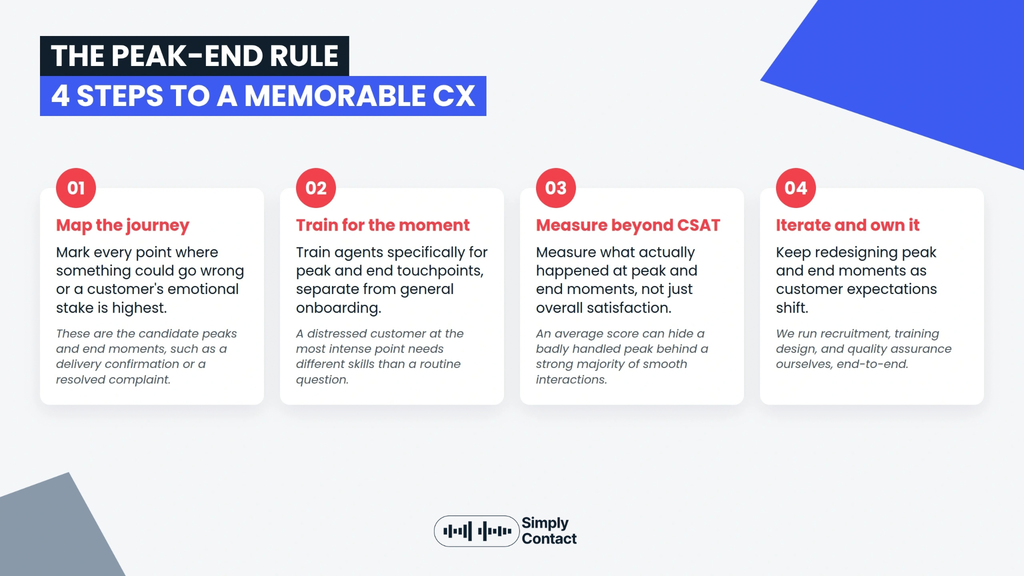
Map the full customer journey first, and mark every point where something could go wrong or where a customer's emotional stake is highest. These are candidate peaks. Then identify the last interaction in each journey type, such as a delivery confirmation or a resolved complaint. These are candidate end moments.
Train agents for these specific touchpoints
Train agents specifically for these touchpoints, separately from general onboarding. Handling a routine question requires different skills than handling a distressed customer at the most intense point of their experience. Training both the same way produces average performance at exactly the moments that need to be exceptional.
Measure what happened, then iterate
Measure what actually happened at the high point and the close, beyond overall CSAT. An average score can hide a badly handled peak behind a strong majority of smooth interactions. Iterate from there: the most memorable customer experience a brand delivers this year should inform how the next journey gets designed.
Own the process end-to-end
Full operational ownership holds this together. We run recruitment and training design ourselves, and we own quality assurance end-to-end for the accounts we support, rather than supplying headcount against someone else's process. Owning the full process is what makes it possible to keep redesigning the highest-impact moments as customer expectations shift, instead of treating the first version as final.
Where luxury brands go wrong
A few habits quietly cancel out the benefit of an otherwise strong service model:
- Generic scripting that treats every interaction the same, leaving no room for an agent to create a genuine peak moment.
- Inconsistent agent quality, where a strong recovery on one call and a flat, disengaged close on the next leave customers with an unpredictable impression of the brand.
- Unmanaged closing moments, where calls end the instant the technical issue is solved, with no attention paid to how the customer actually feels at that point.
- Measuring only how quickly calls get resolved or overall satisfaction, which hides exactly the peak and end data that would show where the experience is being won or lost.
Any one of these is enough to erase the effect of a strong peak elsewhere in the journey.
Peak-end rule examples: Putting the framework into practice for luxury brands
Applying the peak-end rule for luxury and high-end brands isn't a messaging exercise for us at Simply Contact; it shapes how we staff and manage accounts for luxury customer service.
We start by staffing for the moments that matter, not just the volume. Our agent pool is highly educated, with a bachelor's degree as the baseline and Master's-level agents on some accounts, so the person handling a customer's most intense moment has the judgment to manage it without escalating it through multiple layers.
Two peak end rule examples from our own work illustrate the approach. In one, redesigning how peak moments were identified and handled lifted CSAT from 51% to 88%. In another, building empathy- and tone-specific quality scorecards for vulnerable-customer interactions made closing moments a measured, managed part of the process instead of an afterthought.
What connects both is that we don't outsource just headcount. We own recruitment, training design, and quality assurance end-to-end, which means the standard applied to a peak or end moment doesn't depend on which agent happens to be on shift. For a luxury customer experience, that consistency is the difference between a brand that occasionally gets remembered well and one that reliably is.
Conclusion
Customers don't remember the average of what a brand does. They remember the peak and the end, and treat those two moments as the whole story. For luxury and high-end brands, where the cost of a lost relationship is high, and the audience notices everything, designing deliberately around the peak-end rule is what turns good service into a memorable customer experience.
That takes staffing, training, and quality management built specifically for the moments that decide how a customer remembers you, not just good intentions on the day. If you want to see what that looks like for your support operation, talk to Simply Contact.

Newsletter
Subscribe
Subscribe to our newsletter to receive valuable industry insights and the latest research reports.