



Article
European CX Delivery Resilience: A 2026 Benchmark for Regulated and Complex Industries
To this day, many RFPs for multi-country customer support open with the same question: which market offers the lowest hourly rate?
It is a reasonable question. It is also a much smaller one than the question a COO actually carries, which is whether a regulated operation keeps running when a labour market tightens, a regulator moves, or a single site goes dark.
Three things made that distinction concrete in 2026. Onshore capacity in the higher-cost Western and Southern European markets is shrinking under wage and absenteeism pressure. Central European markets are repricing as they move up the value chain. And the EU AI Act transparency rules landed on 2 August 2026, which has put compliance inside the vendor evaluation rather than alongside it.
This article sets out a three-axis framework for assessing European delivery locations on resilience grounds: compliance and regulatory readiness, language depth, and labour market stability. Figures come from national industry associations, EU statistical and regulatory sources, and published buyer research. All sources are listed at the end.
Why single-location delivery became a risk question
When a support operation runs from one site, it inherits that site’s labour market, energy grid, regulator, language pool and political environment with nothing to offset any of them. When one of those moves, the whole operation moves with it. Buyers usually find the concentration at the point where it fails.
Three developments over the past two years turned this from theory into documented fact.
Onshore capacity in high-cost Western and Southern Europe is contracting
Spain gives the clearest read:
- Companies representing around 75% of the Spanish CX outsourcing market employed 78,234 people in 2025, down 4.1% year on year
- Spanish domestic employment fell 6.7% to 65,859
- Offshore employment rose 12.5% to 12,375
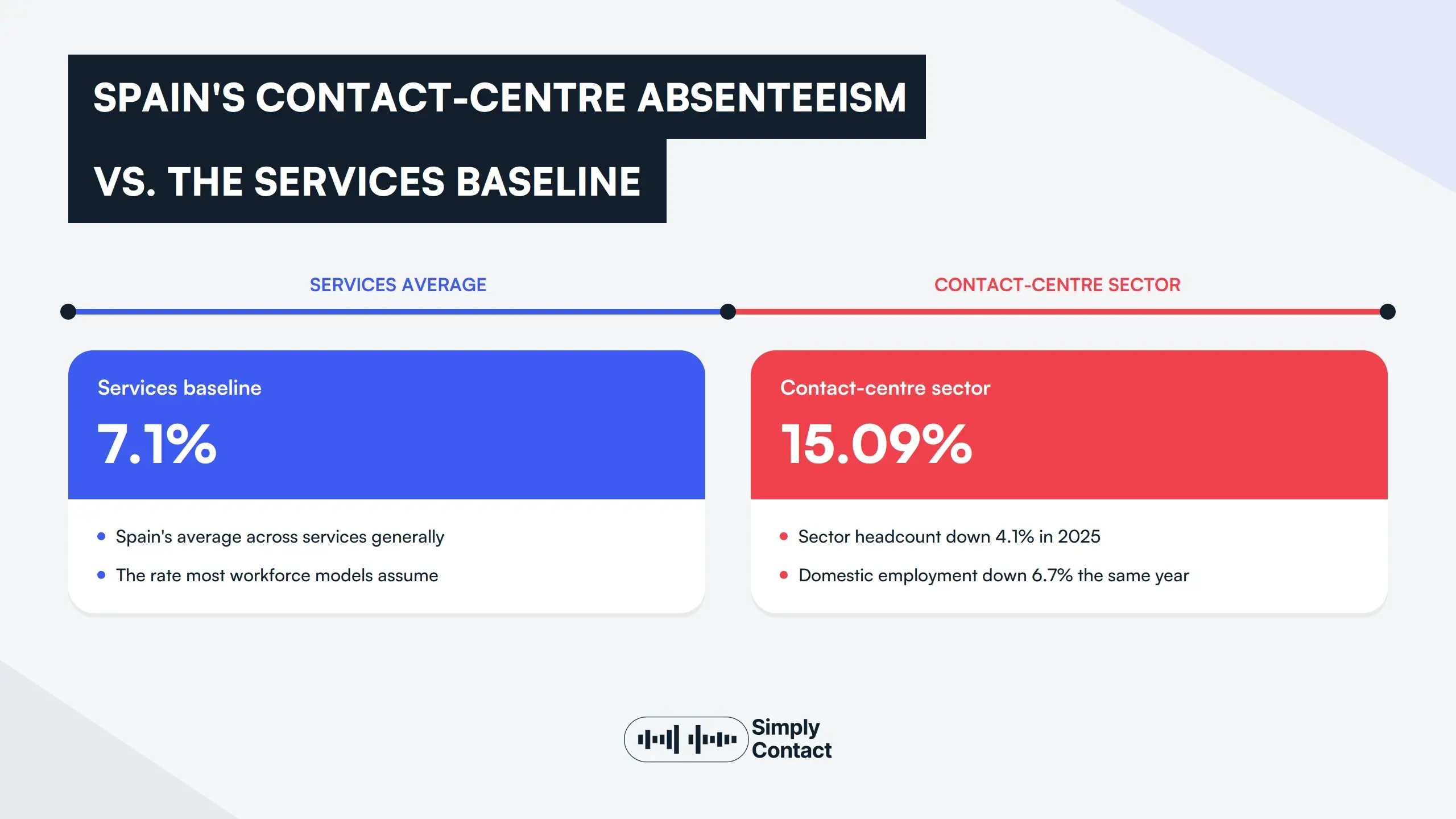
- Sector absenteeism hit 15.09%, against 7.1% across Spanish services generally
A workforce model built on a 7% absenteeism assumption in a market running at 15% will miss service levels structurally rather than occasionally.
Central Europe shifted from headcount growth to capability growth
Poland’s business services sector employed 500,500 people across 2,179 centres at the end of Q1 2026. Employment grew 1.8% year on year, against 6.2% the year before. Only 46 new centres opened during 2025, and four in Q1 2026, the slowest pace in a decade.
For a buyer planning a ramp, that number says how quickly incremental capacity can appear in the market. It is a continuity question rather than a pricing one.
Buyer preference moved toward distributed European nearshore
A 2026 survey of 815 enterprise decision-makers across twelve demand markets placed Poland joint third among offshore destinations. Among German respondents, Czechia and Romania tied for first and Poland came second. Poland also placed top five for UK and Italian buyers.
The pattern is buyers spreading delivery across several European markets rather than consolidating into one.
Meanwhile, the channel carrying the most risk has not receded. UK buyer research reports customer preference for live voice on complex and urgent queries at an all-time high, average speed to answer at 111 seconds, and chatbots handling 46% of web chats wholly or partly, down on the previous year. AI is the number one technology investment priority, named in the top five by 78% of respondents, and 91% of customer service leaders report pressure to implement AI during 2026.
Voice volume is holding while automation pressure rises. The human layer absorbing complex and escalated contacts is becoming more concentrated and more consequential. Putting that layer in one location compounds the exposure.
The three-axis framework
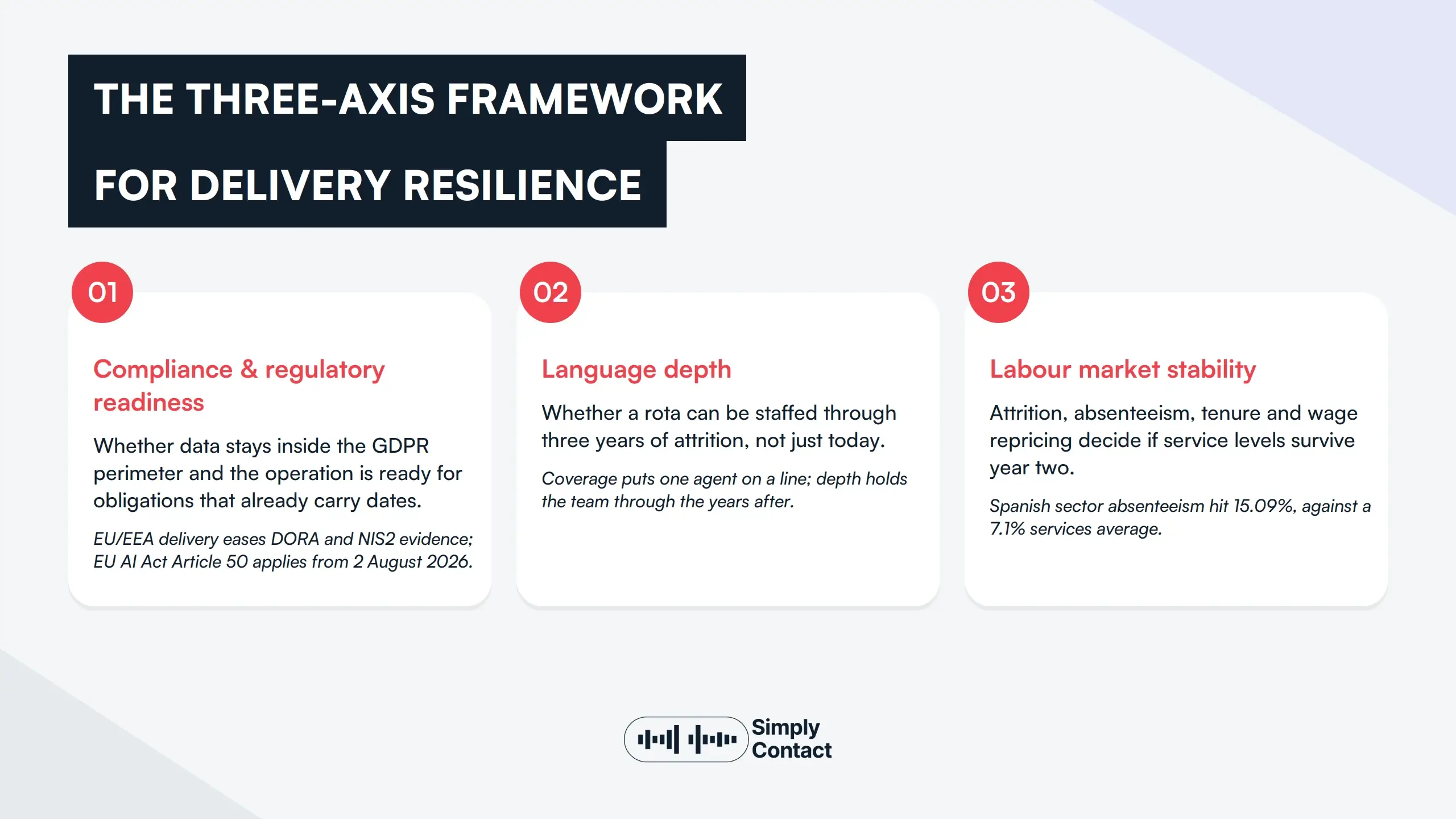
The framework below is not a ranking and not a cost-per-agent comparison. A market that scores well on compliance may be shallow in a specific language. A market with deep talent may sit outside the EU data perimeter. The point is to make those trade-offs visible before they are signed into a contract.
Compliance & regulatory alignment
Does personal data stay inside the GDPR perimeter without an additional transfer mechanism? Can sector rules such as DORA and NIS2 be evidenced from that jurisdiction? How developed is national supervisory enforcement? Is the operation ready for obligations that already carry dates? The main one is EU AI Act Article 50, alongside sector regimes that bind regulated buyers regardless of delivery location.
Language depth
Can the market staff a rota in a given language through three years of attrition? This is separate from whether it can put one agent on a line today.
Labour market stability
What is the exposure on attrition, absenteeism, tenure, graduate supply and the pace of wage repricing? Together these decide whether a service level survives the second year of a contract.
Two further factors sit alongside the axes and affect how much risk the buyer keeps after signature. One is the commercial model, covered further down. The other is verification: how much of a proposal can be evidenced before contract rather than assured. Language quality, attrition, availability and certification scope are all verifiable in advance, and a proposal that resists verification on any of them has just identified the axis worth examining most closely.
Axis 1: compliance and regulatory readiness
Delivery from an EU or EEA member state keeps personal data inside the GDPR perimeter with no additional transfer mechanism. That is the cleanest compliance position available, which is why regulated buyers in fintech, insurance and healthcare anchor at least part of their delivery inside the union.
| Jurisdiction group | Markets | Transfer position | Resilience implication |
|---|---|---|---|
| EU / EEA | Ireland, Germany, France, Netherlands, Belgium, Nordics, Italy, Portugal, Spain, Greece, Malta, Cyprus, Poland, Czechia, Slovakia, Hungary, Slovenia, Croatia, Romania, Bulgaria, Baltics | Inside the GDPR perimeter, no transfer mechanism required | Cleanest position for regulated workloads; supports DORA and NIS2 evidence with no jurisdictional gap |
| Adequacy decision | United Kingdom | Adequacy renewed 19 December 2025, valid to 27 December 2031 | Stable across the current contract horizon, subject to ongoing monitoring |
| Third country | Serbia, Albania, North Macedonia, Bosnia and Herzegovina, Kosovo, Ukraine, Moldova, Morocco, Tunisia, Egypt, Turkey | Standard contractual clauses plus transfer impact assessment | Viable with documented safeguards; adds evidence burden and slows onboarding where the provider has not done it before |
Transfers to third countries are lawful and routine. The work has to be completed and evidenced before go-live rather than retrofitted during an audit.
Sector rules that narrow the shortlist
- DORA applies to financial entities and their critical ICT third-party providers, with concrete requirements on contractual terms, exit plans and a register of information
- NIS2 raises security obligations across a wide set of sectors and their supply chains
- FCA rules bind UK financial services outsourcing regardless of where delivery sits
- Healthcare support touches national patient data rules, stricter than baseline GDPR in several member states
EU AI Act Article 50 from 2 August 2026
Three points reach outsourced support directly:
- Systems interacting with people must make clear the person is dealing with a machine, unless that is obvious from context
- Any organisation putting its own branding on a chatbot or voicebot carries provider obligations, not only the model vendor
- AI-generated content must be marked in machine-readable format where the conditions apply. Systems already on the market at 2 August 2026 have until 2 December 2026 to comply
The high-risk regime under Annex III was postponed to 2 December 2027. The transparency obligations were not.
Enforcement infrastructure is still being stood up unevenly as national AI Office and market surveillance designations complete across member states — a reason to design disclosure to the strictest plausible standard rather than assume any single jurisdiction is fully staffed yet.
Axis 2: language coverage and talent depth
Conflating coverage with depth is the most common structural failure in multilingual European programmes.
- Coverage means a provider can put one agent on the line in that language today
- Depth means it can staff a rota, absorb attrition and hold quality standards in that language for three years
English proficiency rankings for 2025 give a comparable read across delivery markets: Netherlands 1st, Croatia 2nd, Portugal 6th, Slovakia 10th, Romania 11th, Poland 15th, North Macedonia 17th, Bulgaria 18th, Greece 20th.
Addressing language scarcity
Some languages carry structural, not cyclical, shortages across Europe. Demand exceeds local supply in every market that delivers them, and the pattern shows up first as ramp lead time and second as a rate premium.
German is the clearest example. Germany itself runs one of the tightest and most expensive contact centre labour markets in Europe, so domestic capacity is constrained at the same time as nearshore capacity. Nordic languages and Dutch behave similarly, for different reasons.
Where a scarce language carries meaningful volume, plan a longer hiring runway than for English in the same location, and size the pool before committing to a ramp date.
The relocated-speaker model and its failure mode
Nordic and Dutch delivery from Southern European hubs runs largely on relocated native speakers, recruited into Lisbon, Athens, Sofia, Málaga, Larnaca and Valletta with relocation packages.
The model works. It also carries a specific failure mode: relocated agents leave for reasons unconnected to the job, including homesickness, relationships and the end of a planned year abroad. Attrition on these teams runs materially above local-language teams on the same site.
| Language group | Markets with genuine depth | Depth risk |
|---|---|---|
| English | Ireland, Poland, Romania, Bulgaria, Serbia, North Macedonia, Ukraine, Moldova, Portugal, Greece | Broad supply across many markets; lowest single-market dependency of any European language |
| German | Poland, Czechia, Hungary, Croatia, Serbia, Bulgaria, Romania | Demand exceeds supply everywhere; ramp lead times run longer than English |
| French | Romania, Bulgaria, Portugal, Poland, Morocco, Tunisia | Romania holds the deepest EU-based Romance-language pool |
| Italian | Albania, Romania, Bulgaria, Croatia, Greece | Heavy concentration in Albania, which sits outside the EU perimeter |
| Dutch | Netherlands, Belgium; relocated speakers in Bulgaria, Greece, Portugal, Spain, Malta, Cyprus | Realistic ceiling per site is tens of agents, not hundreds |
| Nordic: Swedish, Norwegian, Danish, Finnish | Home markets; relocated speakers in Greece, Portugal, Spain, Bulgaria, Malta, Cyprus; Estonia and Lithuania for Finnish and Swedish | Highest attrition and longest replacement lead times of any European language group |
| Romanian | Romania, Moldova | Two-market supply, one of which sits outside the EU |
| Baltic: Lithuanian, Latvian, Estonian | Lithuania, Latvia, Estonia | Single-source markets with no realistic alternative |
Ask each provider for attrition split by language team rather than by site average, and for the replacement lead time on the scarcest language in the mix. A site-average figure conceals exactly the exposure that determines whether a multilingual programme holds.
Multi-market depth helps here. Czechia’s sector employs around 200,000 people, 43% of them foreign nationals spanning more than thirty languages. Lithuania has 105 GBS centres employing around 26,000 specialists, with more than half of Lithuanians fluent in at least two foreign languages. A model spread across several such markets can rebuild a language rota from a second location.
Assessing voice quality rather than assuming it
Voice quality is the dimension buyers most often decide by reputation. Assumptions about accent and comprehension attach to whole countries and travel independently of what a specific provider delivers.
They are also unnecessary, because voice quality is one of the few things in an outsourcing evaluation you can measure directly before signing anything.
Three distinctions do most of the work:
- Native, C1 and B2 are different products. A provider quoting “fluent German” may mean any of them. Specify the level per language and per channel in the contract, with the assessment method named. Written channels tolerate a level that voice does not.
- Assessment method matters more than the claim. Ask how language level is tested at hiring, whether testing is internal or external, and what the pass threshold is. Screening voice candidates with a scripted reading test measures something different from scoring unscripted conversation under time pressure.
- Accent and comprehension are separable. Customer complaints usually concern comprehension and handling rather than accent alone. Scorecards measuring clarity, pace, active listening and tone give a more useful reading, and they are auditable.
The evaluation step itself is simple. Ask for:
- Blind call recordings from the actual delivery site in the actual language, not a showreel
- Live listening on a working queue
- The language-specific quality scorecard and the last quarter of scores
Any provider running a mature operation in that language can produce all three within a week, in any market. A provider that cannot has told you something about the depth of that language team.
This applies uniformly. Onshore delivery carries no automatic quality advantage, and a native speaker with poor handling skills produces a worse interaction than a C1 speaker with strong ones.
AI as a response to language scarcity
The usual framing of AI in outsourced support concerns volume: how much contact can be deflected. In language-scarce programmes there is a second application that addresses supply instead.
The structure separates channels by language requirement:
- Voice stays with native or C1 speakers, because it is synchronous, unforgiving, and the channel where customers notice language quality most
- Written channels, where response time allows review and correction, can be handled by strong English-speaking agents working with AI translation and agent-assist tooling
A language rota that could not be staffed entirely by native speakers becomes staffable, while voice stays on native delivery.
The model carries conditions, and a buyer should hold a provider to all of them:
- Quality tracked separately for translated and native-handled contacts, during the transition and afterwards, with the comparison shared rather than summarised
- Channel split explicit in the contract: which languages, which channels, what proportion, and what triggers a return to native handling
- Article 50 disclosure designed and documented where AI is customer-facing. Translation support inside an agent workflow sits differently from an autonomous system
- Regulated and sensitive interactions excluded from translated handling by default, included only where the client agrees explicitly
Used this way, AI extends the reach of a language pool that would otherwise cap the programme.
Axis 3: labour market stability
Labour market stability decides whether a service level survives the second year of a contract, and it varies more widely across Europe than any other axis here.
Four indicators carry most of the signal: absenteeism, sector tenure, graduate supply against unfilled positions, and the pace of wage repricing. The last one belongs here for a practical reason. Rapid repricing forces mid-contract renegotiation, and renegotiation under pressure is where scope, quality thresholds and governance commitments get traded away.
| Market | Stability indicator | Reading |
|---|---|---|
| Spain | Sector absenteeism 15.09% against a 7.1% national services average; sector headcount down 4.1%, domestic employment down 6.7% | Scheduling assumptions built on services-average absenteeism will not hold |
| Hungary | Over 110,000 people across 215 companies, around 3% of GDP, 60% of centres operating more than ten years | Among the most stable tenure profiles in the region |
| Poland | 500,500 employed across 2,179 centres; employment growth slowed to 1.8%; 46 new centres opened in 2025 | Deep and mature, with slower incremental capacity creation than the previous cycle |
| Romania | More than 250,000 people across BPO, IT, support and shared services; roughly 10,000 ICT graduates a year | Strong replenishment; fastest ten-year minimum wage growth in the EU at 13.1% a year |
| Bulgaria | 105,436 full-time equivalents across 833 companies, BPO the largest subsector at 43.3% | Deep multilingual pool; largest euro-denominated labour cost increase of any EU member state in 2025, at 13.1% |
| Croatia | Around 65,267 people in ICT in 2024, up from 52,000 in 2020; Split produces roughly 450 ICT graduates a year against about 1,400 unfilled positions | High quality with genuinely constrained supply; size the pool before committing to a ramp |
| Ukraine | More than 307,000 IT specialists in 2025; 85% of developers kept working full time through the war, 52% of firms retained 100% of contracts | Continuity performance is documented rather than asserted; energy and mobilisation risk require contracted mitigation |
| Moldova | Around 30,500 ICT specialists plus an estimated 3,000 in BPO and shared services | Small pool with native Romanian, Russian and English; suits second-site depth rather than primary volume |
Wage repricing is running fastest in the markets buyers have been moving toward. Between January 2016 and January 2026, average annual minimum wage growth in national currency was highest in Romania at 13.1%, followed by Lithuania at 12.7%, Bulgaria at 11.2% and Poland at 10.1%. Across 2025 alone, total hourly labour costs rose in euro terms by 13.1% in Bulgaria and 11.6% in Croatia, against 2.0% in France.
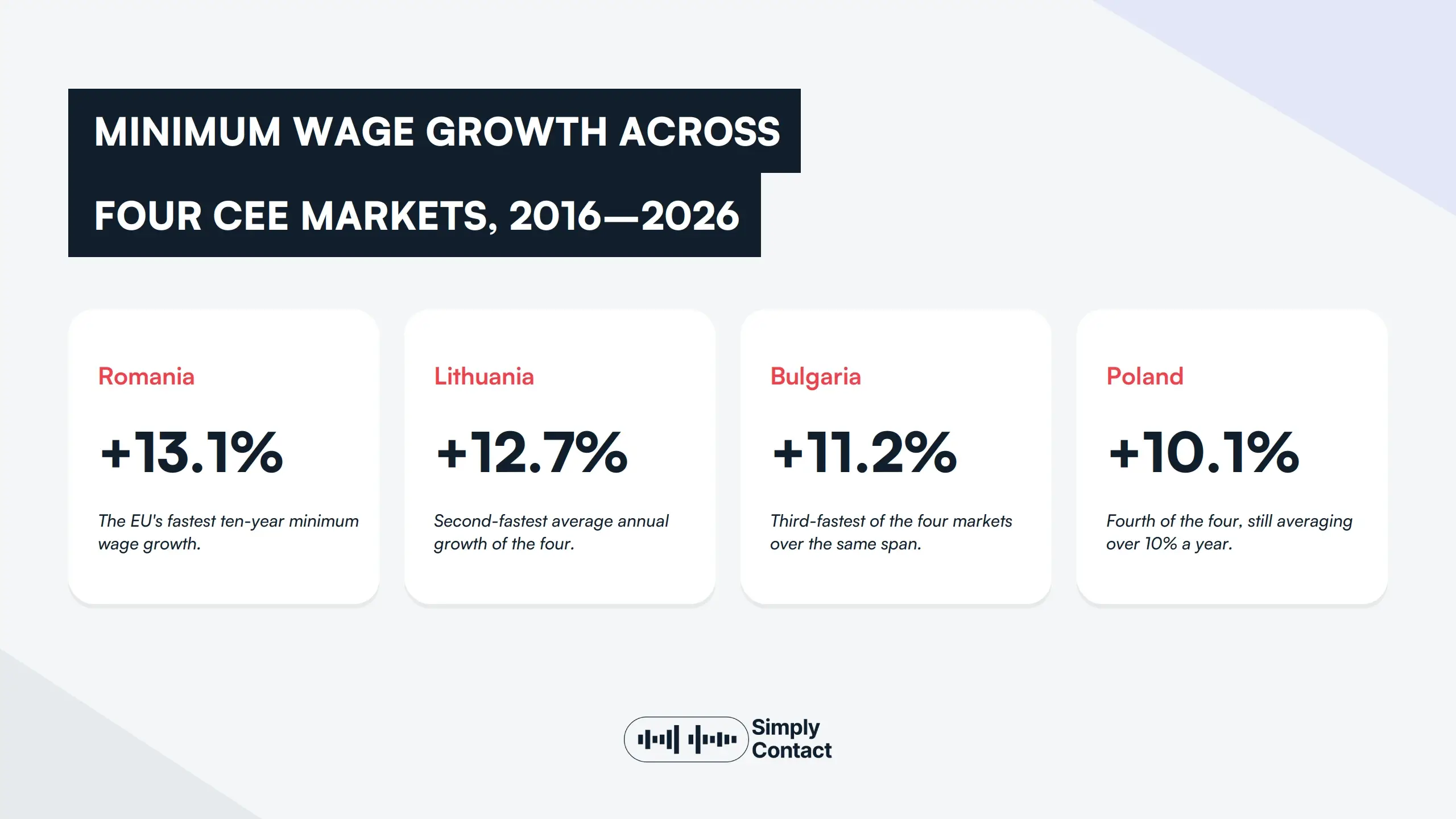
A multi-year contract in these markets without an indexation clause is a contract that gets reopened, and the reopening is where operational commitments erode.
What operational resilience looks like in practice: the multi-country delivery model
The three axes above are an evaluation framework. What they add up to inside a live operation is easier to show than to describe in the abstract.
The model has been tested under real conditions. When Ukrainian delivery was disrupted in 2022, Simply Contact stood up Polish operations and scaled them to 95 FTE within six months, with no SLA breach. That programme now runs across all locations under one operational framework.
Two client programmes show the axes working day to day rather than in crisis.
Wizz Air's support runs on a blended cross-channel model: agents move between inbound and outbound work and across markets as volume shifts, so seasonal spikes are absorbed through utilisation rather than emergency hiring. During a period when call volumes doubled overnight, the model held 80% of calls answered within 35 seconds year-round, cut average handle time by 30%, and maintained 85% agent utilisation through the peak. That is the labour-market-stability axis in practice: a scheduling model built to absorb volatility before it forces a rate-card renegotiation.
Ditto Music shows the coverage-versus-depth distinction from axis 2 in a different form. The team started from a 51% CSAT score and no music-industry knowledge on the account. Simply Contact rebuilt it as a combination: agents with genuine domain fluency, more than 80% are working musicians, alongside structured QA workflows and defined response targets. CSAT rose to 88% and response throughput more than doubled, from 3.5 to 8 resolved contacts per hour. That combination of hiring and process discipline is what depth looks like in practice: a team engineered to hold a result, rather than a single hire that happened to work.
The commercial model as a resilience factor
Pricing structure is usually treated as a procurement matter settled after the operational evaluation. It belongs inside the resilience assessment, because it decides how risk is distributed once the contract is running.
Per-FTE pricing places delivery risk with the buyer
The provider is paid for staffed hours regardless of what those hours resolve. Productivity improvement, accurate forecasting and quality management all become the buyer’s supervisory burden, because the provider’s revenue does not move with them.
Outcome-based pricing moves part of that risk to the provider
Paying per resolved contact, or against defined quality and resolution thresholds, aligns provider revenue with the result the buyer needs. It also reduces the oversight load, since the commercial model does work that governance would otherwise have to do. A provider willing to price this way is accepting exposure to its own performance, which is itself evidence of how confident it is in what it is proposing.
Neither model suits every programme. Outcome pricing needs a contact taxonomy both sides accept, a resolution definition that survives edge cases, and enough volume history to set a baseline. New programmes often start on FTE pricing and transition once the data exists. The useful question at evaluation stage is whether a provider will move in that direction at all, and on what conditions.
Two further commercial factors carry resilience weight:
The contracting entity
A provider with an established legal entity inside the EU gives a regulated buyer a compliant counterpart from day one, with VAT, employment and liability arrangements in place. Where a provider proposes to establish a new entity for the engagement, that setup timeline becomes part of the delivery timeline, and the buyer carries the risk of it slipping.
Scale fit
A 100 to 150 seat programme placed with a provider built around 1,000-seat engagements receives a proportionate share of senior attention. The same programme placed with a provider whose typical engagement is that size sits near the top of the account list. Provider size predicts responsiveness less reliably than the ratio between programme size and the provider’s typical engagement.
Ask where the proposed programme would rank in the provider’s client base by revenue, and who from the leadership team is named on the account.
The question list for your next RFP
Each question below is written to be answerable with evidence rather than assurance. The quality of the answer is itself the signal.
Compliance readiness
- For each delivery location, is personal data inside the GDPR perimeter, covered by adequacy, or transferred under standard contractual clauses? Ask for the completed transfer impact assessment, not the intention to complete one.
- Which certifications are held at the delivering entity rather than at group level, and when was each last audited?
- If we fall under DORA or NIS2, can you produce the register of information entries and documented exit plan today?
- Where AI sits in the workflow, how is Article 50 disclosure implemented in the live customer journey? Who carries provider obligations for a chatbot branded with our name?
Language depth
- What is attrition for each language team in scope, separately from the site average?
- How many agents in each language did you hire in this location over the last twelve months?
- What is the replacement lead time for the scarcest language in our mix?
- If the primary site for a scarce language became unavailable, which location rebuilds that rota, and over what period?
- What proficiency level is contracted for each language and channel, how is it tested at hiring, and by whom?
- Can you provide blind call recordings from the delivering site in each language, plus live listening on a working queue, within a week?
- Where AI translation supports a channel, which languages and channels does it cover, what proportion of contacts, and how is quality tracked separately from natively handled contacts?
Labour market stability
- What is trailing twelve-month attrition at the delivering site, and does that include involuntary departures?
- What absenteeism rate is built into the workforce model, and how does it compare with the actual figure for the last four quarters?
- What indexation mechanism applies over the contract term? What happens if local labour costs move by more than ten percent in a year?
Continuity and geographic risk
- How many independent internet providers serve each site, what is the generator capacity and fuel reserve, and is telephony cloud-mirrored?
- What is the date of the last documented failover test, and what were the results? A provider answering with a policy document rather than a test log has not tested it.
- Which second location absorbs this workload, how much of it, and within what timeframe?
Commercial model
- Which parts of the engagement are you willing to price against outcomes rather than staffed hours, and what conditions would need to be in place?
- Which legal entity contracts with us, in which jurisdiction, and is it already established?
- Where would this programme rank in your client base by revenue, and which named member of your leadership team owns the account?
Operating model
- Does the proposal include recruitment, training design, quality, workforce management and team leadership in scope? Proposals with different scopes cannot be compared, and the leaner one usually describes the more expensive operation.
- For vulnerable-customer or duty-of-care workloads, how is the quality scorecard weighted for tone, patience and active listening, and who signs it off?
- What governance structure applies from go-live: named owners, escalation architecture, review cadence and a shared performance dashboard?
Conclusion
The market question in European CX delivery has moved. A decade of RFPs asked which location delivers the lowest rate. The question that now determines outcomes is which delivery model absorbs volatility, regulatory change and labour market pressure without passing them to the customer.
Answering it takes evidence on four axes rather than a rate card:
- Whether data stays inside a defensible compliance perimeter
- Whether language rotas hold through three years of attrition
- Whether the labour market can replenish and reprice predictably
- Whether the model can rebuild capacity from somewhere other than the site that just failed
Geographic distribution is the mechanism that makes those answers possible. Spreading a workload across several European markets is a straightforward form of risk architecture, and it remains one of the practical advantages the region holds over single-site delivery anywhere else. Simply Contact delivers customer support outsourcing from five European delivery centers.
Sources
National and regional industry data
- Asociación CEX, Market Study 2025 (Spanish contact centre sector employment and absenteeism): https://www.asociacioncex.org/actualidad/el-contact-center-en-espana-crece-un-094-hasta-llegar-a-los-2-025-millones-de-euros/
- ABSL, Business Services Sector in Poland 2026: https://absl.pl/en/reports
- ABSL Czech Republic, Report 2025: https://absl.cz/report-2025/
- AIBEST, Annual Report 2025 (Bulgarian sourcing sector): https://aibest.org/annualreport2025
- HIPA, Hungarian business services sector results: https://hipa.hu/news/outstanding-results-at-regional-level-in-the-hungarian-bsc-sector/
- Invest Lithuania, GBS and ICT Sector Overview 2026: https://investlithuania.com/gbs-and-ict-sector-overview-2026/
- Invest Croatia, ICT sector: https://investcroatia.gov.hr/en/ict/
- Invest Moldova, BPO and SSC sector: https://invest.gov.md/en/sectors/bpo-ssc
- IT Ukraine Association, Ukrainian IT industry reboot in wartime: https://itukraine.org.ua/en/ukrainian-it-industry-reboot-in-the-wartime/
Buyer and market research
- Ryan Strategic Advisory, 2026 CX Technology and Global Services Survey: https://ryanadvisory.com/latest-research/
- ContactBabel, UK Contact Centre Decision-Makers’ Guide: https://www.contactbabel.com/the-uk-contact-centre-decision-makers-guide/
- Gartner, February 2026 survey on AI implementation pressure among customer service leaders: https://www.gartner.com/en/newsroom/press-releases/2026-02-18-gartner-survey-finds-ninety-one-percent-of-customer-service-leaders-under-pressure-to-implement-ai-in-2026
- EF English Proficiency Index 2025: https://www.ef.com/wwen/epi/
Statistical and regulatory sources
- Eurostat, minimum wage statistics: https://ec.europa.eu/eurostat/statistics-explained/index.php?title=Minimum_wage_statistics
- Eurostat, hourly labour costs: https://ec.europa.eu/eurostat/statistics-explained/index.php?title=Hourly_labour_costs
- Eurostat, labour cost index Q2 2025: https://ec.europa.eu/eurostat/web/products-euro-indicators/w/3-16092025-bp
- European Commission, renewal of UK adequacy decisions, 19 December 2025: https://ec.europa.eu/commission/presscorner/detail/en/ip_25_3059
- Information Commissioner’s Office, receiving personal information from the EEA: https://ico.org.uk/for-organisations/uk-gdpr-guidance-and-resources/international-transfers/receiving-personal-information-from-the-eea/
- EU AI Act, Article 50 transparency rules: https://artificialintelligenceact.eu/transparency-rules-article-50/
- Analysis of the EU high-risk AI delay under the Digital Omnibus: https://www.joneswalker.com/en/insights/blogs/ai-law-blog/yes-august-2-still-matters-the-eu-approved-a-high-risk-ai-delay-but-most-trans.html
- European Data Protection Board, GDPR enforcement decisions by member state: https://www.edpb.europa.eu/

Newsletter
Subscribe
Subscribe to our newsletter to receive valuable industry insights and the latest research reports.