


Article
Why Outsource Your Call Center for Black Friday
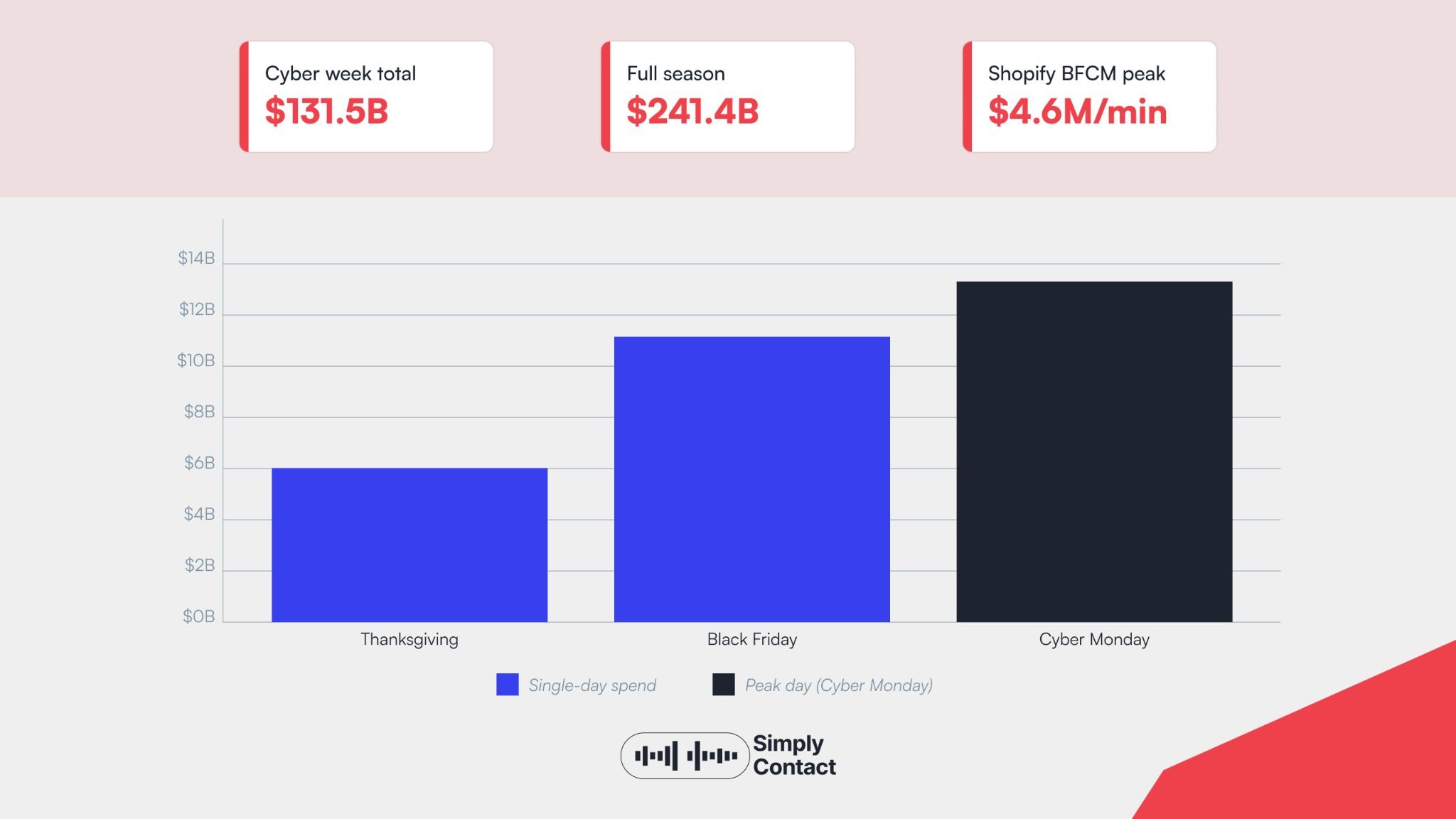
Black Friday, Cyber Monday, and the holiday weeks that follow compress close to a quarter of a year's demand into a handful of days. US shoppers spent $10.8 billion online on Black Friday, up 10.2% year over year, and $13.3 billion on Cyber Monday, the biggest online shopping day on record at the time, according to Adobe Analytics.
Shopify merchants alone saw sales peak at $4.6 million per minute during the recent BFCM weekend. That number matters here because the buying spike and the support spike are the same event, separated by a few hours: every one of those transactions eventually generates an order confirmation, a delivery question, or a "did my payment go through" call.
Support is the system that either holds under that load or breaks in public, on social media, in reviews, in refund requests that never had to happen.
This guide covers why outsourcing beats scrambling to scale an in-house team at the last minute, what to look for in a peak-season partner, and how to build a readiness timeline that starts months before the surge. Good Black Friday customer service isn't a stretch goal for that one week. It's the output of a staffing decision made well in advance.
Why Black Friday pressure-tests customer support like nothing else
No other week compresses demand the way Black Friday does. The National Retail Federation counted 197 million people shopping over the recent Thanksgiving-through-Cyber-Monday weekend, spending an average of $315.56 each, and that crowd grew then to a record 202.9 million shoppers. Two hundred million people compressing a year of gift buying into five days is what makes the operational math hard.
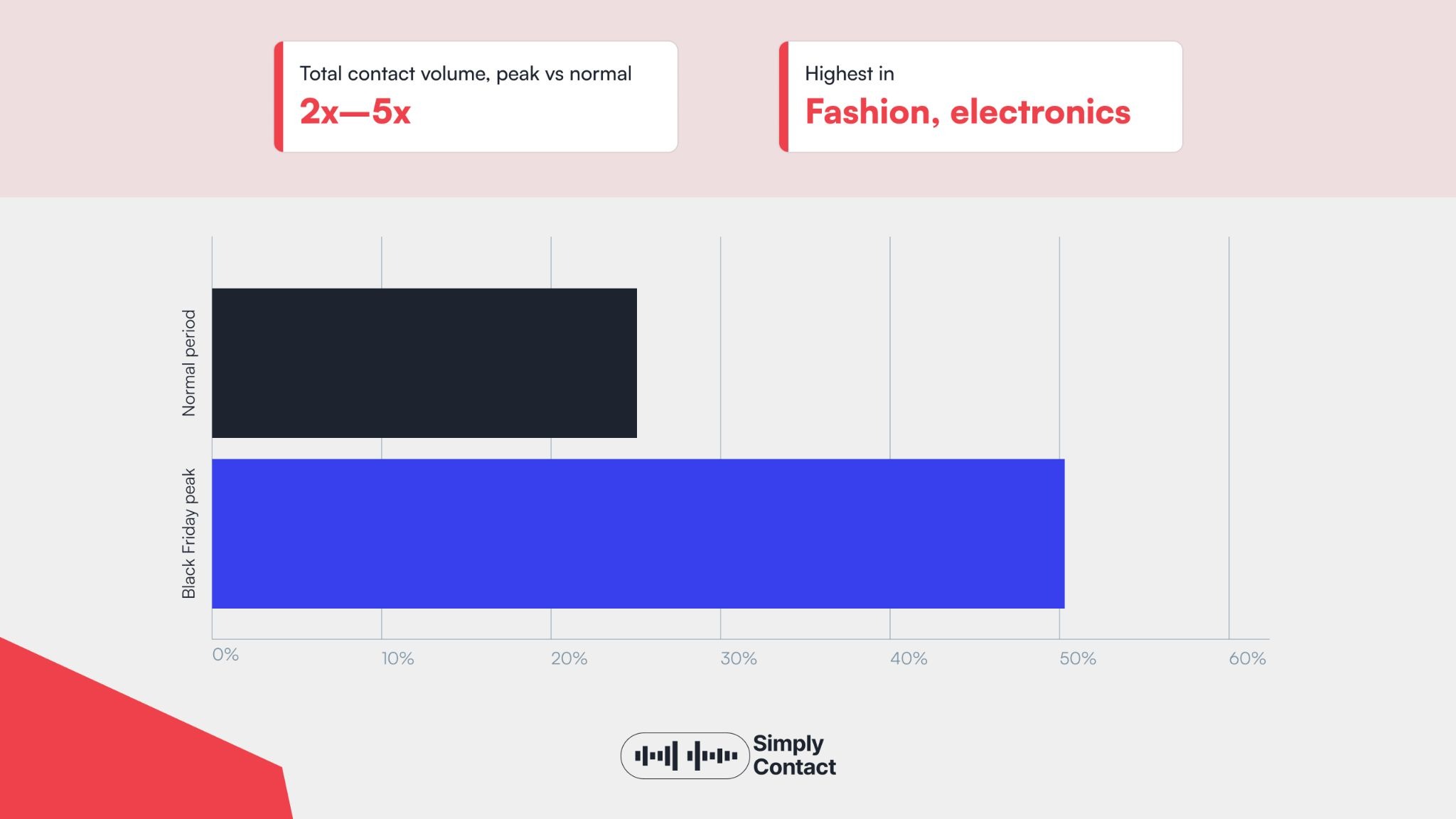
A retailer that handles a steady, predictable volume all year can see multiples of that volume in a single week, across every channel at once. Concentrix puts typical Black Friday contact volume at roughly twice normal levels, climbing to 3x to 5x normal demand in fashion and electronics specifically, with voice, chat, and email spiking together rather than one channel absorbing the overflow while others stay calm.
That simultaneity is what breaks a support operation. A team sized for average daily volume, with a normal channel mix, has no slack to redirect when all three channels spike together.
The result is the same failure mode aviation operations see during irregular ops: a system built for the normal case, tested for the first time by the failure case, at the exact moment it can least afford to fail.
The stakes compound the problem. Black Friday customer service failures don't happen quietly. A slow response during a Black Friday checkout issue is a lost sale during the single highest-revenue week many retailers have all year.
The real cost of being understaffed during peak season
Understaffing during Black Friday and Cyber Monday costs more than the obvious hit to service levels. The damage lands in three separate places: lost revenue in the moment, reputational damage that outlasts the sale, and a burned-out team heading into the next surge. Each compounds the others.
Lost revenue and abandoned carts
Response time during a checkout or order-status spike converts directly into lost revenue. Concentrix has found that "where's my order" contacts climb from roughly 25% of volume in a normal period to nearly 50% during peak, meaning the exact moment total volume doubles is also the moment half of it becomes the same repeatable question asked over and over.
A shopper who can't get a fast answer about a payment error or a delivery question during Black Friday doesn't wait patiently, they close the tab and buy from a competitor who answered faster. During the highest-revenue week of the year, every minute of added response time has a real, measurable cost attached to it.
Slow support during checkout also drives a second wave of cost after the sale: refund requests and chargebacks from customers who completed a purchase under uncertainty, then decided against it once nobody answered their question in time. Both costs land in the same week a business most needs the revenue to hold.
Brand and reputation risk at the worst possible moment
Black Friday is also the week most new customers form their first impression of a brand. Consumer research on online reviews has repeatedly found that a large majority of shoppers read reviews before a purchase, and that a cluster of recent negative reviews measurably reduces conversion, exactly the pattern a bad Black Friday support experience can trigger within days.
A public complaint on social media during peak reaches a larger, more attentive audience than the same complaint in a quieter month, and it reaches them at the exact moment competitors are actively courting the same shoppers.
Review-site damage compounds slowly but doesn't fade quickly. A cluster of one-star reviews citing slow or unhelpful support during Black Friday sits on a product or company page well past the sale itself, shaping purchase decisions for months after the surge has ended.
Agent burnout and post-peak attrition
Forcing an internal team through a demand spike without added capacity has a direct human cost. Mandatory overtime during the surge produces a measurable quality drop in its final days, exactly when volume is often still highest, because tired agents make more mistakes and take longer to resolve straightforward issues.
The damage extends past the peak itself. Industry benchmarking groups like ICMI have long reported contact center attrition among the highest of any service sector, commonly cited in the 30 to 45% annual range even before a peak-season surge is added on top.
Teams pushed hard through Black Friday and Cyber Monday commonly see elevated attrition heading into January, leaving a business understaffed again right as returns and post-holiday support volume climb. A single unmanaged peak can create a staffing gap in the customer service department that outlasts the season that caused it.
Which industries feel the Black Friday surge
Black Friday gets framed as a retail event, but the same demand-spike dynamics hit several other verticals in the exact same week, often for reasons that have nothing to do with holiday shopping directly. Businesses that outsource ecommerce customer support are usually the first to feel it, since the sale itself originates in that vertical.
Ecommerce and luxury retail
Ecommerce carries the most obvious version of the spike: order status questions, delivery delay inquiries, and returns pre-registration all surge together. The channel mix has shifted hard toward mobile too. Adobe Analytics found 57% of Cyber Monday 2024 sales came from a mobile device, an all-time high, while Salesforce put mobile's share of global Cyber Week orders at 70%.
A customer who buys on a phone tends to follow up on a phone, which is part of why voice and chat volume climbs together rather than one channel absorbing the load. For luxury retail specifically, the challenge is sharper, since a VIP or high-AOV customer's experience can't degrade into a generic call-center queue just because volume tripled.
Our guide to outsource ecommerce customer support covers the broader model this vertical typically builds peak coverage on top of, and the decision to outsource ecommerce customer support usually pays for itself in the first surge alone. The same luxury retail clienteling standards that apply the rest of the year still have to hold during the surge.
Travel and aviation
Black Friday and Cyber Monday have become a major booking spike for travel brands, layered directly on top of the irregular-operations disruption risk, weather, schedule changes, that travel support already carries heading into the holiday travel season. Our breakdown of a call center business continuity plan covers how that layered risk gets managed operationally.
A contact center handling both a booking surge and a disruption event in the same week needs staffing built around the actual shape of that combined demand. Simply Contact's work with Wizz Air, which delivered a 30% reduction in average handle time through staffing matched to real demand rather than a flat average, shows what that model looks like operating under pressure.
Fintech and payments
Transaction volume spikes during Black Friday and Cyber Monday raise fraud, chargeback, and KYC-adjacent query volume in parallel with the support volume itself. Payment fraud prevention vendors consistently report attempted fraud rates climbing well above baseline during the BFCM weekend, since fraud rings deliberately target the same high-volume window merchants rely on for peak revenue.
A fintech or payments company needs overflow call center services with compliance-aware capacity built in. Extra headcount that can answer the phone without also handling a dispute or a fraud flag correctly solves only half the problem.
Why outsourcing beats emergency in-house hiring
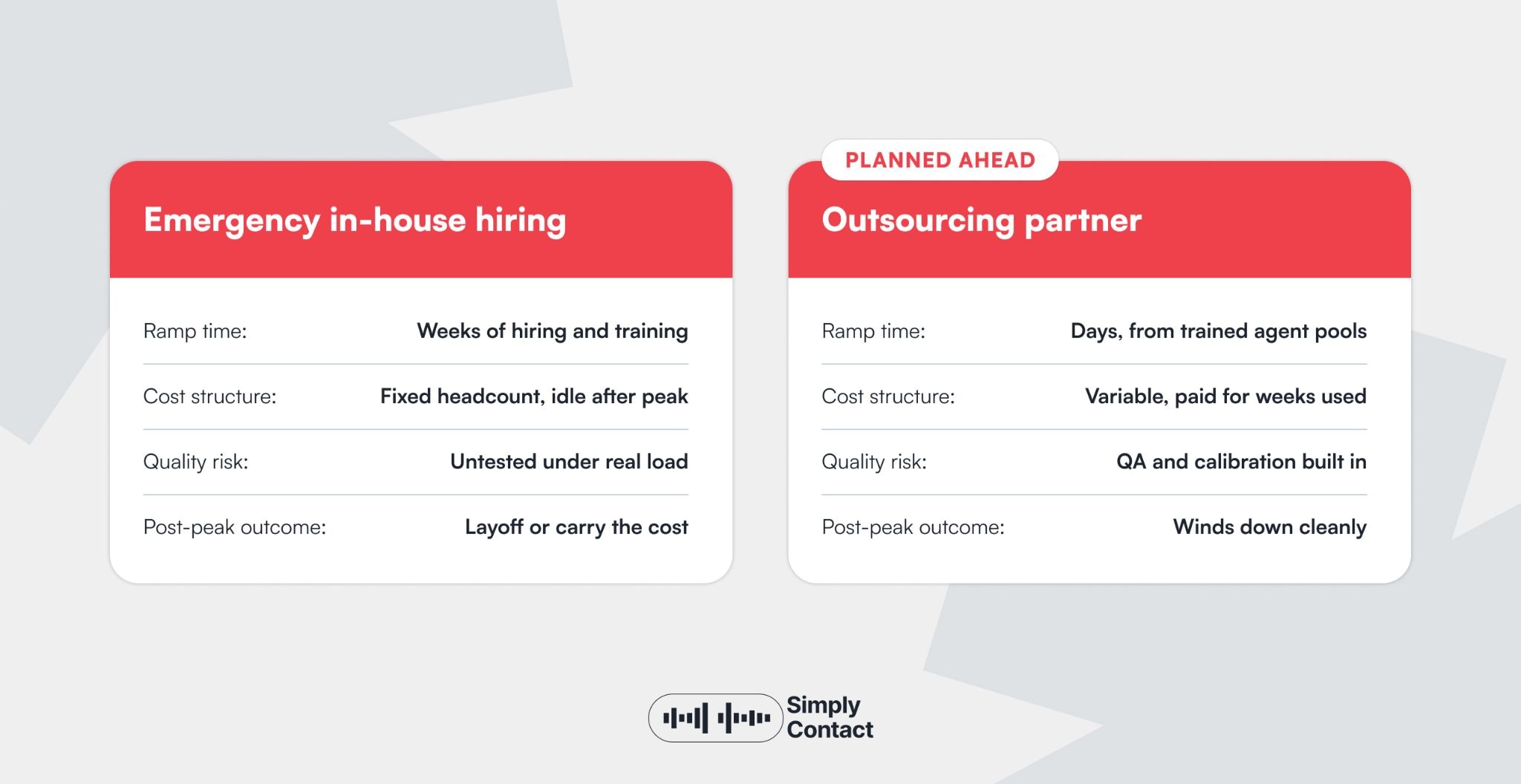
Outsourcing for Black Friday works best as a planned operational decision made months ahead. Three specific advantages separate a planned outsourcing decision from a reactive one, and they mirror the broader tradeoffs covered in our comparison of in-house vs outsourced call centers.
| Factor | Emergency in-house hiring | Planned outsourcing |
| Speed to ramp up | Recruiting, hiring, onboarding, and training can take weeks, often too long when Black Friday demand is already approaching. | Existing trained agents can be deployed quickly because recruitment and training are already complete. |
| Cost flexibility | Creates additional fixed headcount and leaves businesses with a choice between layoffs after peak season or carrying unnecessary labor costs. | Converts seasonal staffing into a variable cost, allowing businesses to pay for capacity only when needed. |
| Multilingual coverage | Building multilingual teams from scratch for a short seasonal period can be expensive and difficult to justify. | Established outsourcing partners can provide trained multilingual agents ready to support international Black Friday and Cyber Monday customers. |
| Peak-season readiness | Reactive hiring begins after demand becomes visible, increasing the risk of staffing shortages during the surge. | Capacity is planned months ahead, allowing the business to prepare for predictable seasonal demand. |
| Operational risk | Higher risk of rushed training, understaffing, and inconsistent customer service during peak periods. | Lower operational risk through experienced agents, established processes, and scalable capacity. |
| Post-peak flexibility | Seasonal employees may need to be laid off or retained despite lower demand. | Capacity can be reduced once the holiday surge ends without permanent headcount commitments. |
| Best use case | Suitable when a business needs to build a permanent internal customer-service function. | Best suited for predictable seasonal spikes such as Black Friday and Cyber Monday. |
Case study in point
E-commerce demand can change dramatically throughout the year. For Volero, monthly customer support volume can swing by as much as 4x between the summer low and the Black Friday and holiday peak.
The challenge was not simply adding more agents for Black Friday. Calls, written inquiries, and marketplace queries all increase at the same time, while the size of the spike varies by market. Poland, for example, has a larger Volero presence and sees significantly higher peak volumes than France.
Simply Contact built for Volero a blended support model across all three markets. Agents can shift toward the market experiencing the highest demand, while staffing can be scaled through hiring, cross-team blending, or extended shifts depending on how much preparation time is available before the peak.
The team also handles support directly across the marketplaces where Volero sells. This keeps Amazon, Kaufland, Allegro, and other marketplace queries within the same flexible support operation rather than splitting them across separate teams.
Delivery delays create another layer of pressure during the busiest weeks. Volero provides predefined guidance for handling these cases, while automated delay notifications help reduce unnecessary contacts before customers need to reach support.
The model has allowed Volero to absorb major seasonal fluctuations while maintaining its service targets:
- Up to 4x volume swing between the low season and Black Friday peak
- Support expanded from two markets to three within about a year
- Around 2 hours average first response time
- Around 1 day total resolution time
- Voice, written, and marketplace queries handled by the same flexible team
What to look for in a peak-season outsourcing partner
Evaluating a peak-season staffing partner comes down to four concrete criteria.
Ramp-up and ramp-down flexibility in the contract
Peak season contingent staffing only works if the contract itself is built for a temporary spike. Look for short-term or flexible-volume clauses specifically, rather than a standard annual contract with no mechanism to scale down cleanly once the surge ends. A partner that only offers long-term lock-in past the peak window is pricing for their convenience.
Quality assurance that holds under load
Peak season staffing that simply adds headcount without maintaining coaching and monitoring discipline produces a CSAT collapse right when volume, and visibility, are both highest. A partner should be able to describe specifically how contact center quality assurance scoring and calibration continue running through a volume surge.
Compliance and data security during high-transaction volume
Payment and data-handling discipline matters more, when transaction volume spikes, since a higher volume of card transactions and account changes during Black Friday creates more surface area for a compliance gap to cause damage. A partner should hold PCI DSS v4.0.1, ISO 27001, ISO 27701, and GDPR alignment as active certifications, with HIPAA-ready delivery for any client handling health-adjacent data alongside retail volume.
Multichannel and multilingual coverage
Holiday season customer service works best as one coordinated queue across voice, chat, and email, rather than three siloed teams each managing their own overflow independently. A shopper who starts on chat and follows up by phone shouldn't have to re-explain the issue to someone with no visibility into the first conversation.
Language coverage matters here too, given how international a Black Friday and Cyber Monday audience typically is compared to an average week.
Beyond Black Friday: managing the post-peak returns surge
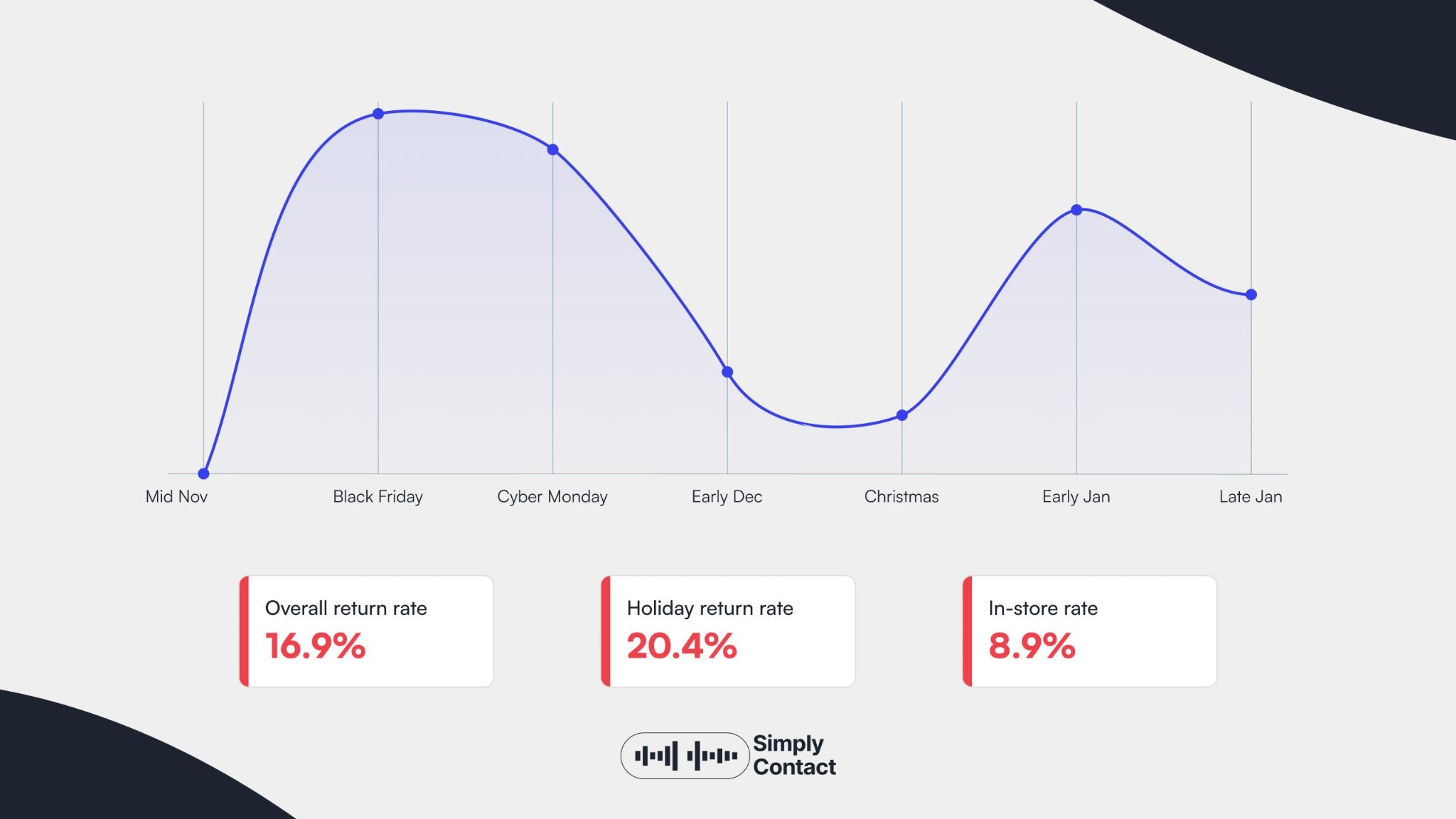
Most in-house teams plan, if they plan at all, for the sale spike itself and stop there. The second wave, returns, exchanges, and warranty queries climbing steadily through December and into January, catches an unprepared team twice: once during the sale, and again during the cleanup.
This is where a reactive, emergency-hire approach fails on both ends. US retail returns reached an estimated $890 billion in 2024, about 16.9% of sales, with holiday-specific return rates running higher still at around 20.4%, according to NRF data. Online return rates sit well above in-store rates, which average closer to 8.9%, exactly the channel mix a Black Friday and Cyber Monday sale skews toward.
A business that scrambled to add seasonal capacity for the sale itself has usually let that capacity go by the time the returns surge peaks, weeks after Black Friday itself. The team left standing is back to its pre-peak, average-volume staffing level right as holiday season customer service volume is still elevated from returns processing alone.
A planned outsourcing model avoids this by treating the full holiday cycle, as the actual demand curve to staff against. Returns and warranty queries follow a predictable pattern every year: a sharp rise through the two weeks after Christmas, a slower tail into late January.
Apparel carries the highest return rates of any major category, and Adobe found apparel drove $24.6 billion in Black Friday season online spend in 2024, up 9.5% year over year. A strong apparel Black Friday reliably becomes a heavier apparel returns January.
Questions to ask before you sign a peak-season outsourcing contract
Before signing with any peak-season staffing partner, a Head of CX or COO should get direct, specific answers to the following:
- What is the actual ramp timeline from signed contract to trained agents live on the floor, and does that timeline fit our expected peak start date with margin to spare?
- How does the partner's QA methodology work specifically during a volume surge, and can they describe a calibration process rather than just a scoring rubric?
- Which compliance certifications does the partner hold today, PCI DSS v4.0.1, ISO 27001, ISO 27701, GDPR, HIPAA-readiness, and can they produce audit documentation on request?
- What does the escalation process look like when a genuinely difficult case, a fraud flag, a VIP complaint, a compliance-sensitive dispute, comes through during peak volume?
- What happens to the relationship and the contract terms once peak ends? Does capacity wind down cleanly, or is there pressure to commit to a longer-term volume than needed?
Building a Black Friday readiness timeline
Peak season staffing starts with a timeline measured in months. Waiting until October to start the outsourcing conversation for a November peak leaves little room for proper onboarding, and even less room to fix a bad fit before the surge arrives.
A realistic readiness timeline runs through four phases, the same structure any solid peak season staffing plan should follow regardless of which vertical is running it:
- Months out: scope and select. Define expected volume, channel mix, and compliance requirements, then evaluate partners, including a review of customer support outsourcing companies, against the criteria covered earlier in this guide: contract flexibility, QA discipline, certifications, and channel coverage.
- Weeks out: onboarding and knowledge transfer. Train the partner's agents on product knowledge, escalation paths, and brand voice well before volume starts climbing.
- Pre-peak: run a smaller live test. A limited volume test in the weeks immediately before Black Friday surfaces gaps in knowledge transfer or process while there's still time to fix them.
- Peak and beyond: monitor and extend. Track QA and volume metrics daily through the surge, and extend coverage smoothly into the returns period rather than winding down the moment Cyber Monday ends.
A business that has already secured trained, ready capacity by October is negotiating from a position of choice. A business starting the same conversation in November is negotiating from a position of urgency, with less room to negotiate and less time to get the fit right. Staffing during peak season is a planning problem months before it's ever a hiring problem.
Conclusion
Outsourcing a call center for Black Friday is operational risk management. The businesses that treat it that way, starting the conversation months ahead, vetting partners on QA and compliance discipline rather than price alone, and planning for the returns surge as carefully as the sale itself, are the ones whose CX holds steady through the one week of the year it's tested hardest.
If your current peak-season plan is still a scramble to add headcount once volume starts climbing, talk to Simply Contact about building Black Friday readiness the way an operation that's done this before builds it.

Newsletter
Subscribe
Subscribe to our newsletter to receive valuable industry insights and the latest research reports.