



Article
How to Improve AHT in a Call Center: Proven Strategies
Handle time is lost in friction points: a knowledge base agents cannot search, scripts that miss the real question, and manual after-call updates. On the Wizz Air account, removing that friction brought a 30% reduction in average handling time from the project baseline. Agents did not rush customers to get there.
Handle time should be read by contact type before any target is set. In outsourced customer support operations, the lost seconds usually sit in searches, repeated questions and wrap-up. Below are the measurement rules, the six usual causes and the order of fixes to apply. The same method helps a whole customer service department improve its results without trading away resolution.
How average handle time is measured
Average handle time (AHT) is the average time an agent spends on one contact from start to finish. It includes talk time, hold time and the after-call work that closes the case. The definition of after-call work is agreed with the client before the first measurement, so both sides read the same number.
Average handle time calculation
The AHT formula depends on the type of average handle time you need to find out. For instance, you may be interested in AHT for chats, emails, or phone call conversations, which will impact the type of data collected.
rnAHT for calls = (hold time + talk time + after call work time) / total number of calls rnrnAHT for chats = total handle time of chats / total number of chats rnrnAHT for emails = (total time of communication + waiting time) / total number of emails rn
So, for a better understanding of how to calculate AHT, let’s see how it works in practice. Imagine your call center receives 200 calls. If you summarize the times of interactions, it includes 2,000 minutes of talking, 600 minutes of holding time, and, let’s assume, 400 minutes for after-call work.
So, in this case, the average handle time call center KPI will be the following:
(2,000 + 600 + 400) / 200 = 15
It means that your average handle time is 15 minutes.
You can measure the time in seconds, minutes, or hours, but use only one type of unit of measurement per calculation; otherwise, the results may be unreliable.
Why there is no single good average handle time
A good average handle time is the one that fits the contact mix of a specific desk. Published industry averages rarely name their sample, year or channel, so they make poor targets. A password reset and a disputed refund cannot share one target.
Before a target is agreed, the volume should be split by contact type, language and channel. Each group gets its own baseline from the first weeks of live data. Complex contacts, interpreted calls and chats handled in parallel all need different numbers.
Why reducing handle time matters, and where it stops helping
Shorter handle time frees capacity, so the same team covers more contacts and the cost per contact falls. Fewer agents are needed for the same volume, and queues stay shorter at peak. The gain holds only while contacts are resolved the first time.
A call cut short often comes back as a second call, a chat or a complaint. That repeat contact costs more than the seconds saved on the first one. This is why handle time is never read alone.
What a shorter handle time changes in support costs
Handle time sits next to SLAs and KPIs in every cost discussion, because it sets how many agents a volume needs. The music distribution platform case shows CSAT climbing once the wider support operation was rebuilt.
A lower handle time means a smaller headcount for the same volume, so additional hiring can be avoided.
Common causes of high average handle time
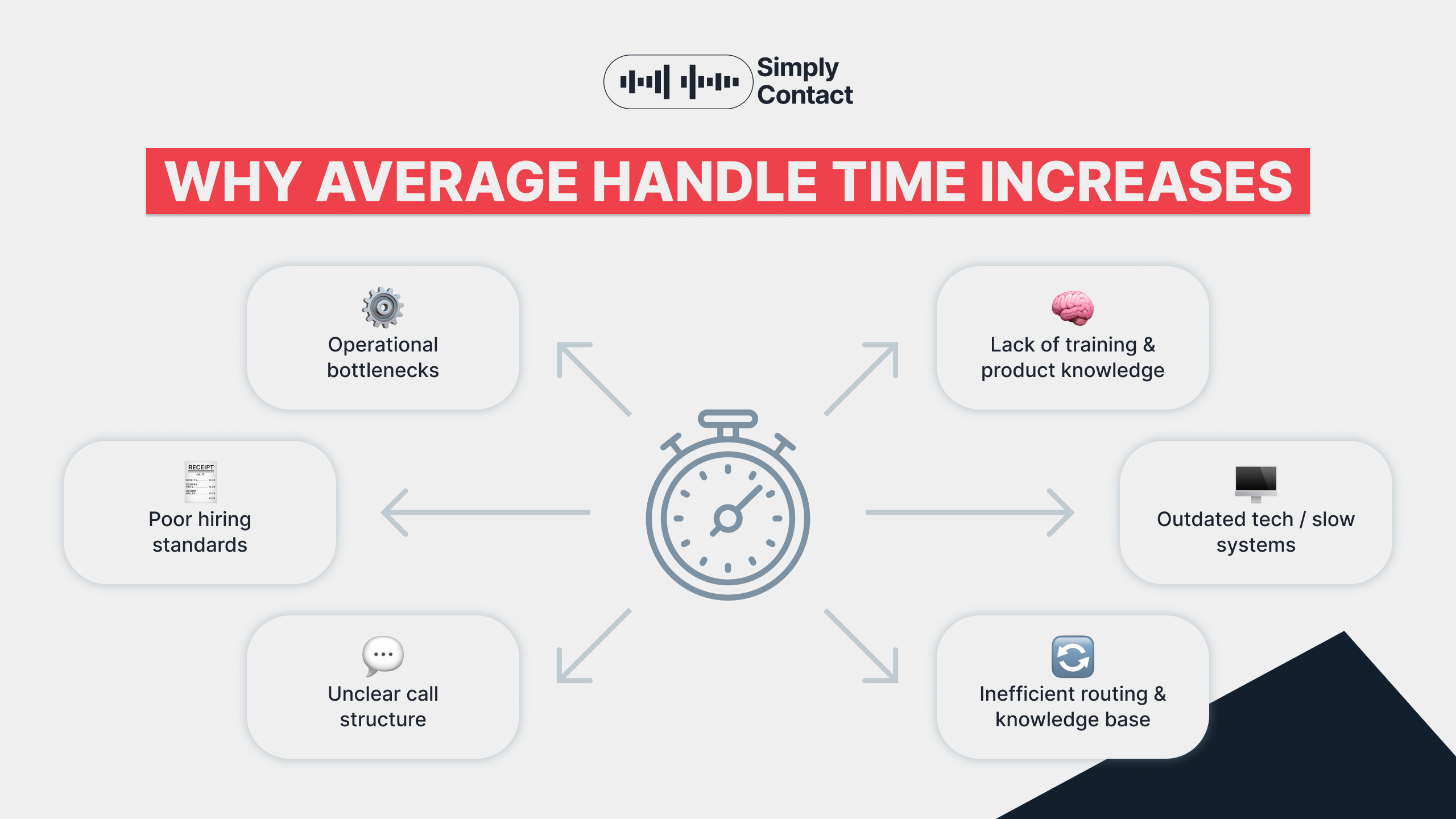
High handle time comes from six causes: thin product knowledge, outdated tools, poor routing or knowledge bases, operational bottlenecks, weak hiring standards and unclear call structure. Each one leaves its own trace in the data, so the fix starts with reading that trace.
Lack of agent training or product knowledge
Product knowledge decides how quickly an agent can explain a fix. An agent who knows the product and its exceptions answers without searching or escalating. In the data, thin knowledge shows up as long holds while the agent looks for an answer or asks a colleague.
Knowledge alone is not enough, so training covers handling as well as facts. New agents practice the contact types they will meet, including the difficult ones, before they take live contacts.
Complicated processes or outdated technology
Outdated tools add seconds to every contact. An agent who switches between several systems to find one order status cannot resolve it quickly. Tools that support the agent at each step of the contact remove that delay.
Tools such as AI in call centers can take over routine steps, so agents focus on complex cases. Translation features help agents serve customers from other regions. On the Wizz Air account, a new tool went live only where testing showed it reduced handling time.
Inefficient call routing or knowledge base
Smart routing sends each contact to the agent best placed to resolve it. AI can read incoming tickets and route them by intent, which cuts transfers and handle time. The knowledge base decides whether agents find the right answer quickly.
On the Wizz Air program, unclear knowledge bases and inconsistent escalation paths were treated as structural friction, not agent faults. The guide on how to build a knowledge base agents use covers the structure in detail.
Operational bottlenecks
Operational bottlenecks are often the main reason for long handle time. In the first weeks of a new project, the standard workflow should be mapped step by step. The review looks for steps that slow the contact without adding quality.
A common example is after-call work that requires manual updates in several systems. In that case, the updates can be automated wherever the client's systems allow it. Other bottlenecks come from technology issues, poor solution design or gaps in training.
Poor hiring standards
The willingness to provide training for new agents is always a good thing, but it doesn’t mean you have to lower hiring standards too much. Accurate agent selection should be a top priority. Look at candidates' hard and soft skills, as well as their experience working in call centers, to judge whether they have the expertise to join your teams. Establish hiring standards and select employees who can meet the requirements of your call center metrics.
Unclear call structure
The predefined structure of conversation is more important than it seems. For instance, the AHT may rise if there are no standards for conversational flow, such as opening, problem diagnosis scenario, or closing patterns. If the agents have to jump between topics or repeat questions, they will become overwhelmed, and the resolutions will take longer.
You can apply scripts for each call type to make the flow clear for employees and reduce the chance of getting lost in the process.
How to reduce average handle time on a live desk
Average handle time comes down on a live desk through four levers, applied in this order. Conversation control comes first, then tested agent tools, then self-service, then real-time monitoring by contact type.
Step 1: Achieve productive communication with customers
The logic suggests that the faster you jump to the solution, the faster you will solve the case. However, in reality, frustrated and upset customers will not let the agent do their job; instead, they try to interrupt and talk until they feel heard. We recommend letting customers finish their thoughts. Once they express frustration, they feel valued and understood and become more cooperative and attentive in the process.
However, there are situations when customers stray too far from the topic, and agents need to know when they can intervene and guide callers back on the right track. The balance between involvement and listening will increase the chances of fast handling and lower AHT.
Being polite does not mean using only open questions. They can help gather more information on complex problems, but once you are getting closer to the solution, closed questions with only “yes” or “no” options are the best friends of customer support representatives.
Closed questions allow agents to keep both their and customers' brains focused on the task and resolution. It is one of the working strategies for those who think about how to reduce talk time in a call center.
Step 2: Give agents assist tools that are tested against handle time
Technologies such as artificial intelligence can enhance the capabilities of customer support agents and increase their operational efficiency. For example, agent-assist solutions enable fast access to all relevant data required for a conversation with a customer.
Automation solutions, such as smart ticket and call routing, and auto-draft for replies, can minimize manual effort and increase the speed of all interactions. Real-time support channels, where more experienced agents can assist their colleagues with complex issues, can also make the teams’ lives easier.
Every tool passes a readiness test before rollout. On the Wizz Air account, agents completed structured readiness assessments before any tool went live. New technology was deployed only where it reduced handling time. New call flows can also be rehearsed first, as in practicing new call flows in AI simulation.
Step 3: Self-service options for customers
The use of self-service options does not mean the complete replacement of the support team, but it can lower the number of queries with simple questions, as customers will be able to find answers themselves. Virtual AI-powered agents can assist with initial troubleshooting steps and pass the request to human agents if the customer needs more complex help.
Self-service changes the contact mix. Simple questions leave the queue, so the contacts that reach agents are harder on average. Average handle time can rise while total workload falls, and the target has to move with the mix.
Step 4: Watch handle time in real time, by contact type
Analytics support real-time monitoring and anomaly detection. Supervisors can see when a call runs longer than expected and decide whether to step in. Real-time agent assist can listen to calls and surface relevant information or scripts. Real-time analytics also supports staffing and routing changes during peak loads.
The parts of handle time outside the talk: Hold, after-call work, queue and adherence
Hold time and after-call work are usually the easiest seconds to remove, because the customer gains nothing from them. Queue time and schedule adherence sit with planning, but they still change handle time. Each part has its own cause and its own fix.
Hold time
Agents put customers on hold for a few reasons: to look something up, to ask permission or to arrange a transfer. Each reason has a different fix. Lookups shrink with a better knowledge base, and permission holds shrink when agents get clear authority limits.
Transfer holds shrink with better routing. Counting holds by reason for a few weeks shows which fix to make first.
After-call work
After-call work covers notes, wrap-up codes and updates in other systems. The usual culprit is the manual update of several systems after each contact. Automated updates, a short list of wrap-up codes and note templates cut most of it.
Queue time, occupancy and schedule adherence
Queue time, occupancy and schedule adherence are planning metrics, yet they change handle time indirectly. Very high occupancy leaves agents no recovery time between contacts, and errors and repeat contacts rise. Poor adherence leaves gaps at peak, so queues grow and customers arrive frustrated.
Workforce management sets the balance between these metrics and handle time. The forecast, the schedule and the handle time target are agreed together.
An AHT reduction plan in sequence
An AHT reduction plan works best as a sequence, because each step depends on the one before it. The table sets out a workable order. Its middle steps use the levers named on the Wizz Air case page. These are knowledge base optimization, script restructuring, pilot agent groups and regular calibration sessions, plus readiness testing before any tool went live.
| Baseline by contact type Measure handle time per contact type, channel and language before changing anything. |
| Fix the knowledge base and scripts Remove unclear articles, inconsistent escalation paths and scripts that do not match real conversations. |
| Pilot agent group Try each change with a small group first and compare its handle time with the rest of the desk. |
| Calibration sessions Hold regular calibration sessions so team leads and QA score the same contacts the same way. |
| Add tools only where tests cut handle time Run a readiness test for each tool and deploy it only where it reduced handling time. |
| Review against FCR Check first contact resolution and repeat contacts on the same contact type after each change. |
How we cut handle time by 30% on the Wizz Air project
Simply Contact has run multilingual customer support for Wizz Air since 2020. In November 2022, Simply Contact launched a focused AHT improvement program built on 25 strategies.
The work covered knowledge base optimization, script restructuring, pilot agent groups and regular calibration sessions. AI readiness testing meant new technology went live only where it reduced handling time. The result was a 30% reduction in average handling time from the project baseline.
Today the account runs with 120+ agents on the line and 6,000 calls handled per day. The case page lists two 2025 awards. They are the 2025 CX Awards Gold Winner - Best Customer Service BPO and the Stevie Awards 2025 Silver Winner - Best Outsourcing Partnership.
How to balance AHT with service quality
How to improve AHT without a quality loss? It is one of the most challenging tasks for the customer service department, as simply making conversations shorter is not enough to address the issue. Agents need to strike a balance between providing effective assistance in the short term and offering empathetic responses to queries. It is essential not to rush customers for better timing, but to keep them on track and guide them to the necessary solutions.
If the AHT becomes the sole target, rushing can make customers feel disconnected or left without proper assistance. They will be more likely to repeat calls and increase the workload on agents as they try to get assistance.
The same time standards do not work for all tasks, as different issues need different time frames. Instead of pushing agents to talk faster, supervisors can show them how to streamline the workflow. Technology should remove wasted time, not the time spent on care.
When handle time drops on a contact type, first contact resolution and repeat contacts on that same type should be watched in the following weeks. If repeats rise, the saving is not real, and the change is reviewed.
Conclusions
Average handle time is the time a desk spends on each contact, and it reflects how the desk is designed. It falls when friction is removed from the knowledge base, the scripts, the escalation paths and after-call work. Each tool is tested before rollout. It is read together with first contact resolution and the wider metric set AHT is read with. A shorter number that brings customers back is not a gain.
To review handle time on a desk, talk to our team.

Newsletter
Subscribe
Subscribe to our newsletter to receive valuable industry insights and the latest research reports.