



Article
The Hidden Costs of AI Customer Service and Why Outsourcing is Back in the Conversation
Today, many support organizations view Al as the obvious answer to rising support costs. The logic is straightforward: automate a portion of the workload, reduce cost per ticket, and demonstrate operational savings to leadership.
Then Gartner published a forecast that quietly broke that math. By 2030, the cost per resolution for generative AI in customer service will exceed $3, higher than many B2C offshore human agents. Patrick Quinlan, Senior Director Analyst at Gartner, was direct: "Full automation will be prohibitively expensive for most organizations."
After eight years working in SaaS and observing how teams evaluate automation, I've developed a clear view on where Al delivers and where the economic assumptions start to break down.
The three AI implementation costs nobody budgets for
When support leaders evaluate AI, they compare model pricing to agent salaries. That comparison misses most of the real spend.
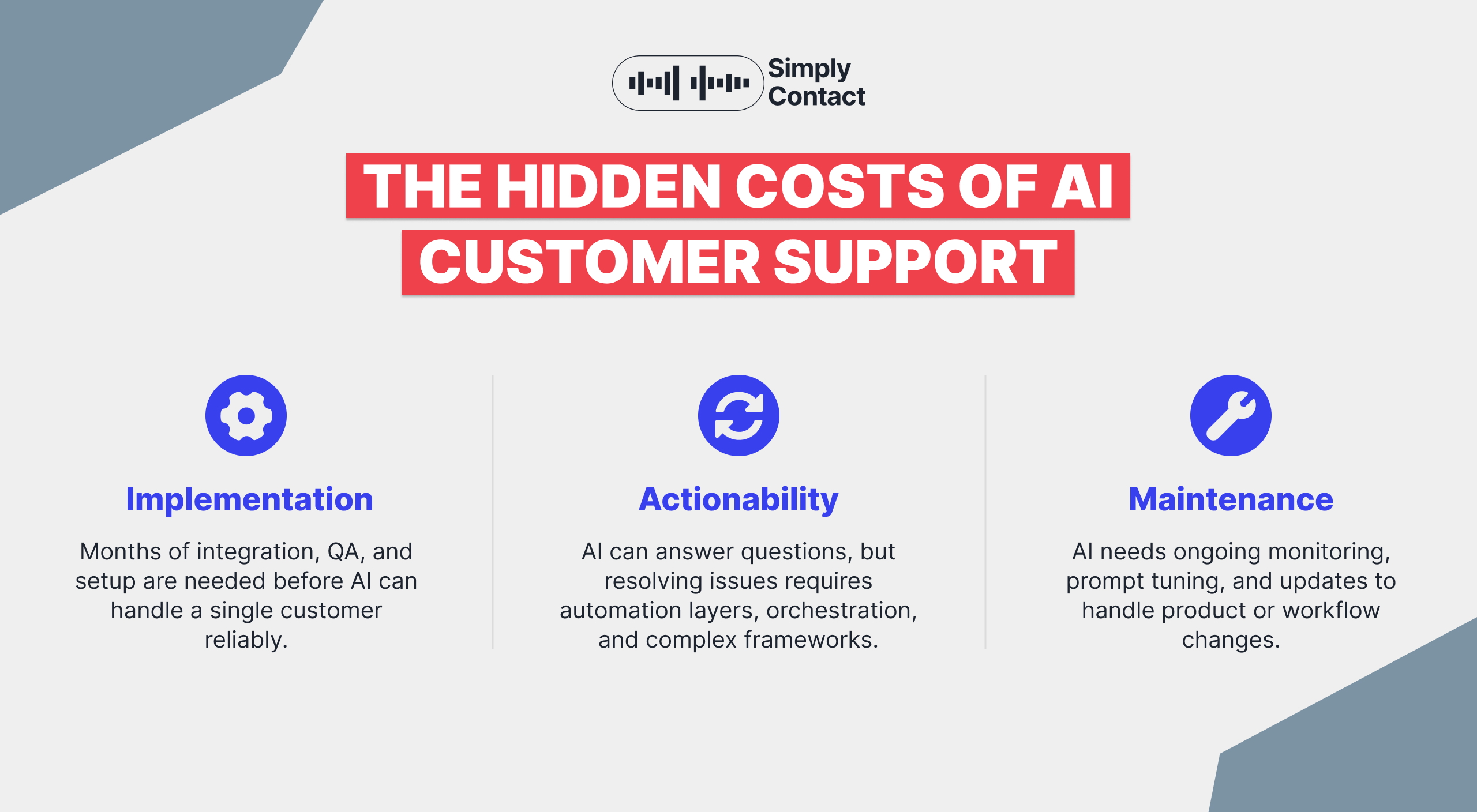
1. Implementation
AI doesn't work out of the box. Before it handles a single customer interaction reliably, you need:
- Knowledge base integration and cleanup
- Ticketing system and CRM connections
- Prompt optimization and testing cycles
- Edge case handling and fallback flows
- QA alignment and escalation logic
That work takes months and requires people with specialized skills who are not cheap.
2. Actionability
A chatbot that answers questions is useful. A system that can actually resolve issues requires API orchestration, automation layers, or agentic AI frameworks. Each layer adds cost, complexity, and a new failure point.
The gap between "AI can answer questions about our product" and "AI can fully resolve customer issues" is wider than most planning documents acknowledge.
3. Maintenance
AI is not infrastructure you deploy and forget. Every product update, workflow change, or policy revision can silently break automation flows. Monitoring, debugging, and prompt tuning are ongoing operational costs.
According to Amplifai: “Only 25% of call centers have successfully integrated AI automation into their daily operations. The remaining 75% own customer service contact center AI tools but haven't fully operationalized them within their workflows.” That gap has a cost too, investment with no return.
The AI regulation shift most teams are ignoring
Gartner's forecast includes a finding that hasn't gotten enough attention yet.
By 2028, regulatory changes related to AI will increase assisted service volume by 30%. Legislation in the EU and elsewhere will give customers the legal right to speak with a human agent. Quinlan warned that organizations will have to "maintain or even rehire human agents, possibly at higher numbers or at a higher salary than they previously paid."
If you've been reducing human capacity in anticipation of AI handling more volume, this creates a real operational problem. Rebuilding a support team takes longer than it looks on a spreadsheet.
How the hybrid model fills the void
From an operational perspective, neither pure Al nor fully human- staffed support is the right architecture for most companies right now.
| AI Handles Well | Human Agents Handle Well |
| High-volume, repetitive queries (FAQs, order status, account lookups) | Complex troubleshooting requiring judgment |
| First-line triage and data gathering before agent handoff | Emotional or escalated interactions |
| 24/7 coverage for simple, pattern-driven interactions | High-value customer retention conversations |
| Real-time agent assist (surfacing knowledge base articles during live calls) | Edge cases outside AI’s training scope |
| Sentiment detection and routing | Situations where a wrong answer could damage the relationship |
Based on the research paper “Generative AI at Work” by Erik Brynjolfsson, Danielle Li and Lindsey Raymond, AI assistance increases worker productivity by 15% on average when humans and AI work together rather than in isolation. The gains come from AI handling what it does well: volume, speed, data retrieval, while humans focus on what AI still can't do: judgment, empathy, complex resolution.
Where outsourced teams fit in the hybrid model
Building this infrastructure yourself takes 12–18 months minimum. You need AI tooling, integration work, QA frameworks, training systems, and workforce management, before you handle a single customer interaction at scale.
Because of this complexity, outsourced support teams often play a role in hybrid service models. Business process outsourcing (BPO) providers typically already operate the underlying infrastructure required for large-scale customer support. Their environments combine trained support agents, operational workflows, and AI-enabled tools such as automated routing, knowledge retrieval, and agent-assist systems.
Within a hybrid model, outsourced teams usually take responsibility for the operational layer:
- handling day-to-day customer interactions,
- managing multilingual coverage,
- maintaining service continuity during volume spikes.
AI systems support this work by triaging requests, surfacing relevant information to agents, and automating routine tasks. Human agents remain responsible for complex troubleshooting, sensitive conversations, and cases that require contextual judgment.
Beyond infrastructure, experienced BPO providers also bring operational perspective developed across multiple companies and support ecosystems. Their teams regularly work with a wide range of support platforms, CRMs, ticketing systems, automation workflows, and service processes. This exposure allows them to recognize operational patterns and apply proven practices that individual organizations may not encounter within a single environment.
When the partnership is well integrated, this experience can extend beyond staffing capacity. BPO teams can contribute practical insights on workflows, tooling, and service operations drawn from their broader industry exposure.
For many support leaders, this operational knowledge transfer is one of the less visible advantages of working with experienced outsourcing partners.
The question that actually matters now
88% of contact centers use AI-powered solutions, but only 25% have integrated automation into their daily operations, a 63-point implementation gap. Most organizations are buying AI faster than they can operationalize it.
The companies that figure out the hybrid model now will have a real advantage by 2028, when regulatory changes force a reckoning with what was dismantled in the pursuit of automation savings.
Three questions worth taking into your next planning cycle:
- What is your actual cost per resolution today, including tooling, maintenance, and the staff managing your AI?
- What percentage of your current ticket volume genuinely requires no human judgment? That's your real AI-addressable volume.
- If regulations require 30% more assisted volume by 2028, do you have the human capacity to handle it?
The Gartner is an argument for being honest about what AI costs, what it solves, and what it doesn't, before you've already dismantled something that worked.
Iryna Shevelova is Enablement Team Manager for Support at Superhuman (formerly Grammarly), where she has spent 8 years scaling support teams and operations. She is also Founder and CEO of Collabro, an event networking app built to improve the quality of professional connections.

Newsletter
Subscribe
Subscribe to our newsletter to receive valuable industry insights and the latest research reports.