



Article
Customer Experience Innovation: Examples & Strategies
Customer expectations have moved faster than most companies' ability to respond to them. The passenger who books a flight expects real-time rebooking when it is delayed. The SaaS customer who contacts support expects the agent to already know their account history. The shopper who messages on Instagram expects the same answer they would get on the phone.
The gap between what customers now expect and what most companies actually deliver is where customer experience innovation lives.
This guide covers what customer experience innovation actually means, where it produces measurable results, and what the practical strategies look like for companies that do not have enterprise-scale resources.
What is customer experience innovation?
Customer experience innovation is the deliberate rethinking of how a company delivers value across customer interactions. It goes beyond incremental improvement (fixing a slow response time or adding a new contact channel) and addresses the underlying design of how customers experience the company across the full relationship.
The distinction from incremental improvement matters in practice.
- Incremental improvement asks: how do we make this existing process faster, cheaper, or more consistent?
- Customer experience innovation asks: is this the right process in the first place, and does it serve what customers actually need?
Customer service innovation sits within this broader category. It focuses specifically on the service interaction layer: how contacts are handled, how agents are equipped, how problems are resolved, and how the experience of seeking help affects the customer's overall perception of the brand.
Why innovation and customer experience are inseparable today
The business case for innovation and customer experience is no longer theoretical.
- A Qualtrics study found that 86% of customers who rate an experience 5/5 will purchase again. For those who rate it 1/5, only 36% return.
- A Watermark Consulting study tracking US companies over ten years found that CX leaders outperformed CX laggards by more than 80 percentage points in cumulative total stock return.
That 50-point gap in repurchase rate, applied across a customer base and compounded across referrals, represents a significant portion of the revenue difference between companies that lead on CX and those that trail.
The competitive pressure is also structural. Customers now interact with companies that have invested heavily in CX: a bank app that anticipates needs, a streaming service that resolves billing issues automatically, a retailer that proactively notifies about delays before the customer asks.
Those interactions set the benchmark for every other company the customer deals with. A mid-market B2B software company is being judged against the customer's experience with Amazon, whether that comparison is fair or not.
The cost of inaction is also direct. Poor CX generates failure demand: customers contacting support because something went wrong that could have been prevented. A contact centre where 40% of volume is failure demand is paying for a problem that better process design would significantly reduce.
SQM Group research shows that a 1% improvement in first contact resolution rate reduces annual re-contact cost by approximately $276,000 at average contact volume. Innovation in customer experience, applied to failure demand reduction, produces cost savings as well as satisfaction improvements.
The customer service process guide covers how to identify and reduce failure demand structurally.
Customer experience innovation examples from leading companies
Delta Air Lines: proactive disruption communication
Delta's investment in real-time, proactive customer communication during irregular operations is one of the most documented customer experience innovation examples in aviation. When a flight is delayed or cancelled, Delta's system automatically sends personalised rebooking options to affected passengers before they reach the gate or contact the airline. Passengers who had already been rebooked before contacting the support team represent a direct reduction in inbound contact volume.
The outcome is measurable in two directions. Contact centre volume during disruption events is significantly lower than for comparable carriers. J.D. Power's US airline customer satisfaction studies have consistently placed Delta at or near the top of traditional carriers for the past several years.
Ditto Music: domain expertise as a CX innovation
The music distribution platform needed support agents who understood both the workflow and the users: professional musicians navigating distribution, royalty tracking, and release issues.
Simply Contact provided Ditto Music with agents who had direct experience as musicians. CSAT moved from 51% to 88%. Response throughput more than doubled. The innovation was not a technology deployment. It was matching agent profile to customer profile with deliberate precision.
Wizz Air: proactive IROPS handling at scale
Applying the same principle as Delta's proactive disruption model at the contact centre level, Simply Contact's Wizz Air operation achieved 80% of calls answered within 35 seconds and a 30% reduction in average handle time on key contact lines, maintaining 85% agent utilisation across high and low seasons.
The customer experience innovation was a staffing model and escalation design built for volume variance, not average demand.
Amazon: the returns experience as a retention lever
Amazon's approach to returns is a customer experience innovation example that most retailers have observed but few have fully replicated. The return process for most retailers is designed around the retailer's convenience: the customer must find the receipt, package the item, print a label, and arrange a drop-off. Amazon's process is designed around the customer's convenience: a QR code, no packaging required at most drop-off points, and an immediate refund in many cases before the item has even been received.
The innovation is a deliberate decision to absorb operational cost and friction on the retailer's side rather than the customer's side. The result is that returns, which in most retail contexts create dissatisfied customers, create loyal ones for Amazon.
Monzo: banking support that feels like a consumer app
Monzo's customer support model changed what customers expect from banking interactions. In an industry where contacting support typically means a 20-minute hold followed by multiple authentication questions, Monzo built support into the app interface: a chat that opens within seconds, an agent who can see the full transaction history before the first message, and resolution of most issues without a phone call.
The chatbots for banks guide explores how escalation architecture determines whether digital-first banking support succeeds or frustrates.
Innovative customer service strategies for mid-market companies
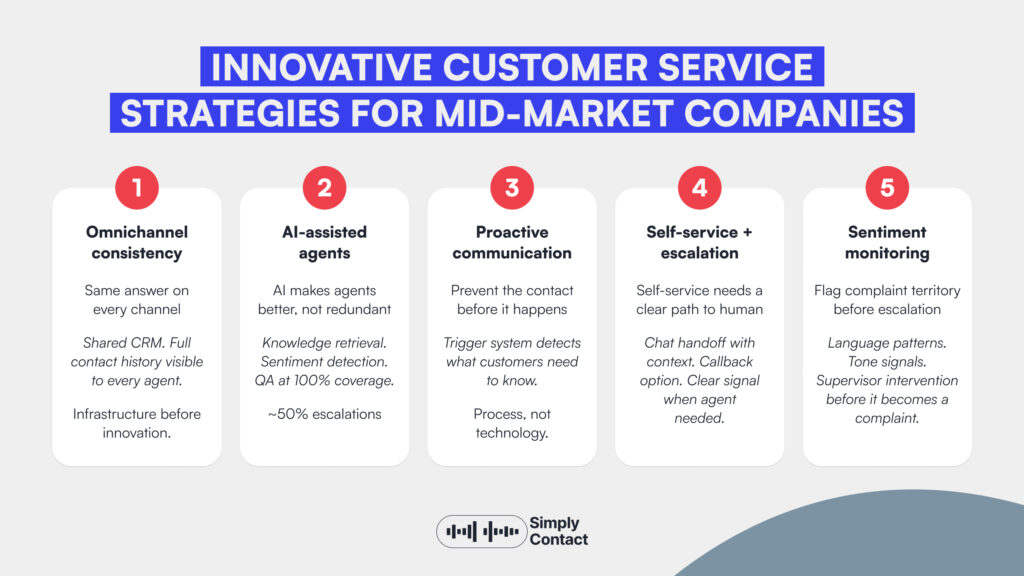
Most customer experience innovation examples in published research involve enterprise companies with large technology budgets. The strategies that produce results at mid-market scale are less expensive to implement and more likely to produce measurable returns faster.
Omnichannel consistency as a baseline
Innovative customer service does not start with AI or automation. It starts with the core requirement that a customer receives the same answer regardless of which channel they use to ask the question. A customer who gets a different response on live chat than on email, or who has to repeat their account history when they switch from chat to phone, is experiencing a failure of CX design at the most basic level.
Omnichannel consistency requires a shared CRM where every agent sees the full contact history across all channels, and defined standards for how each contact type is handled regardless of channel. This is infrastructure before innovation, and it is what makes every subsequent innovation work reliably.
AI-assisted agents, not AI-replaced agents
The most effective application of AI in customer service at mid-market scale is not chatbots that handle contacts independently. It is AI that makes agents better: real-time knowledge retrieval so agents do not search three systems mid-call, sentiment detection that flags contacts approaching formal complaint territory before the customer escalates, and AI-assisted quality scoring across 100% of interactions rather than a 5% manual sample.
Simply Contact's AI Knowledge Management implementation reduced supervisor escalations by 50% and lifted CSAT by 8 percentage points in a single operation. The agent was still the interaction point. The AI made the agent's response faster and more accurate. See the AI knowledge management case for how this model is structured, and the voice AI vs human agents comparison for where the AI/human division produces the best outcomes by contact type.
Proactive communication before the contact arrives
The most cost-effective innovative customer service idea is often the one that prevents the contact from happening. A customer who receives an accurate shipping delay notification before they check their order status does not call support. A SaaS customer who receives a proactive heads-up about an account issue before their renewal does not churn quietly.
Proactive communication requires two things: a trigger system that detects conditions the customer would want to know about, and communication standards that make the message clear enough that the customer does not need to follow up. Both are process investments, not technology investments, and both produce immediate measurable reductions in inbound contact volume.
Self-service with a real escalation path
Self-service reduces contact volume on structured, repetitive queries (account status, order tracking, standard FAQs). It fails when the self-service layer cannot handle the contact and has no clear path to a human agent. A customer who enters a chatbot flow, cannot get their question answered, and cannot find a way to reach a person has a worse experience than one who could not find the self-service option at all.
Innovative customer service ideas in this area are not more sophisticated bots. They are better-designed escalation paths: a live chat handoff that transfers the full conversation history to the agent, a callback option when wait times exceed a threshold, and a clear signal within the self-service interface when a contact type requires human handling.
Real-time sentiment monitoring
Identifying contacts that are approaching formal complaint territory before the customer explicitly escalates allows intervention that changes the outcome. Sentiment monitoring tools that flag contacts based on language patterns, tone, or contact history can alert supervisors to intervene or route contacts to senior agents before a resolution failure becomes a complaint.
This is innovation in customer experience at the operational level rather than the technology level. The technology exists in multiple forms at accessible price points. The implementation question is whether the team has defined what intervention looks like and given supervisors the authority and time to act on the signal.
Outsourcing as a customer experience innovation lever
Building CX innovation in-house requires technology investment, process design capability, training infrastructure, and the time to iterate. For most mid-market companies, the faster path to proven innovation is partnering with a specialist CX provider that has already built what the company needs.
This is the customer service innovation argument for outsourcing that goes beyond cost reduction. A specialist provider brings:
- Proven process design. The escalation structures, training protocols, and quality assurance frameworks are already documented and tested. A company inheriting this infrastructure skips the iteration cycle that in-house development requires.
- Technology stack at scale. AI-assisted quality scoring, sentiment monitoring, knowledge management systems, and omnichannel infrastructure are embedded in the operation rather than requiring separate procurement and integration.
- Multilingual coverage. A company expanding into new markets needs native-language support. An outsourcing partner with existing language capability provides this without a hiring cycle per language.
- Trained agent pools. Onboarding speed is a significant innovation lever. An outsourcing partner with structured training programmes and calibrated agents reaches operating quality faster than in-house recruitment and training from scratch. Simply Contact's AI-assisted agent training programme reduces time to full productivity by 30% and doubles first-contact resolution readiness before agents handle live contacts.
Simply Contact's work with METRO Cash & Carry shows what proven process infrastructure delivers at high volume: 98% of contacts resolved within 120 seconds, a 95% excellent quality rating, and consistent performance across 12,000 calls per month across five channels. That consistency comes from documented SOPs, tiered escalation, and QA coverage applied uniformly, not from individual agent performance.
How to measure the impact of customer experience innovation
Innovation in customer experience that cannot be measured cannot be justified for reinvestment. Five metrics track whether the innovation is working. It was found that 96% of customers who had a high-effort service interaction became more disloyal, making Customer Effort Score one of the strongest leading indicators of churn available to CX teams.
| Metric | What it tracks | Signal that innovation is working |
| NPS trend | Likelihood to recommend — advocacy change over time | Sustained upward movement over 2+ quarters following an initiative |
| CSAT at contact level | Satisfaction with a specific interaction | Improvement correlated with a specific process or training change |
| First contact resolution rate | Contacts resolved without repeat contact | Rising FCR indicates process design and agent capability improving simultaneously |
| Customer effort score (CES) | How much effort the customer had to exert | Falling CES indicates friction reduction — the goal of most CX innovation |
| Churn rate by segment | Customer loss rate among affected segments | Reduction in churn following a specific CX initiative confirms causal link |
Measuring one metric in isolation produces misleading conclusions. A rising CSAT with flat FCR means customers feel better served but are still coming back for the same unresolved issues. A falling CES with flat NPS means friction has reduced but not enough to convert neutral customers into advocates.
Customer experience innovation is a decision you should make today
The companies that consistently outperform on CX are not always the ones with the largest technology budgets. They are the ones that have decided, at a leadership level, that how they serve customers is a competitive variable worth deliberate investment and continuous rethinking.
Innovation in customer experience at mid-market scale starts with the decisions that do not require large budgets: documenting the contact-level process, defining escalation ownership, giving agents resolution authority, and designing self-service with real escalation paths. Those foundations make every subsequent technology investment produce better returns. If you would rather test these changes with a partner than build everything in-house, see how customer support outsourcing works at Simply Contact.

Newsletter
Subscribe
Subscribe to our newsletter to receive valuable industry insights and the latest research reports.