



Article
Voice AI vs. Human Agents: The Honest Comparison for 2026
Voice AI has moved fast. Two years ago, most AI phone agents could handle appointment reminders and basic FAQs with modest accuracy. Today, the better systems carry full conversations, handle interruptions, switch languages mid-call, and escalate to a human agent with context intact. The technology gap between voice AI and a trained human agent has narrowed considerably.
That doesn't mean the decision is simple. Voice AI agents still fail in ways that human agents don't, and in customer support, the failures that matter most tend to be the ones that happen on the calls that matter most.
This is an honest comparison. Not a case for AI replacing human agents, and not a defence of human-only operations. The answer for most contact centers in 2026 is some combination of both, the question is which proportion, for which contact types, at which cost point.
Key takeaways
- Voice AI agents handle high-volume, low-complexity contacts efficiently and cost-effectively. This is where the ROI case is clearest.
- Human agents outperform voice AI on emotionally complex contacts, non-standard situations, and interactions where trust or relationship continuity matters.
- The gap between voice AI and human performance narrows as contact complexity decreases and widens sharply as it increases.
- Call center voice AI works best as the first tier of a tiered model, handling what it handles well and routing everything else to humans with context preserved.
- The hybrid model, where AI handles volume and humans handle complexity, produces better outcomes than either approach alone.
How voice AI agents work
Voice AI agents use large language models combined with speech recognition and text-to-speech synthesis to hold spoken conversations with customers. They listen, interpret intent, generate a response, and speak it in real time, with latency measured in milliseconds on current infrastructure.
The better systems do more than follow a decision tree. They handle interruptions. They track context across a conversation. They recognise when a customer is frustrated and adjust their tone. They can transfer to a human agent mid-call, passing a full transcript and intent summary so the human doesn't start from zero.
AI phone agents in 2026 operate in 50+ languages with near-parity accuracy across major language pairs. They don't get tired, don't need breaks, and can run at any volume without staffing adjustments. A contact center running call center voice AI for tier-1 contacts can answer the 3am call from a customer in a different time zone without routing it to an understaffed night shift.
What they can't do reliably is navigate genuine ambiguity, read emotional subtext below the surface of what's being said, build real rapport, or make judgment calls in situations the training data didn't cover. Those gaps matter for some contact types and barely matter for others.
Where voice AI performs well
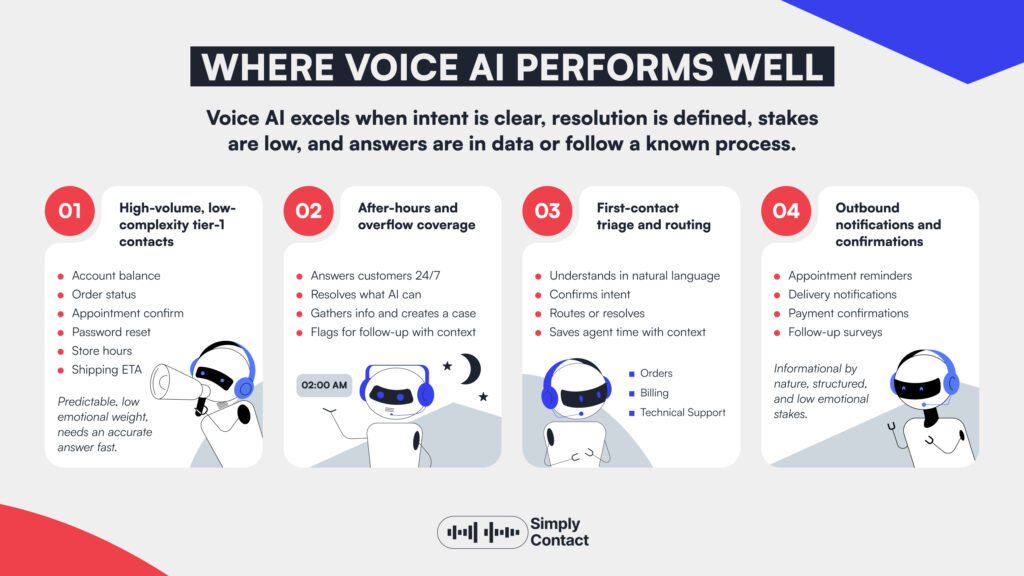
The performance profile of current voice AI agents is clearest on contacts that share a few characteristics: the intent is unambiguous, the resolution path is defined, the emotional stakes are low, and the answer is either in a database or follows a known procedure.
High-volume, low-complexity tier-1 contacts
Account balance queries, order status checks, appointment confirmations, password reset guidance, store hours, shipping ETAs, these contacts are predictable in structure and low in emotional weight. A customer who calls to check whether their parcel has shipped doesn't need empathy. They need an accurate answer in under 60 seconds.
Call center voice AI handles these contacts well. The accuracy rate on well-configured intent recognition for contained contact types consistently exceeds 90% in production deployments. The cost per contact is a fraction of a human agent interaction. And unlike a human agent, a voice AI agent handles 500 simultaneous contacts as easily as one.
After-hours and overflow coverage
Staffing a contact center for 2 AM calls is expensive. The volume doesn't justify the headcount, but leaving customers without a response until morning generates complaints and, in some sectors, churn.
Voice AI agents cover these windows without the overhead of a staffed night shift. For contacts that can be resolved by the AI, the customer gets their answer immediately. For contacts that need a human, the AI gathers information, creates a case, and flags it for morning follow-up with context already documented.
First-contact triage and routing
Before a human agent picks up a call, someone has to understand what the customer wants and route them to the right place. Interactive voice response systems have done this for decades, but they do it badly; customers navigate menus that don't match their situation and end up in the wrong queue.
Voice AI agents handle triage conversationally. The customer explains their problem in natural language. The AI interprets the intent, confirms it, and routes to the appropriate team or resolves it directly. Average handle time on routed calls drops because the agent receives a customer whose intent has already been identified and documented.
Outbound notifications and confirmations
AI phone agents work well for outbound contacts where the purpose is informational: appointment reminders, delivery notifications, payment confirmations, follow-up surveys. The interaction structure is defined, the customer isn't initiating with an unknown problem, and the emotional stakes are typically low.
Where human agents still win
The performance profile of voice AI degrades predictably as contacts become more complex, more emotional, or more novel. Human agents' performance on difficult contacts is, with proper training, more consistent than AI on the same contacts.
Emotionally complex interactions
A customer who calls to dispute a charge they believe is fraudulent is not in the same state as a customer checking their balance. They may be angry, anxious, or distressed. What they need from that interaction, beyond the actual resolution, is to feel heard.
Empathy in customer service is a quality that emerges from shared human experience, understanding what it feels like to be in the customer's situation and responding in a way that reflects that understanding. Current voice AI agents can simulate empathetic language. They can say the right words. What they can't do is make the customer feel genuinely understood in the way that a skilled human agent can.
Complaints and escalations
Customer complaints in contact centers require agents who can hold a difficult conversation, absorb expressed frustration without becoming defensive, and navigate to a resolution that the customer considers fair. These are skills that require judgment, not just pattern-matching.
When a customer escalates, they've usually already had an interaction that didn't resolve their problem. The escalation agent inherits a customer who is more frustrated than when they first called. The AI agent vs human agent comparison on this contact type isn't close: human agents who are properly trained handle escalations better. Voice AI, when it encounters a contact type it wasn't trained for or an emotional intensity it can't read accurately, tends to produce responses that feel tone-deaf, which makes escalations worse, not better.
Complex, multi-step problem resolution
A customer whose issue involves multiple systems, a policy exception, a missing record, and a third-party dependency isn't following a known resolution path. Resolving it requires the agent to hold context across a long conversation, reason about what's happening, ask the right clarifying questions, and make decisions at each step.
Voice AI agents are built around intent recognition and defined resolution paths. When the resolution path is undefined, their performance drops. Human agents trained on complex contact types handle these calls through a combination of product knowledge, conversational skills, and judgment.
Regulated and liability-sensitive interactions
In healthcare, financial services, insurance, and legal contexts, what an agent says carries regulatory weight. An incorrect statement about coverage, eligibility, or account terms may be a compliance violation with legal consequences.
Human agents in regulated sectors operate with awareness of what they can and can't say, and when to refer to a specialist. They ask for clarification before making statements they're uncertain about. Voice AI agents make confident-sounding statements at the same rate regardless of certainty, which creates compliance exposure in sectors where precision matters.
Watch on YouTube:
The honest performance comparison
The discussion around voice AI in customer service is often framed as a replacement story. In practice, it is a workload allocation problem. Voice AI performs extremely well in structured, repetitive, low-risk interactions where speed and consistency matter more than judgment. Human agents outperform AI in conversations that require emotional intelligence, contextual reasoning, negotiation, or regulatory awareness.
The strongest operations are not choosing between AI and people. They are designing systems where each handles the work it is best suited for. The result is lower operational cost, faster response times, and better customer outcomes without sacrificing service quality where human interaction still matters most.
| Contact type | Voice AI agent | Human agent |
| Balance, status, and information queries | High accuracy, fast, low cost | Reliable but expensive at scale |
| Appointment booking and confirmation | Well within current capability | Capable but overqualified |
| Outbound notifications | Strong for structured, low-risk interactions | Cost-inefficient at volume |
| First-contact triage and routing | More effective than legacy IVR systems | Adds handle time |
| Complaints and escalations | Struggles under emotional pressure | Critical for empathy and judgment |
| Complex multi-step resolution | Performance drops outside defined flows | Where skilled agents create value |
| Regulated or compliance-sensitive interactions | Incorrect confidence creates risk | Trained agents understand compliance boundaries |
| High-value customer interactions | Cannot maintain relationship continuity | Human connection drives retention |
| After-hours and overflow coverage | Handles volume without staffing overhead | Expensive and difficult to staff overnight |
Why the hybrid model produces better outcomes than either alone
The framing of voice AI vs. human agents as a binary choice misrepresents how effective operations are actually designed.
The AI-powered translation case from Simply Contact illustrates the principle. An English-speaking support team needed to serve customers in German, Spanish, Dutch, and Norwegian. Rather than building four separate language teams or replacing the team with AI, the operation integrated AI translation into a live chat workflow. The result:
- 34% cost reduction in the first three months.
- 23% improvement in first response time.
- 91–94% CSAT across all four languages.
The human agents kept their role. The AI extended their reach. Neither alone would have produced those numbers.
The same logic applies to voice. AI phone agents handle the contacts where they perform reliably. Human agents handle the contacts where performance requires judgment, empathy, or regulatory awareness. The handoff between the two is designed so the human receives the customer with context already captured, not starting from zero.
Wizz Air's contact center handles one of the more demanding voice environments in European travel: high volumes, multiple languages, seasonal spikes, and emotionally charged interactions when flights are disrupted. The operation achieves:
- 80% of calls answered within 35 seconds.
- 30% reduction in average handle time.
- 85% agent utilisation through both peak and off-peak seasons.
That performance comes from trained human agents with a strong operational infrastructure. For the contact types Wizz Air handles (complex, multilingual, emotionally significant) voice AI as a first-tier filter reduces handle time without replacing the human capability that produces the CSAT scores.
What to measure when evaluating call center voice AI
The metrics that matter for evaluating voice AI in a contact center environment are different from the metrics that matter for evaluating human agents. These are the ones worth tracking.
- Containment rate. The percentage of contacts the voice AI agent resolves without human intervention. A well-configured system should contain 60–80% of tier-1 contact types in production. Containment below 50% suggests the AI is being applied to contact types outside its reliable range.
- Escalation quality. When a contact escalates from voice AI to a human agent, how much context transfers? Does the human agent receive a transcript and intent summary, or does the customer have to repeat themselves? Poor escalation design is where voice AI deployments lose the CSAT gains from faster handling.
- CSAT by contact type. Aggregate CSAT masks performance differences between contact types. A voice AI agent might produce CSAT of 4.2/5 on information queries and 2.8/5 on complaint contacts handled in the same system. Tracking separately is the only way to see where the AI is working and where it isn't.
- Average handle time by tier. If voice AI triage is working, the average handle time for contacts that reach human agents should fall, because those agents are receiving pre-qualified contacts with intent already identified. If AHT for human contacts rises after AI implementation, the triage isn't working as intended.
- False escalation rate. Contacts the AI escalated to a human agent that the AI could have handled. High false escalation rates indicate over-cautious configuration, the system is routing more than it needs to, which costs money and adds unnecessary queue time.
How Simply Contact approaches the AI agent vs. human agent question
Simply Contact's position on voice AI customer service is not ideological. AI phone agents belong in the parts of an operation where they perform reliably. Human agents belong where performance requires what AI currently can't do: read emotional context accurately, reason under genuine ambiguity, and hold the kind of conversation that makes a customer feel like they're talking to someone who cares about their problem.
The AI knowledge assistan implementation that reduced supervisor questions by 50% and lifted CSAT by 8% is a good illustration of the practical approach. The AI gave agents instant access to accurate information so they could resolve contacts faster and with greater confidence. That's the correct application of AI in a human-operated support function: reducing the friction that slows agents down, not replacing the agents themselves.
For operations evaluating call center voice AI, the starting point is a contact type audit, which contacts, by volume and complexity, are genuinely suited to AI handling, and which require human judgment. That audit usually reveals that the ROI case for voice AI is strongest on 30–50% of contact volume, and that the remaining contacts need human agents who are well-trained, well-supported, and working within a QA framework that maintains quality over time.
The customer support outsourcing model at Simply Contact is built to combine both. AI handles the tier where AI performs. Trained human agents handle everything else. The operation is designed around that division, not bolted together after the fact.
Conclusion
It's which contacts belong to each, and whether the operation is designed to route them correctly.
Voice AI in 2026 is genuinely capable of a well-defined set of contact types. It is genuinely not capable on another set. The companies that get the most out of call center voice AI are the ones who are honest about that boundary, design the handoff carefully, and invest in human agent quality for the contacts where human quality is what determines the outcome.

Newsletter
Subscribe
Subscribe to our newsletter to receive valuable industry insights and the latest research reports.