



Article
Customer Service Process: Steps and Best Practices
A customer service team that handles requests well when there are fifty tickets a week often struggles when there are five hundred, because the process was never designed to scale. What worked through shared context and informal coordination at small volume falls apart when headcount grows, channels multiply, and volume spikes unpredictably.
A defined customer service process is what makes consistent quality achievable at scale. It is also what makes outsourcing, automation, and quality measurement possible. None of those work well on top of an undefined workflow. This guide covers how to build a customer service process that holds up under operational pressure, and how to know when it is working.
Key takeaways
- A customer service process is a defined sequence of steps that handles every contact consistently, from intake to resolution and feedback loop.
- Five core steps cover the full contact lifecycle: intake, triage and routing, resolution, follow-up, and feedback integration
- The escalation process is the part that fails most visibly when underdefined. Clear L1/L2/L3 ownership prevents contacts from stalling or getting lost at handoff.
- FCR, CSAT, AHT, and escalation rate are the four metrics that tell you whether your customer service workflow is actually working
- Outsourcing a customer service process makes the most sense when you need scale, coverage, or language capability faster than in-house hiring allows
What is a customer service process?
A customer service process is a structured sequence of steps that a support team follows to handle every incoming contact, from the moment a customer reaches out to the moment the issue is resolved and the interaction is closed.
The distinction from ad-hoc support matters operationally. Without a defined process, resolution depends on which agent picks up the contact, how experienced they are, and what they happen to know at that moment. Moreover, Salesforce's State of Service report found that 88% of customers say the experience a company provides is as important as its products, and that experience is determined almost entirely by the process behind it, not by individual agent effort. With a defined process, the sequence is the same regardless of who handles it: intake is documented, routing follows defined criteria, resolution draws on a shared knowledge base, and follow-up happens on a consistent schedule.
The customer service management process is broader than a single contact. It covers the governance layer above individual interactions: how standards are set and maintained, how performance is reviewed, how training is updated based on what the team learns from resolved contacts, and how the process itself is refined over time.
Both are required. The contact-level process ensures consistency. The management process ensures that the contact-level process stays current and continues to produce the right outcomes as the business changes.
Customer service steps: how to build your workflow
A customer service workflow that handles the full lifecycle of a contact moves through five stages. Each one has a defined output that feeds the next.
| Step | What happens | Output |
| 1. Intake | Contact received and logged across all channels (phone, chat, email, social). Contact type, priority level, and customer identity confirmed. | Documented ticket with full context |
| 2. Triage and routing | Contact categorised by type and complexity. Assigned to the right agent tier or team based on defined routing criteria. | Ticket assigned to correct handler |
| 3. Resolution | Agent works the contact using knowledge base, authority level, and escalation path if required. Customer receives a complete answer or confirmed next step. | Contact resolved or escalated |
| 4. Follow-up | For unresolved or complex contacts, a follow-up is scheduled. Customer confirmation of resolution requested where appropriate. | Closed ticket with resolution confirmed |
| 5. Feedback and learning | Resolved contacts reviewed for quality. Patterns identified. Knowledge base and scripts updated based on findings. | Process improvement inputs |
The customer service process flow between steps matters as much as the steps themselves. A contact that completes intake but stalls at routing because no criteria exist for that type, or that moves from resolution to follow-up with no ownership assigned, creates exactly the repeat contacts and escalation failures that a process is supposed to prevent.
The customer service steps only work consistently when every agent knows the criteria for each stage and has the authority and tools to execute within them.
Customer service escalation process: structure that prevents failures
The customer service escalation process is the part of the workflow that determines what happens when a contact exceeds an agent's resolution authority or capability. When it is defined clearly, escalations are fast and clean. When it is not, contacts stall, customers repeat themselves, and the problem that should have been resolved at first contact generates multiple follow-ups.
The L1/L2/L3 model
Most customer service escalation processes use a three-tier structure:
- L1 (front-line agents) handle high-volume, structured contact types with clear resolution paths. Account queries, standard complaints, product information, booking changes. L1 agents have defined authority to resolve these without escalating.
- L2 (specialist agents or team leads) handle contacts that exceed L1 resolution authority: complex complaints, compensation decisions, technical issues requiring product knowledge beyond the general knowledge base, or contacts that have already had one failed resolution attempt.
- L3 (management or specialist teams) handle regulatory contacts, major complaints, PR-sensitive situations, and anything that requires a decision above standard authority levels.
What escalation triggers must specify
An escalation trigger is not "the agent feels it is too complex." It is a defined condition: the contact involves a refund above a set threshold; the customer has contacted three times about the same unresolved issue; the contact requires access to systems outside L1 permission scope; the customer has expressed a formal complaint. Vague triggers produce inconsistent escalation decisions and inconsistent outcomes.
What breaks without a defined escalation structure
A fintech platform handling card dispute queries saw its resolution time on complex disputes triple after a period of rapid headcount growth. New agents were not escalating consistently. Some attempted to resolve contacts they lacked authority for and gave incorrect information; others escalated contacts they could have resolved, creating an unnecessary backlog at L2. The fix was a documented escalation decision matrix and a two-week calibration programme. Resolution time returned to baseline within a month.
Context transfer is the other failure mode. When an L1 agent escalates a contact to L2 without passing the full interaction history, the customer repeats themselves. That repetition is the most commonly cited frustration in customer service research. Zendesk's CX Trends report consistently finds that having to repeat information is the single most frustrating aspect of customer service for consumers, and it is entirely avoidable with a defined handoff protocol that requires the full context to accompany every escalation.
Simply Contact's AI Call Simulation training programme addresses this at the onboarding stage. Agents are trained against realistic escalation scenarios before handling live contacts, covering both the trigger criteria and the context handoff protocol. The result is 30% faster time to full productivity and double the first-contact resolution readiness compared to standard onboarding.
Best practices to optimise your customer service management process
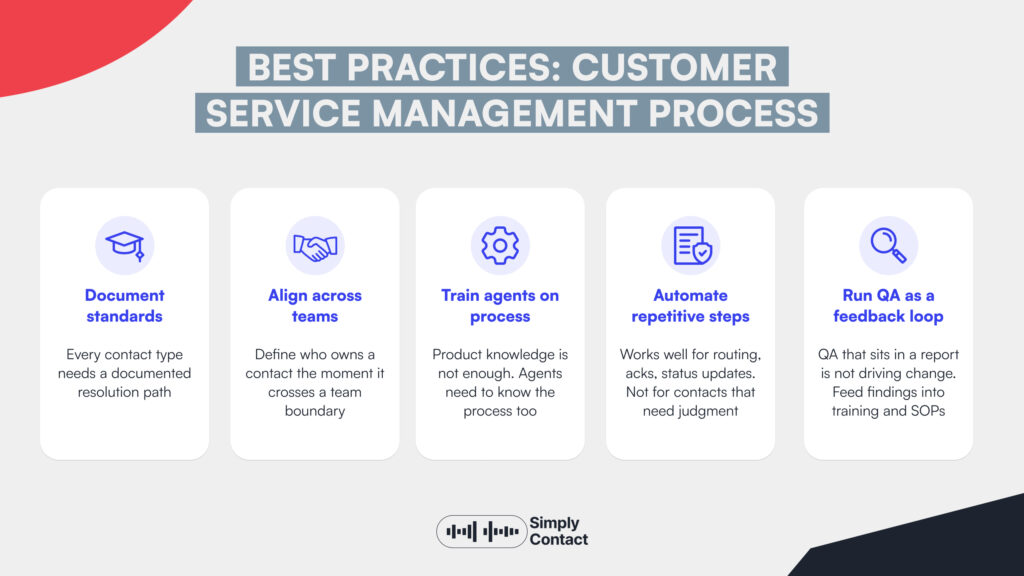
Document standards at the contact level
Every contact type that appears regularly should have a documented resolution path: what information the agent needs, what authority they have, what the correct resolution looks like, and when to escalate. Agents who improvise on undocumented contact types produce inconsistent outcomes. Documenting the standard takes time once and saves it continuously.
Align across teams before a contact arrives
A customer service process that involves multiple teams (billing, technical support, account management, logistics) needs defined ownership rules at every handoff point. Who owns the contact from the point it crosses a team boundary? What information transfers with it? What is the response time commitment from the receiving team? Without these answers, handoffs become failure points.
Train agents on process
Product knowledge is necessary but not sufficient. Agents also need to know the customer service process itself: how to document a contact correctly, how to identify escalation triggers, how to handle a contact where the standard resolution path does not apply. Process training is as important as product training and is often skipped.
Automate repetitive steps
Automation applies well to acknowledgment messages, ticket routing by contact type, status update notifications, and post-resolution surveys. It applies poorly to contacts where the right response depends on context the automation cannot access. A well-designed customer service management process identifies which steps are candidates for automation and which require agent judgment, and applies each accordingly. See the voice AI vs human agents comparison for how this division applies in practice.
Run QA as a continuous improvement input
Quality assurance that produces a score and then sits in a report is not driving process improvement. QA findings should feed directly into knowledge base updates, training adjustments, and, where a pattern appears across multiple agents, process revisions. The call center quality assurance guide covers how to build a QA loop that closes this gap.
How to measure the effectiveness of your customer service workflow
The customer service workflow is working when contacts are resolved correctly, quickly, and without repeat contact. Four metrics tell you whether that is happening:
| Metric | What it measures | What it reveals about process health |
| First contact resolution (FCR) | Proportion of contacts resolved without a callback or repeat contact | Whether intake, routing, and resolution are working correctly. Low FCR almost always indicates a process gap. |
| CSAT | Customer satisfaction at the contact level | Whether the experience around the resolution is meeting expectations. High CSAT with low FCR is a diagnostic signal — customers feel treated well but keep coming back. |
| Average handle time (AHT) | Time spent per contact | Whether agents have adequate tools and knowledge. High AHT on simple contact types indicates documentation or routing problems. |
| Escalation rate | Proportion of contacts escalated from L1 | Whether L1 is handling the right contacts. A rising escalation rate on contact types that should be L1-resolvable indicates a training or authority gap. |
| Ticket backlog | Unresolved contacts past SLA | Whether intake volume and resolution capacity are balanced. Persistent backlog indicates a staffing or routing problem. |
Measuring CSAT in isolation is the most common mistake in customer service workflow measurement. It captures satisfaction at the interaction level but misses systemic problems that show up in FCR, escalation rate, and backlog. All five metrics together give a complete picture. The CSAT vs NPS vs CES guide covers how to combine satisfaction metrics with operational ones.
Common customer service problem-solving challenges and how to fix them
Siloed teams creating handoff failures
Applying customer service problem solving steps to recurring failures requires naming the failure mode before designing the fix.
The problem: Billing resolves billing contacts; technical support resolves technical contacts; the contact that involves both stalls between them because neither team has explicit ownership.
The fix: Define cross-team ownership rules for contact types that span boundaries. The team that receives the contact first owns it until it is resolved or explicitly transferred with a documented handoff.
Inconsistent agent behaviour on the same contact type
The problem: Two agents handle the same query type differently. One escalates; one attempts resolution and gives incorrect information. Both are following their own judgment because no documented standard exists.
The fix: Document the resolution path for every high-volume contact type. Review QA scores by contact type to identify the ones with the widest variance. Those are the process gaps to close first.
Poor handoff quality at escalation
The problem: An escalated contact arrives at L2 with no context beyond the customer's name and original contact type. The L2 agent asks the customer to re-explain their situation. The customer gives a 1-star rating.
The fix: Require a structured context note at every escalation point: what the customer contacted about, what resolution was attempted, why escalation was triggered, and what the customer was told about next steps. The receiving agent should be able to pick up the contact without any re-explanation from the customer.
No escalation ownership
The problem: A contact is escalated from L1 to L2. L2 determines it requires specialist input and passes it to a third team. Nobody tracks the contact from that point. It sits unresolved until the customer contacts again.
The fix: Every escalated contact needs a named owner and a resolution SLA from the point of escalation. Escalation is not the end of the original agent's responsibility. They retain visibility until the contact is confirmed and resolved.
When outsourcing your customer service process makes sense
A customer service outsourcing process works best when it imports a proven operational model, not just agent headcount. The distinction matters: an outsourced team that brings its own documented workflow, QA infrastructure, and escalation design accelerates the path to quality faster than one that simply fills seats.
The situations where business process outsourcing customer service produces the clearest operational benefit:
- Scaling beyond internal capacity. A company growing from 50,000 to 200,000 customers in 18 months cannot hire and train internal agents fast enough to keep service quality stable. An outsourcing partner with an established onboarding model and trained agent pool can absorb that growth on a timeline internal hiring cannot match.
- Multilingual coverage. A SaaS platform expanding into German, French, and Polish markets needs native-language support. Building that in-house means separate hiring cycles per language. An outsourcing partner with existing multilingual coverage provides it from the start.
- 24/7 availability. Maintaining genuine overnight and weekend coverage in-house is expensive per contact in the low-volume hours. An outsourcing partner with flexible staffing shares that fixed overnight cost across multiple clients.
- Seasonal peaks. A retail or travel business with predictable seasonal volume spikes cannot justify permanent headcount for peak demand. Flex staffing through an outsourcing partner absorbs the peak without the off-peak overhead.
Simply Contact's engagement with METRO Cash & Carry shows what process structure delivers at high volume. The retail operation required multichannel support across phone, chat, and email, with 98% of contacts resolved within 120 seconds and 95% receiving an excellent quality rating across 12,000 calls per month. That consistency is not agent-dependent. It is the output of a documented workflow, tiered escalation, and QA coverage applied uniformly across all contact types.
For more on how outsourcing integrates with existing CX operations, the in-house vs outsourced call center comparison covers the structural tradeoffs in detail.
A defined process is what really scales
The teams that maintain quality through rapid growth, channel expansion, and volume spikes are not the ones with the best individual agents. They are the ones with the clearest process. Every contact handled the same way, every escalation with defined ownership, every quality finding feeding back into an updated standard.
That is what makes outsourcing work, what makes automation worth deploying, and what makes QA a driver of improvement rather than a reporting exercise.
Talk to our team about how Simply Contact brings a structured, scalable customer service process to mid-market companies, or explore customer support outsourcing options for your sector.

Newsletter
Subscribe
Subscribe to our newsletter to receive valuable industry insights and the latest research reports.