



Article
Forecasting Call Center Demand: Full Guide for CX Leaders
Get call center forecasting wrong in either direction and someone pays for it. Overstaff for a peak that doesn't arrive and the budget absorbs idle payroll for weeks. Understaff for a peak that does arrive and service levels collapse in hours, agents burn out, and customers escalate. Forecasting call center demand is often treated as a workforce management exercise buried three layers below the COO. It isn't. A 10% forecast error on a large contact center can swing staffing costs by six figures a quarter and turn a routine volume spike into a public SLA miss.
What is call center forecasting?
Call center forecasting is the practice of predicting how many contacts will arrive in a given period, how long each one will take to resolve, and how many agents that combination requires. The inputs are historical contact volume, average handle time (AHT), and shrinkage, the portion of paid time agents spend on breaks, training, and other non-contact activities that still have to be staffed for.
The output is a staffing number. A forecast that predicts 4,000 contacts next Tuesday is only useful once it's translated into "you need 38 agents on the floor between 10am and 2pm." That translation, from forecasting call center volume to actual headcount, is where most of the value sits and where most of the error compounds. Get the volume forecast wrong by 10% and the staffing number is wrong by roughly the same margin, but the cost of that error lands as either idle payroll or a blown service level
Why forecasting accuracy is a C-suite concern
Forecasting errors don't stay contained to the workforce management team. They land on the P&L and in attrition numbers.
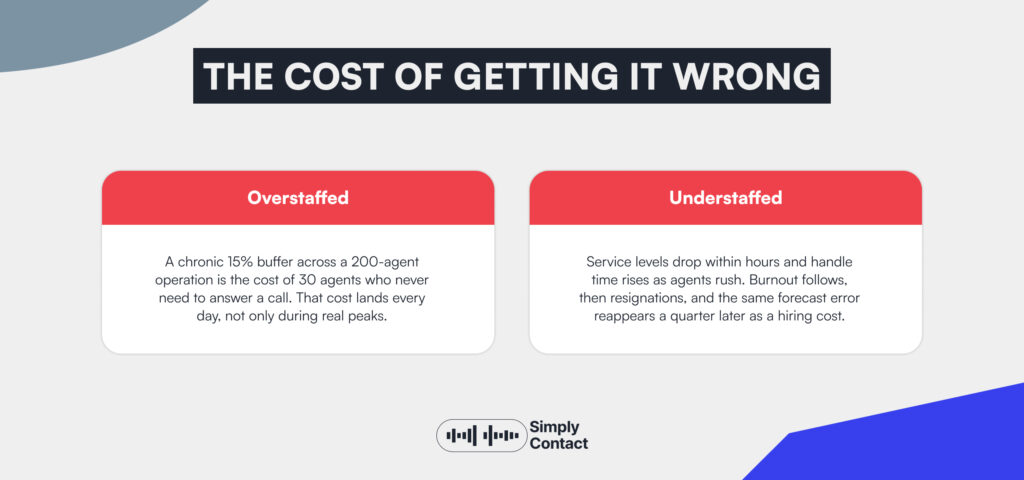
Overstaffing is the easier one to spot. A contact center that pads every shift by 15% to cover forecast uncertainty is carrying that cost every single day. Across a 200-agent operation, a chronic 15% overstaffing buffer is the equivalent of paying for 30 agents who never need to answer a call.
Understaffing costs more, just less visibly. When forecasted volume comes in low and staffing follows it down, a real spike hits an operation with no slack. Service levels drop, wait times climb, and the contacts that do get answered take longer because agents are rushing. Call center workforce management forecasting that treats accuracy as a rounding exercise instead of a risk control tends to produce this pattern on repeat: fine most weeks, broken during the exact weeks that matter most to the business.
The attrition cost is the one that's hardest to put a number on but arrives anyway. Agents who work chronically understaffed shifts handle more contacts per hour under more pressure, with less time between calls to reset. Burnout follows, and burnout drives resignations, which drives hiring and training costs, which is the same forecasting error showing up a quarter later under a different line item. It's also a sign the underlying customer service department structure hasn't been built to absorb demand swings in the first place.
Core call center forecasting models and methods
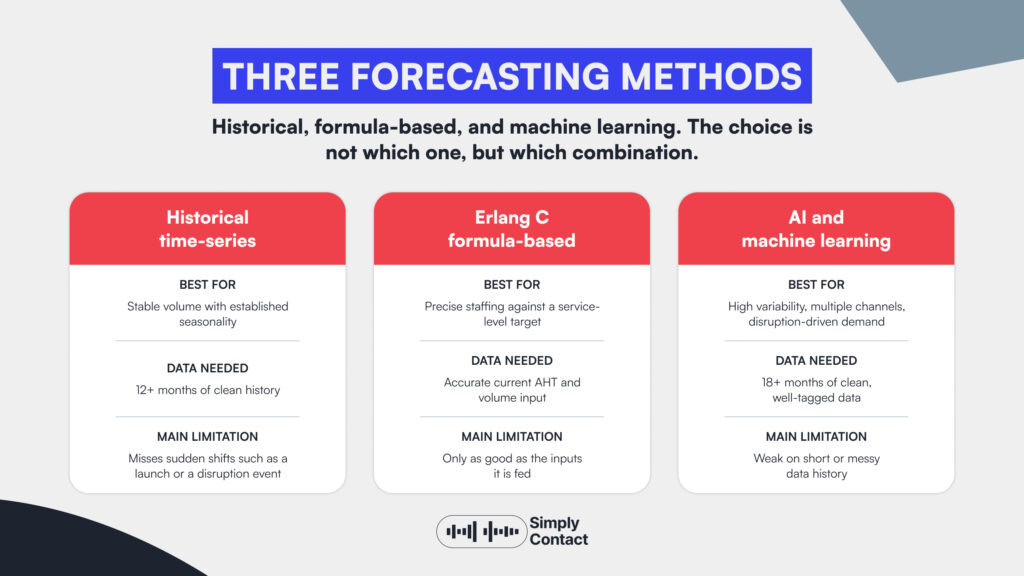
The right method depends on how much historical data an operation has, how stable that volume pattern is, and how many channels feed into the same queue. Most mature operations don't pick one call center forecasting model, they layer historical analysis, formula-based staffing calculations, and machine-learning pattern detection on top of each other, each catching what the others miss.
Historical and time-series forecasting
The starting point for almost every forecasting call center program is historical volume. A moving average smooths out day-to-day noise and shows the underlying trend, while seasonality decomposition separates a repeating weekly or monthly pattern, Mondays are always busier, December always spikes, from a genuine shift in demand.
This method works well when the business is stable and the historical pattern is a reasonable proxy for the future. It works less well the moment something changes: a new product launch, a marketing push, a regulatory shift that drives a wave of calls nobody has seen before. Time-series models are a strong baseline, not a complete answer.
Erlang C and formula-based forecasting
Erlang C is the formula most contact centers still use to answer one specific question: given an expected volume and average handle time, how many agents does it take to hit a target service level? It calculates the staffing level needed to answer a defined percentage of calls within a defined time, accounting for the fact that call arrival isn't perfectly even across an hour.
Call center forecasting formulas like Erlang C are precise, but they're only as good as the inputs. Feed them a stale AHT number or an average volume that hides a lunchtime spike, and the formula produces a confident, wrong answer. The formula doesn't fail, the data feeding it does.
AI and machine-learning-driven forecasting
Machine-learning forecasting earns its place once volume gets genuinely hard to predict by hand: multiple channels feeding one queue, promotional spikes that don't follow a calendar pattern, or disruption events that arrive with no warning. These models continuously re-train on incoming data and catch pattern shifts that a fixed historical model would miss until it's too late.
The tradeoff is data requirements. A machine-learning forecast is only as strong as the volume of clean historical data behind it. An operation with eighteen months of consistent, well-tagged contact data gets real value from this approach. An operation with six months of messy data across three untracked channels won't.
From forecasting to scheduling: closing the workforce management loop
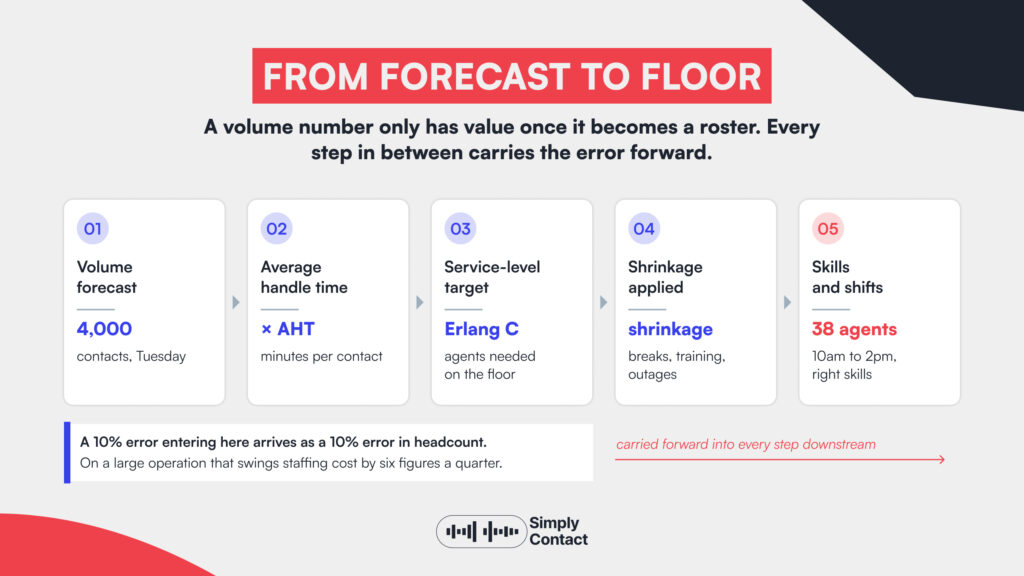
A forecast that never becomes a schedule is a spreadsheet nobody acts on. Call center forecasting and scheduling have to run as one connected process, not two handoffs between two teams that don't talk. Treating call center forecasting and scheduling as separate projects, owned by separate people on separate timelines, is where most of the accuracy gets lost between the forecast and the floor.
Closing that loop means working through the same three steps every cycle:
- Apply shrinkage first. Shrinkage is the actual percentage of paid time lost to breaks, training, coaching, and system outages. Applying it turns the raw "agents needed" number into "agents to roster," not the other way around.
- Match skills to the forecast, not just headcount. A forecast that says "need 40 agents at 2pm" is incomplete if 15 of those contacts require a language or product specialization that only 8 agents on shift have.
- Design shift patterns around the shape of the forecast, not a flat default. A forecast with sharp intraday peaks needs split shifts or staggered start times to match. A flat forecast doesn't.
Building the wrong shift pattern against the right forecast produces the same outcome as building the right pattern against the wrong forecast: a mismatch between coverage and demand that lands in the queue.
Intraday forecasting and real-time re-forecasting
No forecast survives contact with an actual day unchanged. Intraday forecasting call center operations track actual volume against the forecast in real time, typically in 15- or 30-minute intervals, and flag the gap the moment it opens up.
The value is what happens next. A well-run intraday process has escalation triggers built in, a defined response the moment actual volume drifts too far from plan:
- Trigger: Actual volume runs 20% above forecast for two consecutive intervals.
- Response options: pull agents off non-phone work, extend shifts, activate an overflow team.
- Owner: a named supervisor gets the alert and decides which lever to pull, on the spot, not after the shift ends.
Without those triggers defined in advance, intraday monitoring is just a dashboard nobody acts on until the queue is already backed up.
Forecasting demand drivers: seasonality, promotions, and holidays
Call center demand forecasting has to account for drivers that a plain historical average misses: repeating seasonality, single promotions, and holiday-driven spikes that behave nothing like a normal week. Two patterns dominate:
- Unpredictable timing, predictable kind. A weather event or major travel disruption can generate more inbound volume in two hours than a normal day handles in total. The specific storm doesn't announce itself in advance, but disruption season happens every year.
- Predictable timing, protected standard. Seasonal sales surges, holiday gifting periods, and launch days arrive on a known calendar, but the service standard can't drop just because the queue is longer.
Travel and aviation operations live mostly in the first pattern. Call center forecasting for holidays in this sector means building capacity for the disruption pattern, not just the calendar pattern, which is exactly what a call center business continuity plan exists to cover.
Luxury ecommerce lives mostly in the second. A forecasting model that treats every contact the same during a peak, rather than protecting response quality for the highest-value customers, solves the wrong problem. This is the same principle behind luxury retail clienteling, where the volume matters less than who gets the white-glove treatment when it arrives.
Choosing call center forecasting tools and technology
The choice of call center forecasting tools usually comes down to three tiers: spreadsheets, dedicated workforce management platforms, and forecasting managed by an outsourced operating partner.
| Tool tier | Works well when | Breaks down when |
| Spreadsheets | Small scale, one channel, stable volume | A second channel or site is added, or day-to-day volatility rises |
| Dedicated WFM platform | Data hygiene is strong and someone owns ongoing tuning | Fed bad data, still produces a bad forecast with a better dashboard around it |
| Outsourced-partner-managed | The internal team hasn't built deep forecasting expertise yet | Direct day-to-day control matters more than accuracy |
Spreadsheets stop working the moment an operation adds a second channel, a second site, or genuine day-to-day volatility, because the manual update cycle can't keep pace with intraday reality. Dedicated WFM platforms bring automated data ingestion, built-in Erlang C and machine-learning models, and intraday alerting as standard features, but they require a real investment in setup and ongoing tuning to deliver on that promise.
Outsourced-partner-managed forecasting shifts that setup and tuning burden onto an operation that's already run it across other clients and other volume patterns, in exchange for less direct control, the tradeoffs are the same ones covered in our breakdown of in-house vs outsourced call centers.
Most teams weighing that tradeoff end up comparing named providers directly. Our roundup of customer support outsourcing companies is a reasonable starting point if forecasting accuracy is the deciding factor.
Common forecasting pitfalls that increase operational risk
Most forecasting failures trace back to a small set of repeat mistakes. Ask a team or a vendor these questions and the answers usually reveal which ones apply:
- Is the historical data current? A model trained on eighteen-month-old volume patterns will miss a channel shift, a product change, or a customer base that's grown into different behavior since then.
- Is shrinkage built into the staffing number, or bolted on after? A forecast that ignores real shrinkage looks accurate on paper and comes up short on the floor.
- Does the model cover every channel feeding the queue, or just the phone line? Chat, email, and social contacts that route into the same agent pool have to be forecast together.
- Is there a re-forecasting cadence, or is the forecast set once and left alone? A forecast without a review cycle degrades the moment real volume drifts from the plan, and nobody notices until the queue does.
- Is forecast accuracy reviewed after the fact? A team running contact center quality assurance already has the QA data needed to check forecast accuracy against real outcomes, most operations just never connect the two.
Case in point: cutting average handle time through better forecasting and planning
Simply Contact's operation for Wizz Air shows what forecasting-driven planning looks like at scale. The airline operates across more than 50 countries with contact volume that's multilingual, seasonal, and shaped by disruption events that arrive with no warning. The operation built around that demand pattern delivered an 80% answer rate within 35 seconds and a 30% reduction in average handle time on key contact lines.
That AHT reduction wasn't a speed target chased for its own sake. It came from staffing built around the actual shape of demand rather than a flat annual average, agents in the right numbers, on the right shifts, with the right skills available at the moment volume arrived. Fewer contacts got handled by the wrong person at the wrong time, which is why most drives handle time down in a real operation.
How an outsourced CX partner strengthens forecasting accuracy
An outsourced partner strengthens forecasting accuracy through structural advantages a single in-house team usually can't replicate on its own. Cross-site coverage across multiple delivery centers means a volume spike in one market can pull capacity from another without a hiring cycle in between. Simply Contact runs five EU delivery centers specifically to support that kind of surge coverage, with 99.99% operational continuity behind it, part of what our call center outsourcing services are built around.
Compliance infrastructure matters here too, particularly for regulated industries where forecasting has to account for data-handling requirements alongside volume. Operations certified to ISO 27001 and PCI DSS v4.0.1 arrive with that framework already audited, rather than built and tested for the first time under a new client's forecasting requirements.
The proof points speak for themselves without needing a sales pitch attached: an operation that's already forecast for seasonal aviation disruption or luxury retail peaks has patterns on file that a single in-house team, forecasting its own volume for the first time, simply doesn't have yet. That's the core case for customer support outsourcing generally, and it applies just as directly to forecasting as it does to the contacts themselves.
Conclusion
Forecasting call center demand stops being guesswork the moment it's treated as a leadership decision instead of a back-office spreadsheet task. The shift is from reactive, fixing staffing after a queue backs up, to proactive, building capacity before the spike arrives, using the historical, formula-based, and AI methods that fit the actual shape of the demand.
If your current forecasting process was built for an average day rather than the peaks that define your risk, talk to Simply Contact about what a demand-based staffing model looks like in practice.

Newsletter
Subscribe
Subscribe to our newsletter to receive valuable industry insights and the latest research reports.