



Article
Call Center Compliance Monitoring: A Practical Guide
A single unredacted card number on a recorded call, one PHI disclosure to the wrong party, one missing consent record, and a contact center's compliance exposure stops being theoretical. Call center compliance monitoring is the discipline that catches those failures before they become fines, breach notifications, or a lost contract.
Treated as an annual audit checkbox, it misses almost everything that happens on the floor day to day. Run continuously across every channel, it's the difference between a regulator finding a gap and finding a working program.
What is call center compliance monitoring?
Call center compliance monitoring is the ongoing review, recording, and scoring of customer interactions, voice, chat, and email, against two standards at once: the regulatory requirements that apply to the data being handled, and the internal quality bar the operation holds itself to.
It's a distinct discipline from generic quality monitoring, which asks whether the agent solved the problem well. Compliance monitoring asks a narrower, harder question: did this interaction expose the business to regulatory or legal risk, regardless of how it felt to the customer?
The two overlap but don't substitute for each other. An agent can deliver a warm, effective interaction while still failing to read a required disclosure, mishandling a card number, or logging consent incorrectly. Call center compliance monitoring exists specifically to catch that gap, the failure a customer never notices and a regulator finds anyway.
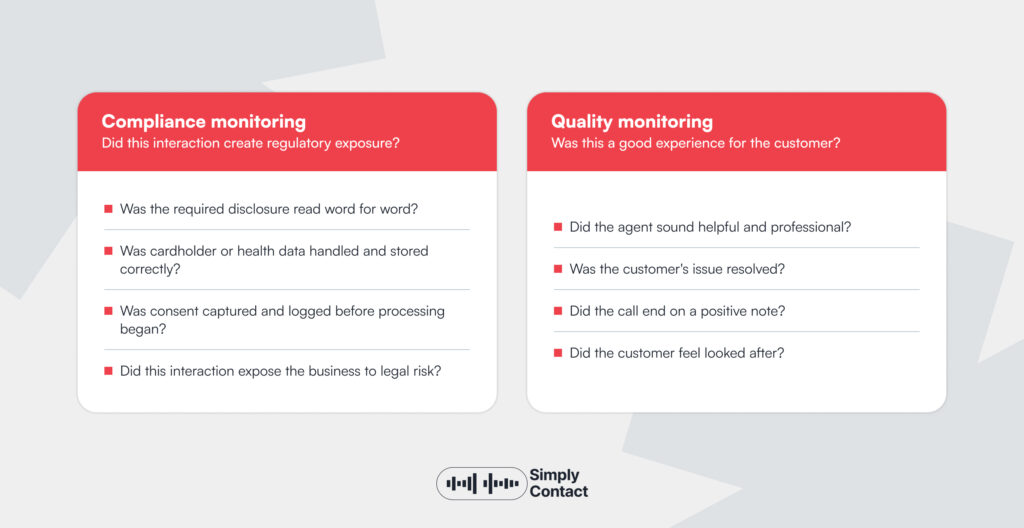
In practice, every interaction touching regulated data gets recorded, a defined sample gets scored against a compliance-specific rubric, and flagged interactions route to a human reviewer for a documented decision. Without all three steps, an operation has a recording archive, not a monitoring program.
Why call center compliance monitoring matters in regulated industries
The cost of a compliance gap doesn't stay contained to one call. Fintech, insurance, healthcare, and travel support all carry direct exposure: cardholder data on a payment line, protected health information on a claims call, EU customer data on any contact touching a European resident.
Contact center compliance failures in these sectors produce three kinds of cost:
- Regulatory fines that scale with the size of the breach and the number of records exposed.
- Mandatory breach disclosure that damages trust independent of the fine itself.
- Lost contracts when an enterprise client's own compliance team finds the gap during a vendor audit.
A single contact center compliance failure in insurance or healthcare rarely stays a single incident. It tends to trigger a wider audit of every interaction the same agent or the same queue has handled.
Call center regulatory compliance isn't optional in any of these sectors, and it isn't static. PCI DSS updates its standard on a defined cycle. GDPR enforcement has sharpened year over year. HIPAA audits increasingly extend to third-party vendors handling PHI on a covered entity's behalf. An operation built to pass last year's audit isn't automatically built to pass this year's.
What mature compliance infrastructure looks like is worth naming concretely. Simply Contact's delivery operates under ISO 27001, ISO 27701, and GDPR alignment, with 99.99% delivery continuity behind it, the kind of proof point a regulated client's own audit team can verify rather than take on faith.
Core regulatory frameworks behind call center compliance
Three frameworks account for most of what a CX leader in a regulated sector needs to monitor for: PCI DSS for payment data, HIPAA for protected health information, and GDPR for the personal data of EU residents. Each imposes different controls on how interactions get handled, recorded, and retained.
| Framework | Data it protects | Core controls | Proof point to look for |
| PCI DSS v4.0.1 | Cardholder data spoken or entered during a call | DTMF masking, call pausing/redaction, secure IVR capture | Current v4.0.1 certification, not an older version |
| HIPAA | Protected health information (PHI) | Access controls, minimum necessary disclosure, secure call logging | HIPAA-certified delivery and signed business associate agreement |
| GDPR | Personal data of EU residents | Consent capture, data minimization, retention limits, right to erasure | GDPR alignment plus ISO 27701 certification |
PCI DSS and payment card data on calls
Cardholder data spoken aloud on a call creates the same exposure as cardholder data typed into a form, arguably worse, since a recorded call captures it permanently unless the system prevents that. Call center PCI compliance depends on DTMF masking, automatic call pausing or redaction, and secure IVR payment capture that keeps the card number outside the agent's hearing entirely.
PCI DSS v4.0.1 is the current version of the standard. It raises the bar on authentication and continuous monitoring. A compliance program built against an older version of the standard is already behind.
HIPAA and protected health information
Healthcare-related support carries protected health information on nearly every call: symptoms, diagnoses, treatment details, insurance and billing information tied to a named individual. Call center HIPAA compliance rests on access controls, minimum necessary disclosure, and secure call logging that keeps PHI-containing recordings separated and access-audited.
HIPAA-certified delivery means the vendor has built these controls into the operation from the start, not bolted them on after a covered entity asked for a business associate agreement.
GDPR and customer data rights in the EU
Any interaction touching an EU resident's personal data falls under GDPR regardless of where the contact center itself sits. Consent has to be captured and logged before data is processed. Data minimization limits what gets recorded to what the interaction requires. Retention limits mean data doesn't sit indefinitely just because storage is cheap.
Right-to-erasure requests have to be actionable against call recordings and chat logs, not just database records. GDPR alignment paired with ISO 27701 certification, the privacy-specific extension of ISO 27001, is what privacy-by-design looks like operationally rather than on a policy document.
Core components of a call center compliance monitoring program
Three operational building blocks make a compliance monitoring program work rather than exist on paper. Together, they separate real call center quality monitoring from a recording archive nobody reviews.
| Component | What it does | Risk it catches |
| Recording, retention, and redaction | Captures the interaction and protects the sensitive segments within it | Data kept too long, or sensitive segments left unredacted |
| QA scorecards and checklists | Turns regulatory language into scoreable, yes-or-no line items | Inconsistent scoring between reviewers, sites, or shifts |
| Speech analytics and monitoring software | Flags high-risk interactions for human review at scale | Violations buried in volume no team could review manually |
Call recording, retention, and redaction
Recording every regulated interaction is the easy part. The harder part is storage that meets the security requirements of the data held, retention windows matched to the specific regulation, and redaction that removes sensitive segments, card numbers, PHI details, from the recording itself, not just the transcript.
Call recording compliance fails most often at the retention step: data kept longer than the applicable regulation permits is itself a violation, independent of anything that happened on the call. Getting call recording compliance right at the retention stage is cheaper than fixing it after a regulator asks for the schedule.
QA scorecards and compliance checklists
A scorecard is where regulatory language becomes something an agent's actual behavior can be scored against. "The agent must obtain documented consent before processing personal data" becomes a specific, yes-or-no line item on a call center quality monitoring form, checked against the recording rather than assumed from a training record.
A call center compliance checklist built this way turns an abstract requirement into a repeatable, auditable measurement, the same call scored the same way regardless of which QA reviewer is listening.
Speech analytics and compliance monitoring software
Manual review alone can't scale to the volume most regulated operations handle, which is where call center quality monitoring software earns its place. Automated flagging surfaces calls where a required disclosure was skipped, a compliance keyword triggered a risk flag, or a sentiment shift suggests a closer look is needed.
The software doesn't replace the human reviewer. It directs attention to the interactions most likely to matter, with a person making the final compliance judgment on anything flagged. A general-purpose call center quality monitoring form imported without adaptation catches far less than one built from the applicable regulation.
Building a call center compliance monitoring checklist
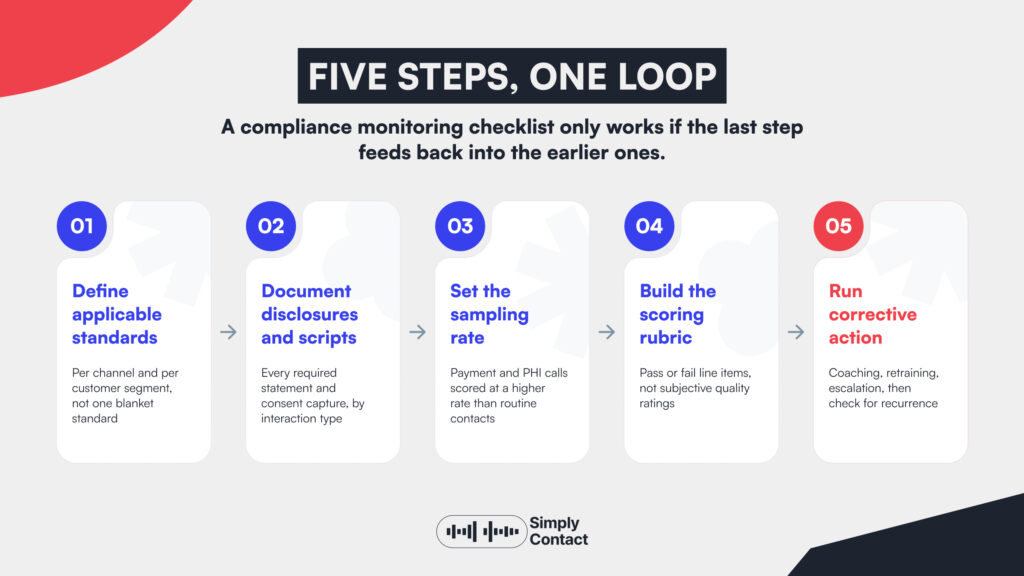
A working call center compliance checklist covers five steps, in this order:
- Define the applicable standards. Identify which of PCI DSS, HIPAA, GDPR, or sector-specific rules apply to each channel and customer segment, rather than assuming one standard covers everything.
- Document mandatory disclosures and scripts. List every required statement, consent capture, and disclosure by interaction type, so scoring has a fixed reference point.
- Set the sampling rate. Decide what percentage of interactions gets reviewed by channel and risk level. Payment calls and PHI-heavy calls warrant a higher rate than routine service contacts.
- Build the scoring rubric. Convert each disclosure and control into a scoreable line item with a clear pass or fail definition, not a subjective quality rating.
- Run a corrective-action loop. Route failed scores to coaching, retraining, or escalation, and track whether the same failure happens again, closing the loop rather than filing the score and moving on.
Skipping any one of these five steps is usually where a compliance program looks complete on paper and fails the moment a regulator tests it.
Training and enabling agents for compliance
Call center compliance training starts before an agent takes a live call, with onboarding certification that requires a demonstrated pass on the relevant regulatory scenarios, not just a training module marked complete. Ongoing refresher training keeps that certification current as regulations update.
PCI DSS v4.0.1's rollout is a recent example of a standard shifting under agents who were originally trained against an earlier version. A certification earned two years ago doesn't guarantee compliance with today's rules.
Calibration sessions between QA and compliance teams matter as much as the training itself. Two reviewers listening to the same call should reach the same score. When they don't, the scorecard has an ambiguity that needs fixing, not a reviewer who needs correcting.
Regular calibration keeps a compliance monitoring program consistent across shifts, sites, and languages, rather than dependent on which reviewer happened to score a given call.
In-house vs outsourced compliance monitoring
| Factor | In-house monitoring | Outsourced monitoring |
| Control | Full, direct control over every decision | Shared, with a partner's process already in place |
| Depth across frameworks | Limited by one team's bandwidth across PCI DSS, HIPAA, and GDPR at once | Frameworks already run across other regulated clients |
| Setup time | Scorecards, redaction tooling, and calibration built from scratch | Infrastructure already tested and audited |
| Cost at scale | Grows linearly with headcount and specialization needs | Shared across a partner's existing operation |
An in-house program keeps every control decision inside the company, a real advantage when the operation is small enough for one team to maintain deep expertise across every applicable regulation. It becomes a constraint once that same team has to maintain PCI DSS, HIPAA, and GDPR expertise simultaneously, across multiple channels and languages, on a budget sized for one specialty.
An outsourced program trades some of that direct control for scale and specialization already built. A certified partner has typically run the same frameworks across other regulated clients, so the scorecards, redaction tooling, and calibration process already exist rather than needing to be built under time pressure. The tradeoffs mirror the broader question covered in our breakdown of in-house vs outsourced call centers.
Disciplined QA and compliance monitoring produce measurable outcomes, not just audit-readiness. In one regulated support engagement, tightening the QA and compliance monitoring program cut average handle time by 30% while raising CSAT from 51% to 88%. That's proof a program built around call center quality assurance best practices improves the customer experience while it reduces regulatory risk, rather than trading one for the other.
Choosing a compliance-ready CX partner
Evaluating an outsourced partner for regulated CX work comes down to a small set of concrete criteria, not a sales deck.
- Relevant certifications, held simultaneously. PCI DSS v4.0.1, ISO 27001, ISO 27701, HIPAA readiness, and GDPR alignment, not one or two picked to match whichever client is asking.
- Audit transparency. A partner willing to walk a prospective client's compliance team through actual contact center quality assurance processes, scorecards, calibration records, and corrective-action logs is demonstrating call center regulatory compliance, not just claiming it.
- Multi-site, multi-region delivery. Simply Contact runs five EU delivery centers with 99.99% operational continuity, the kind of guarantee that matters to a compliance team asking what happens to monitoring coverage if a single site goes down.
- Monitoring software fit. A partner's call center quality monitoring software and process should be part of the same evaluation.
For sectors like insurance, where regulatory exposure and customer volume both spike around renewal periods, that continuity is what a call center outsourcing services partnership is built to protect against.
Conclusion
Call center compliance monitoring is a continuous program: recording built to the right standard, scorecards that turn regulation into something scoreable, analytics that scale review to real volume, and a corrective-action loop that closes.
The operations that treat it that way pass audits because the audit only confirms what the program already knows about itself. If your current compliance monitoring setup was built for last year's audit rather than this year's regulatory reality, talk to Simply Contact about what a certified, multi-region compliance program looks like in practice.

Newsletter
Subscribe
Subscribe to our newsletter to receive valuable industry insights and the latest research reports.