



Article
Customer Service Problems:Why They Keep Happening and How to Fix Them
We all know the familiar pattern: more agents are added, and new advanced tools are deployed, but support failures occur no matter what. 77% of customers reported experiencing a problem with a product or service in the previous 12 months. Managers are constantly looking for reasons for bad service. Sometimes the problem is hidden lies on a more complex level.
It is time to acknowledge that active customer service problems are not agents' failures; they are infrastructure failures. The designed workflows can’t handle all the processes and create problems that impact the entire company’s reputation. Your customer support is just not designed for the required level of service complexity.
Key takeaways
- A bad experience during customer interactions seriously harms brand reputation, but the problem lies in the system.
- Common customer service challenges stem from inefficient workflows, and by making adjustments, a company can finally meet individual customer needs and be prepared for seasonal peaks.
- Only redesigning the system itself can help provide exceptional customer service. Knowledgeable management adjusts support logic for the customer journey and enables the use of QA in a more beneficial way for CS.
- The examples of bad customer service, like the Hertz case, can show you how much customers and brands may suffer due to poor service possibilities caused by fragmented systems.
What is bad customer service at the system level?
For an operations leader, it may be difficult to define what a bad customer service experience is. Our experts believe that it is not always about false tone, rude interactions, or individual agents’ mistakes. Of course, human factors may play a role, but they don’t explain all situations that lead to a bad customer experience. Bad CS is a systemic failure of the support model that can’t guide customers to a resolution. It happens when the processes and tools work against the customer journey rather than addressing customer needs.
At the system level, customer service problems take place as inconsistent outcomes. For instance, two customers with the same problem get different answers, timelines, and policies depending on the channel or agent. Escalation paths become fragmented and unclear, leading to errors across departments due to a lack of connection. Scripted workflows fail to address the problem, and customers get trapped in an endless cycle of having to repeat themselves.
Operators can notice the bad CS issue through repeat-contact rates and a high number of unresolved tickets. Often, channel switching may also signal that an initial channel doesn’t give the desired solution. A rising customer effort score can reflect structural design gaps, like disconnected systems or unclear accountability.

The most common customer service problems and what causes them
Many companies with customer service problems treat them as staffing issues when they are actually systemic design failures. As a result, instead of improving, the company gets higher operational costs and still faces slow response time.
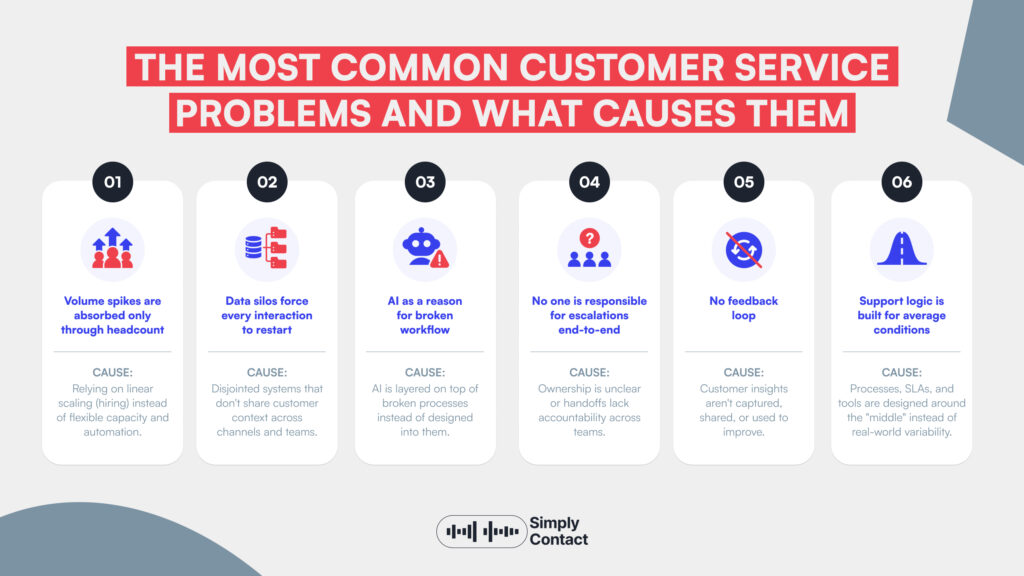
Volume spikes are absorbed only through headcount
One of the most common customer service challenges is the inability to handle unexpected demand spikes without adding more staff. Instead of thinking about extra staff, companies may consider implementing self-service and automation software. For instance, with automated resolutions, companies can cover up to 30% of inquiries, giving human teams more time to deal with difficult cases.
Data silos force every interaction to restart
If customer data is fragmented across systems such as CRM platforms, billing, and ticketing solutions, agents lack context. They must ask the customer to repeat themselves at multiple touchpoints during omnichannel support. According to statistics, 73% of customers want companies to understand their expectations and needs, but more often, they get treated like numbers. Disconnected systems make it a huge problem to understand customer concerns and provide fast assistance.
AI as a reason for broken workflow
Many companies implement artificial intelligence tools without adjusting support processes first. It means that chatbots and automated assistance have the same poor escalation path and inefficient knowledge bases. Poor automation implementation can only increase the number of problems rather than fix them, so we recommend making the necessary adjustments to ensure it works.
No one is responsible for escalations end-to-end
When no one owns escalation and complex issues bounce between several internal departments and external vendors, it only adds to the headache for the customers and support teams. It leads to inconsistent communication and longer resolution times, which causes damage to customers' trust and employees' productivity.
No feedback loop
Support organizations collect a large amount of QA data. Still, in reality, customer feedback rarely drives operational improvements because it is not properly reviewed, and product teams are not connected to frontline support agents. As a result, the same problems persist instead of being fixed in a shorter time.
Support logic is built for average conditions
Many companies design their workflows around usual operating conditions, without considering potential peak demand and crisis scenarios. Their systems may be perfect for stable periods, but absolutely fail during outages. Without proper planning and disruption-ready processes, customer service operations are not efficient enough for scaling.
What recurring customer service problems cost at scale
CS failures create expenses far beyond the support department. For many companies with customer service problems, the financial impact is caused by operational inefficiency and customer churn.
Actually, revenue leakage caused by unresolved churn is one of the highest hidden costs. Slow response times and repeated escalation often make customers leave the brand, searching for better conditions and quality of service. For instance, the research shows that 29% of customers stop buying from the brand because of poor customer experience.
Support inefficiency also impacts the total cost of ownership (TCO), which many organizations consider a growth cost. The main problem is that instead of redesigning workflows, companies try to fix inefficiency with headcount or new software. It can improve the situation a bit, but it will not fix it in the long term.
| Customer service problem | Operational impact | Business cost | Long-term consequence |
| Slow response times | Higher ticket backlog, longer resolution cycles | Increased support labor costs | Customer churn and lower retention |
| Repeated escalations | Multiple agents involved in one issue | Higher cost per ticket | Reduced customer trust |
| Siloed systems and disconnected workflows | Duplicate work and manual data entry | Productivity loss across departments | Brand reputation damage |
| Poor first-contact resolution | Customers contact support multiple times | Increased ticket volume | Lower customer satisfaction (CSAT) |
| Inaccurate customer data | Errors in service delivery and decision-making | Rework and compensation expenses | Compliance and legal risks |
| High agent turnover | Continuous hiring and training needs | Recruiting and onboarding costs | Inconsistent customer experience |
| Lack of process automation | Employees spend time on routine tasks | Rising operational expenses | Limited scalability |
| Unresolved customer complaints | Negative reviews and lost sales opportunities | Revenue leakage | Increased churn rates |
| Cross-department communication failures | Delayed issue resolution | Operational inefficiency | Customer frustration and reputational harm |
| Workflow design flaws | Systemic errors despite capable staff and tools | Financial penalties, lawsuits, compensation payouts | Significant brand damage |
As an example of a system issue that impacts a brand's reputation, we would like to mention the Hertz case. The agent and software did their parts, but the workflow was not integrated across departments, and it didn’t automatically update the company’s asset-tracking and legal databases. As a result, a huge number of customers were falsely accused of stealing rented cars. The company had to pay 168 million USD to compensate customers for false arrests.
How to solve problems in customer service
To solve CS problems for good, the company needs to redesign the system and workflows, not just add more people or replace the software.
Map support logic to a customer journey
Many companies structure their operational workflows around internal departments rather than considering customer intent. You can look at the workflow from the customer's perspective and the steps they can or cannot complete.
Design escalation architecture before deploying AI
Artificial intelligence is a very helpful tool, but only when the system itself works properly. AI should have clear instructions in the following directions:
- When escalation happens
- Who should perform the next step
- What data and where should be transferred
- What resolution actually means.
Build feedback loops that close QA findings into training
One of the biggest customer support challenges is that companies often collect QA data but rarely use it to drive real improvements, instead keeping it as reporting insights. It is important to review the data, especially regarding repeat escalation causes, policy confusion, customer friction patterns, and unresolved intents. Then, we recommend assigning owners and deadlines to address the issue.
Volume design for the peak performance
In most cases, weak support workflows collapse during spikes because they are optimized only for normal conditions. If you create the model originally suited for seasonal peaks, marketing campaigns, or outages, customer service will be better prepared. You can think about staffing flex plans and automated flows, for instance.
Define clear ownership for each stage
The best you can do for CS workflows is to decide clearly what is responsible for what. Ownership may include follow-ups, investigation and resolution processes, issue correction, etc.
Customer service challenges in complex industries
In high-stakes sectors like aviation, fintech, and luxury services, customers experience the issue differently than in the consumer segment. The stakes are much higher, as are the customer expectations.

Aviation
In aviation, customer service challenges happen mostly during disruption peaks. It is when the voice queue collapses under the volume of requests, and the fragmented support systems become extremely overwhelmed. Airlines can’t always rely on temporary staffing or reactive fixes; they require efficient escalation flows, readiness for urgent operations, and very clear ownership structures.
For instance, check our work with Wizz Air. Here, we designed a system that is ready for seasonal spikes and can remain flexible and productive. With optimized scripts and a knowledge base, we reduced AHT and improved quality control.
Fintech
Fintech issues are usually tied to compliance-sensitive escalation and fraud handling. The companies need efficient workflows designed to address regulatory risks and fraud prevention. They should include strict rules and controlled decision-making.
Working with Token.io, Simply Contact addresses these challenges and ensures every customer interaction is secure and compliant. As a result of our enhanced workflows and KPI monitoring, the company achieved nearly 100% retention.
Luxury
Luxury brands often face expectation mismatches and have to work on maintaining highly personalized experiences at scale. Workflows need to be designed for VIP handling and proactive communication. Continuity across channels is vital for workflow efficiency.
These industries cannot afford patch fixes; they require highly efficient, well-designed systems with workflows suited to their customer journeys. For instance, in Simply Contact, we design our system to handle complex customer operations in high-stakes support environments.
Conclusion
Bad customer service seriously harms a brand's reputation, and it is important to understand what exactly you are going to fix. It is not a staffing or tool problem; the issue lies in the workflow and the system itself, and in its inefficient design. For instance, companies that treat recurring CS problems as system failures rather than personal ones are the ones that actually solve them permanently.
If you want to avoid such problems, work with Simply Contact, and your customers will get an outstanding customer experience, as our experts know how to build long-term trust.

Newsletter
Subscribe
Subscribe to our newsletter to receive valuable industry insights and the latest research reports.