


Article
What Is Luxury Customer Experience? Pillars & Real Brand Examples
Customers who buy luxury goods are willing to pay more when the experience around those goods is exceptional. That number shows that the product is already secondary. What sells and what keeps customers coming back is the luxury customer experience itself.
Luxury customer experience is the totality of how a customer feels at every touchpoint with a high-end brand, from the moment they first discover it to the service they receive long after the purchase. It is about how a brand makes people feel: recognized, understood, and worth the effort.
This article covers the definition, what separates luxury customer experience from regular service, the five pillars that underpin it, how leading brands put those pillars into practice, and what it takes to build or outsource a program that actually delivers.
Key takeaways
- Experience outranks products. Luxury buyers have shifted from acquiring objects to acquiring feelings. The experience itself is now the product and brands that treat it as operational overhead lose clients to those that don't.
- Personalization is table stakes in the luxury segment. 81% of customers prefer brands that personalize customer experiences. Luxury brands build 360-degree client profiles: purchase history, preferences, life milestones, and every associate, on every channel, uses them.
- Exclusivity must be felt. Waiting lists, private viewings, bespoke commissions, the best luxury brands engineer scarcity and earned access into the experience itself. Hermès and Rolls-Royce are the clearest proof of concept.
- The revenue case of luxury customer experience is clear. 84% of companies that actively invest in CX improvement report measurable revenue increases. For luxury brands, where lifetime client value is exceptionally high, the return on CX investment compounds over time.
What is a luxury customer experience?
Luxury customer experience is intentional, personalized engagement at every stage of the customer journey, designed to create an emotional connection.
Every interaction blends advanced technology with deep human insight.
- A phone call gets handled by someone who knows the client's purchase history.
- An in-store visit feels like a private appointment, not a sales floor encounter.
- An email follow-up arrives with relevant, tailored recommendations.
None of this happens by accident. It requires deliberate infrastructure, trained people, and consistent execution across every channel.
The scale of the market clarifies the stakes. The global Luxury Goods market is expected to reach $577.8 billion in 2029. Brands that prioritize customer experience are best positioned to retain and recapture that base.
How luxury customer experience differs from regular customer service
The difference between luxury customer service experience and standard customer service comes down to one word: proactive.
Standard service responds. A customer has a problem → a support agent fixes it. The interaction is efficient and transactional, which is fine for most contexts.
The role of customer support in the luxury sector is slightly different. Problems are anticipated before they surface. Preferences are remembered and acted on without the customer having to ask twice. The table below shows where the two models part ways:
| Dimension | Standard customer service | Luxury customer experience |
| Approach | Reactive | Proactive |
| Primary goal | Resolve the issue | Build the relationship |
| Personalization | Limited to the current interaction | Informed by full client history |
| Tone | Helpful and efficient | Warm, knowledgeable, advisor-level |
| Channel consistency | Varies by channel | Identical quality across all touchpoints |
| Follow-up | Triggered by the customer | Initiated by the brand |
| Metric of success | Resolution time, CSAT | Long-term loyalty, lifetime value |
74% of customers say their brand loyalty grows when they feel understood and appreciated. That single finding captures why luxury CX is relationship-driven and why copying a loyalty points program is not the same as delivering a luxury experience.
Elevate Your Luxury Customer Support Strategy
Insights and best practices from luxury customer service leaders.

The 5 pillars of luxury customer experience
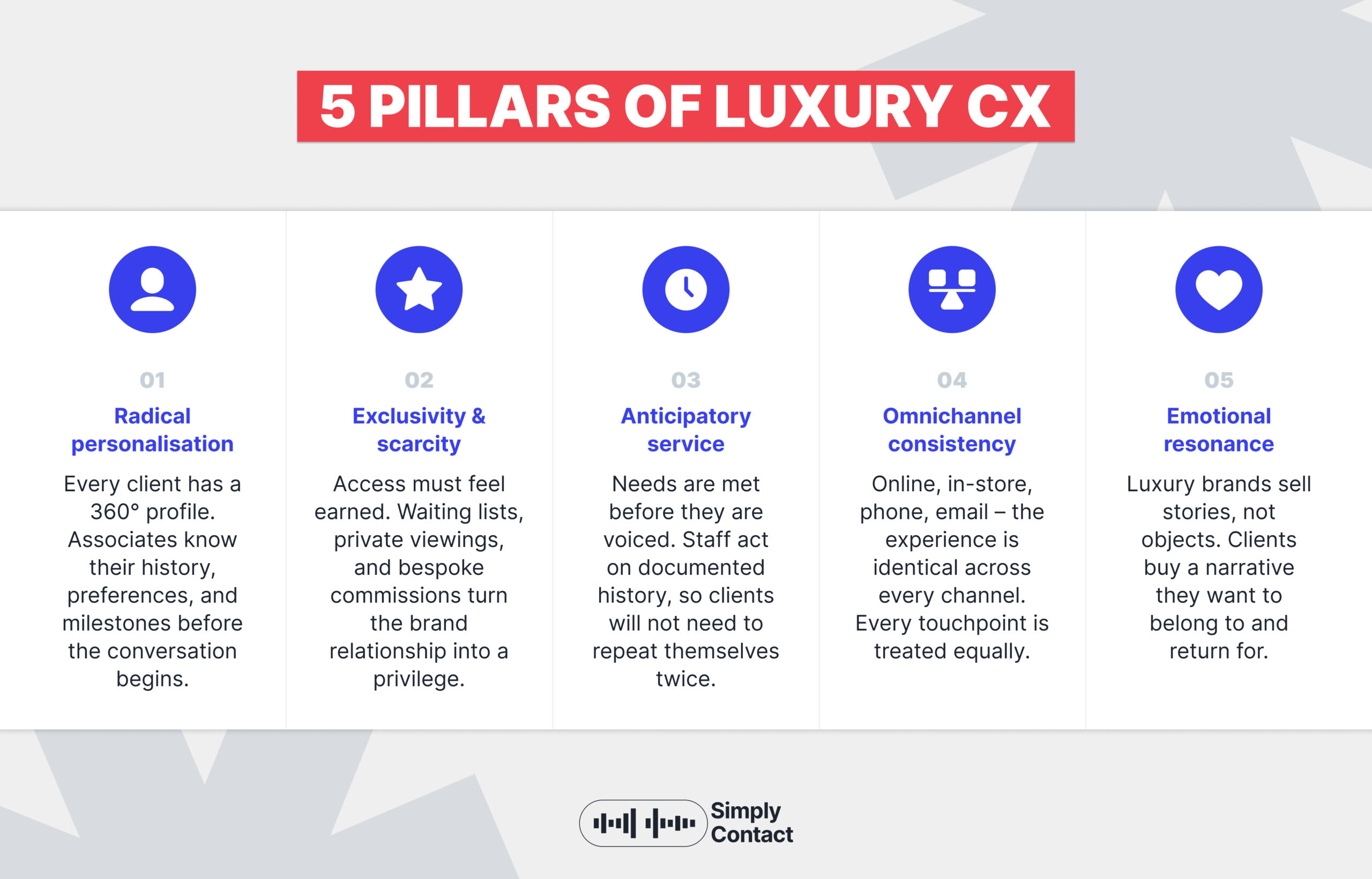
Beneath the surface of every great luxury experience lie five structural pillars that, together, define what it means to treat a customer as a guest, a collaborator, and ultimately a devotee.
1. Radical personalization
Luxury brands know their clients. Associates at Hermès are trained to read clients' emotional states, personalize gift consultations, and remember details across visits. Louis Vuitton offers bespoke monogramming and custom design services that turn a product into something singular. Jo Malone builds scent consultations around personal preference.
None of this works without data. Purchase history, lifestyle cues, anniversary dates, previously expressed preferences – all of it feeds into a 360-degree profile that turns a good associate into someone who feels like a personal advisor. The numbers behind personalization's impact are consistent:
- 81% of customers prefer brands that offer personalized experiences.
- 80% are more likely to purchase from a brand that personalizes its approach.
- 70% of customers value interactions where associates recognize them and understand their history with the brand.
2. Exclusivity and scarcity
According to Affluent Research, 75% of luxury consumers now prioritize spending on experiences over material goods, which means creating those experiences has become the core product.
Luxury experience must feel earned. VIP access, private viewings, invitation-only events, limited editions, these signal to the clientele that their relationship with the brand has value beyond the transactional.
- Hermès has turned its waiting list into perhaps the most famous CX asset in the industry. The experience of waiting for a Birkin bag, being cultivated, advised, and gradually trusted, is itself part of the brand relationship. It creates a sense of exclusivity that no marketing campaign could manufacture.
- Rolls-Royce takes a comparable approach with its Bespoke program: every vehicle is treated as a unique commission, and the customer is involved as a collaborator from design to delivery. The transaction is months-long and personal by design.
3. Anticipatory service
Many customer service organizations are already shifting to proactive customer service strategies, anticipating needs before customers express them.
For example, the Ritz-Carlton's service model operates on a principle that sounds simple but is difficult to execute: staff are empowered and expected to remember guest preferences, greet returning visitors by name, and customize in-room experiences based on documented history. A guest who once mentioned a nut allergy will never be offered a welcome amenity that contains nuts. The guest never has to say it again.
The data also shows that clear service values, like the Ritz-Carlton's credo, can raise customer satisfaction. The discipline of writing down what you stand for and training every associate to it turns out to matter considerably.
4. Seamless omnichannel consistency
According to the Omnisend report, omnichannel engagement produces 250% higher purchase and engagement rates than single-channel campaigns and 90% higher retention. The case is not subtle.
Luxury clients move between channels without caring about the operational complexity behind them. They might research a product online, call an advisor for guidance, visit a store, then follow up by email.
- Louis Vuitton maintains a cohesive brand identity from exclusive in-person events to personalized digital touchpoints.
- Gucci offers a custom sneaker design tool online while delivering the same caliber of service in-store.
- Burberry uses AI-powered personalized recommendations that mirror the intelligence of its best Sales Advisors.
5. Emotional resonance and storytelling
Brands that give their clientele a story to be part of, build emotional connections that withstand competition, comparison shopping, and economic pressure.
- Rolex sells time, associated with achievement, legacy, and craft. Its advertising is built around narrative.
- Louis Vuitton's collaboration with artist Yayoi Kusama made its products feel like wearable art: the purchase became a cultural reference.
Luxury customer experience examples from leading brands
The world's most admired luxury brands share a conviction: the experience is the product. These companies invest as heavily in how customers feel as in what they sell. The examples below illustrate the range of approaches and the consistent outcome of deep loyalty and premium pricing power.
| Brand | Sector | Signature CX approach |
| Ritz-Carlton | Hospitality | EQ-trained staff; $2,000 per-guest empowerment budget; guest profiles shared across all properties |
| Hermès | Fashion/leather goods | Waiting lists as exclusivity signals; private in-store viewings; $250B valuation driven partly by experience model |
| Four Seasons | Hospitality | Preferred program stores preferences globally: dietary, room, amenities, across every property |
| Gucci | Fashion | Custom sneaker design tool online; AI-powered recommendations; consistent clienteling across digital and in-store |
| Burberry | Fashion | AI recommendation engine that mirrors senior Sales Advisor quality; digital and in-store CX parity |
| Rolls-Royce | Automotive | Bespoke program: every car a unique commission; months-long collaborative customer journey |
The role of technology in modern luxury customer experience
Technology makes personalization at scale possible. Without it, even the most talented team cannot maintain a detailed profile of thousands of clients across dozens of channels and locations. The tools luxury brands rely on most fall into four categories:
- CRM and clienteling platforms: Create 360-degree customer profiles accessible at every touchpoint, so any associate, regardless of location or channel, knows who they are speaking with.
- AI and predictive analytics: Anticipate needs and surface personalized recommendations before the customer asks.
- Augmented reality (AR): Gucci's shoe try-on feature, Cartier's ring try-on, and Louis Vuitton's 3D flagship projection in New York extend the in-store sensory experience to digital channels.
- Virtual appointments: Replicate the private consultation model for clients who cannot or prefer not to visit a physical location.
An AI-driven recommendation engine that surfaces the wrong product, or a chatbot that handles a VIP client's complaint without human escalation, does more damage than a phone call from a well-trained advisor. The technology has to work in service of the human relationship.
How to build or outsource a luxury customer experience program
Today businesses compete primarily on customer experience, surpassing both price and product as differentiators. Brands that sit back and respond will lose ground to brands that anticipate and reach out. The operational bar is already high; for luxury brands, it is higher.
A luxury customer experience program has five non-negotiable components:
- Customer data infrastructure: Unified CRM and clienteling profiles that follow every client across channels and locations.
- Trained associates: Emotional intelligence, deep product knowledge, and a mastered brand voice.
- True omnichannel capability: Phone, live chat, email, and SMS all delivering the same white-glove standard, with no channel treated as a lower tier.
- Proactive outreach protocols: Reaching out to clients with follow-ups, check-ins, relevant recommendations.
- Consistent quality at scale: The same standard across every associate, every shift, and every location.
Why in-house teams often struggle to scale luxury CX
Maintaining the personal touch across every associate, every location, and every channel requires infrastructure that most in-house teams struggle to build.
The talent problem is real: 50% of executives identify talent acquisition as their top internal challenge. Training an associate to know a brand deeply, communicate with empathy, and handle a VIP client's complex request with competence and confidence takes time and resource that is difficult to maintain at scale.
Brand inconsistency is the specific risk. One associate who does not recognize a long-standing client, one email sent without the correct context, one channel that responds slower than the others, any of these can break trust that took years to build.
How Simply Contact can help with luxury customer support
84% of companies that actively work to improve their CX report a measurable increase in revenue.
Simply Contact specializes in high-touch, outsourced luxury customer service outsourcing for premium and luxury brands. Our team trains in brand voice, empathetic communication, and personalized outreach across phone, live chat, email, and social media, giving luxury brands a consistent omnichannel support.
Whether the need is inbound support, VIP client follow-ups or AI-powered customer services, we deliver white-glove service at the scale in-house teams rarely achieve on their own.
Experience is the new luxury product
The research is consistent: luxury buyers have shifted from acquiring objects to acquiring experiences. The majority of luxury consumers now prioritize experiences over material goods. For luxury brands, this means the customer experience itself has become the product.
Brands that win the next decade of luxury retail will treat every interaction as an opportunity to reinforce exclusivity, personalization, and emotional connection. The ones that treat those interactions as operational overhead will find that their clients, and the considerable spending they represent, have moved on.

Newsletter
Subscribe
Subscribe to our newsletter to receive valuable industry insights and the latest research reports.