



Article
Customer Service Goals: How To Set and Track Them
Most support organizations default to the same customer service goals: answer faster, close tickets faster, keep average handle time down. Speed matters, but it isn't what protects revenue or keeps a regulator satisfied.
Customer service goals that survive real pressure combine speed with satisfaction, resolution quality, and compliance. A support operation optimized only for speed can hit every AHT target and still lose customers, or fail an audit, without a single metric flagging the problem.
Key takeaways
Customer service goals vs. customer service objectives: what leaders should track
Customer service goals are the broad outcomes a support operation is built to deliver: higher retention, lower risk, a support experience customers trust. Customer service objectives are the specific, measurable targets that ladder up to those goals: CSAT above 90%, first contact resolution above 75%, zero compliance incidents this quarter.
The distinction matters at the leadership level. A goal like "deliver support customers trust" is directional but not actionable on its own. Customer service objectives make it operational: a named metric, a target number, a deadline, and an owner accountable for hitting it.
Leaders who track only objectives risk losing sight of the goal they're supposed to serve, chasing a number that technically improves while the underlying experience doesn't. Leaders who track only goals have no way to tell whether they're making progress. Durable CX programs run both layers at once.
How to set customer service SMART goals that survive daily operations
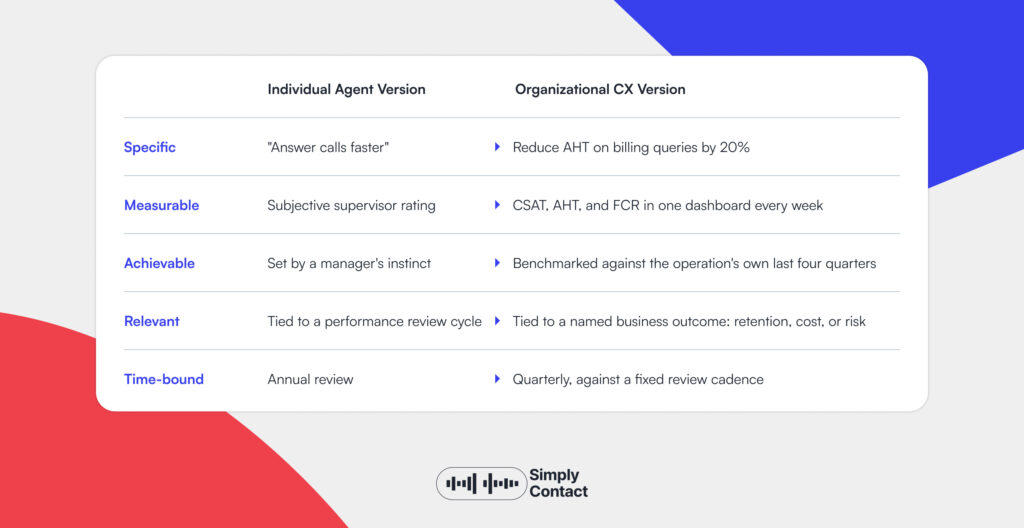
The SMART framework, Specific, Measurable, Achievable, Relevant, Time-bound, was built for individual performance reviews, but it adapts cleanly to organizational customer service smart goals when the targets are set at the operation level rather than the agent level.
| SMART element | Individual agent version | Organizational CX version |
| Specific | "Answer calls faster" | "Reduce AHT on billing queries by 20%" |
| Measurable | Subjective supervisor rating | CSAT, AHT, FCR tracked in the same dashboard every week |
| Achievable | Set by a manager's instinct | Benchmarked against the operation's own last four quarters |
| Relevant | Tied to a performance review cycle | Tied to a named business outcome: retention, cost, or risk |
| Time-bound | Annual review | Quarterly, reviewed against a fixed cadence |
Benchmarking before setting a target is the step most organizations skip. A CSAT target of 90% means nothing without knowing the operation's current baseline. Set the target 10 to 15 points above the trailing quarter's actual performance, not against an industry average that may not reflect the operation's channel mix or customer base.
Tying each goal to a business outcome keeps it from becoming a vanity metric. An FCR goal tied explicitly to "reduce repeat contact cost" gets funded differently than an FCR goal tied to nothing beyond "improve the number."
10 customer service goals and examples for CX leaders
These customer service goals examples cover ten measurable categories, spanning experience, efficiency, and risk, that most CX leaders need to track.
| # | Goal category | What it measures | Example target |
| 1 | CSAT | Satisfaction with a specific interaction | Raise CSAT from a baseline to a defined target within two quarters |
| 2 | First contact resolution (FCR) | Issues resolved without a repeat contact | FCR above 75% across all channels |
| 3 | Average handle time (AHT) | Time to resolve a contact, start to finish | Reduce AHT by 20-30% on the highest-volume contact types |
| 4 | Escalation rate | Contacts requiring supervisor involvement | Escalation rate under 5% of total volume |
| 5 | SLA adherence | Contacts answered within a target response window | 80% of calls answered within 35 seconds |
| 6 | Net Promoter Score (NPS) | Likelihood a customer recommends the brand | Move the detractor-to-promoter ratio by a defined margin per year |
| 7 | Cost per contact | Total operating cost divided by contact volume | Reduce cost per contact without dropping CSAT |
| 8 | Agent quality score | QA scorecard performance against defined standards | 90% average QA score across all scored interactions |
| 9 | Channel coverage | Response time and resolution consistency across voice, chat, and email | Equal FCR performance across every supported channel |
| 10 | Compliance and security incident rate | Regulatory or data-handling violations per period | Zero reportable compliance incidents per quarter |
CSAT goals show what's possible when a target is tied to a real operational redesign rather than a general aspiration to "improve satisfaction." Among these customer service goals examples, CSAT is the clearest case: Simply Contact's work with Ditto Music moved CSAT from 51% to 88% by rebuilding the support operation around the metric itself, not by asking agents to simply try harder.
The lesson generalizes beyond that one case: a CSAT goal only moves when the operation underneath it changes, staffing, scripts, escalation authority, not when the target number changes on a dashboard.
Setting compliance and continuity goals for regulated support operations
Travel, fintech, insurance, and healthcare support all carry regulatory exposure that speed and satisfaction metrics don't capture on their own. A CSAT score of 95% doesn't mean anything if the same operation failed a PCI DSS audit last quarter.
Compliance and continuity goals for regulated operations typically cover three areas:
- Data-security incident goals. Zero reportable incidents per quarter is a common target, tracked against certifications like PCI DSS v4.0.1, ISO 27001, and ISO 27701 rather than a general security policy.
- Audit-readiness targets. The operation should be able to produce QA scorecards, calibration records, and corrective-action logs on demand, not scramble to assemble them when an auditor asks.
- Uptime and continuity targets. A defined delivery continuity number of 99.99% is a reasonable benchmark, tied to a documented business continuity plan rather than an assumption that outages won't happen.
Healthcare support carries HIPAA-specific goals around PHI handling, and fintech or insurance operations typically add fraud-detection and dispute-resolution targets on top of the standard KPI set. The common thread: a regulated operation's goals are incomplete without a compliance dimension, no matter how strong the CSAT and AHT numbers look.
Call center goals and metrics that roll up into customer service goals
Team and queue-level metrics don't exist in isolation. Call center goals and metrics like AHT, occupancy, and service level are the operational inputs that roll up into the organization-wide customer service goals a CX leader reports to the business.
A queue-level AHT target only matters because it feeds a company-level cost-per-contact goal. An occupancy target only matters because understaffed queues break the SLA adherence number leadership reports upward. Treating call center goals and metrics as disconnected from the broader customer service goals is how a support operation ends up hitting every team-level target while missing the outcome the business needed.
Simply Contact's operation for Wizz Air shows this connection directly. Staffing built around the actual shape of demand, rather than a flat average, delivered a 30% reduction in average handle time on key contact lines. That queue-level metric rolled up into a measurably faster, lower-cost passenger support operation overall, not just a better-looking dashboard number.
Common mistakes that undermine customer service goals
Four common mistakes undermine even well-intentioned CX goal programs. Ask these as direct questions to a support team or outsourcing partner:
- Are we tracking too many metrics at once? A dashboard with 20 KPIs dilutes attention. Five to seven goals, each with a clear owner, beats twenty tracked loosely.
- Does every goal have a named owner? A goal with no single accountable person tends to drift until nobody can say whether it was hit or missed, a sign the underlying customer service department structure hasn't assigned clear ownership.
- Does the goal set ignore compliance and risk? Speed and satisfaction goals without a compliance dimension leave regulated operations exposed no matter how good the CSAT score looks.
- Is there a fixed review cadence? A goal reviewed once a year can't catch a problem that started three months ago.
How to track and review customer service goals over time
A working review process runs on two layers: a live dashboard for day-to-day visibility, and a scheduled review cadence for decisions about whether targets need to change.
Monthly reviews catch operational drift early, a creeping AHT increase or a slipping FCR rate, before it becomes a quarterly miss. Quarterly reviews are where targets themselves get revisited: is the current CSAT target still realistic given a shift in customer mix or channel volume?
Targets should move when the underlying business changes: a new channel launch, a volume spike, an acquisition that changes the customer base, not stay fixed simply because they were set at the start of the year. A goal that never gets revisited stops measuring anything useful within a few quarters.
How an outsourcing partner helps you hit customer service goals faster
Building a CX operation capable of hitting CSAT, AHT, FCR, and compliance goals simultaneously takes years to develop in-house: the scorecards, the staffing model, the certifications, the calibration process between QA and compliance teams.
An outsourcing partner that has already built this infrastructure across other clients compresses that timeline. Simply Contact runs five EU delivery centers, holds PCI DSS v4.0.1, ISO 27001, ISO 27701, GDPR, and HIPAA-aligned certifications, and has demonstrated outcomes on both sides of the KPI set: the Ditto Music CSAT improvement from 51% to 88%, and the Wizz Air AHT reduction of 30%.
Those aren't abstract capabilities. They're proof that the same call center outsourcing services model can move a satisfaction goal and an efficiency goal at the same time, without trading one for the other. For CX leaders comparing that path against building from scratch, the tradeoffs mirror the broader question covered in our breakdown of in-house vs outsourced call centers.
Conclusion
Durable customer service goals combine three dimensions at once: speed, satisfaction, and compliance. An operation optimized for only one of them looks good on a single dashboard and fails the business in a way that dashboard never shows.
If your current goal set is still built around speed alone, talk to Simply Contact about setting and hitting customer service goals that survive real operational pressure.

Newsletter
Subscribe
Subscribe to our newsletter to receive valuable industry insights and the latest research reports.