



Article
Customer Service in Healthcare: A Complete Guide
Customer service has a great impact on a brand’s reputation: according to the recent report, 78% of patients decide whether to seek future care based on their experience. Respectful communication and relevant assistance can significantly simplify and improve any visit or call to the healthcare center. It increases patients’ loyalty and trust, confirming that the facility will provide all necessary help and understanding when the customers need them the most. This is why customer service is important in healthcare and requires special attention and effort.
At Simply Contact, we partner with healthcare providers as an outsourcing customer service company. Today, we will share our insights on how to enhance service quality in this area. We will review key elements of effective patient care and highlight challenges that you can face in hospitals and clinics. Here, you can find a few recommendations for improvements and a simple checklist to assess your support team's readiness.
What is customer service in healthcare?
Healthcare customer service extends beyond diagnosing and curing illnesses; it encompasses empathetic support and thoughtful assistance throughout the entire process. It includes interactions before, during, and after receiving medical aid. The service team creates a safe and positive environment where patients can feel heard and valued.
Entering or contacting a healthcare facility, patients may feel anxious and unsure of what to expect. Positive interactions with attentive staff may alleviate the fear and create a comfortable space for communication and further care.
Why customer service is important in healthcare
For patients, a healthcare visit is rarely just a transaction. It's tied to health, money, and sometimes fear, which makes the support experience around it carry more weight than in almost any other industry. Get it right and patients stay; get it wrong and they don't just leave quietly, they tell other people why.
Retention runs on trust more than convenience in healthcare. A patient who reaches a responsive, well-informed representative is far more likely to return for follow-up care and recommend the practice to family, while one who's left on hold or given conflicting information starts looking elsewhere, often mid-treatment plan. That's a different kind of churn than a retail brand deals with: it can mean a patient delaying or skipping care entirely.
Customer service healthcare organizations invest in also shows up directly on the balance sheet. In the US, HCAHPS scores, the standardized patient-experience survey the Centers for Medicare & Medicaid Services (CMS) uses, feed straight into the Hospital Value-Based Purchasing program, tying a meaningful share of Medicare reimbursement to how patients rate communication, responsiveness, and discharge information, not to clinical outcomes alone. Low scores mean lower reimbursement and a public rating that's visible to every patient comparing providers.
There's a compliance angle too. Patient customer service interactions routinely touch protected health information, eligibility details, and consent, so the same interactions that build or break trust are also the ones regulators scrutinize most closely. A support team well-trained on both empathy and Health Insurance Portability and Accountability Act (HIPAA) requirements does double duty: it protects the patient relationship and the organization's compliance posture at the same time.
Key elements of effective patient customer service
Interaction with a healthcare facility triggers stress for the patient, and the customer service agent’s mission is to reduce that stress and not add to it. For instance, they can ensure responsiveness via prompt replies to queries through emails, phone calls, or any other contact channels.
Service agents need to consider the preferences and unique needs of each patient to develop an effective and appealing communication style. For example, they often have to explain complex medical procedures in simple words, cutting the overloaded medical jargon.
By addressing complaints and concerns, customer support agents can build trust with patients and raise satisfaction. Active listening and responsiveness demonstrate the company’s commitment to delivering high-quality care, built on respect and support.
Challenges in delivering quality customer service in healthcare
Insufficient number of professionals
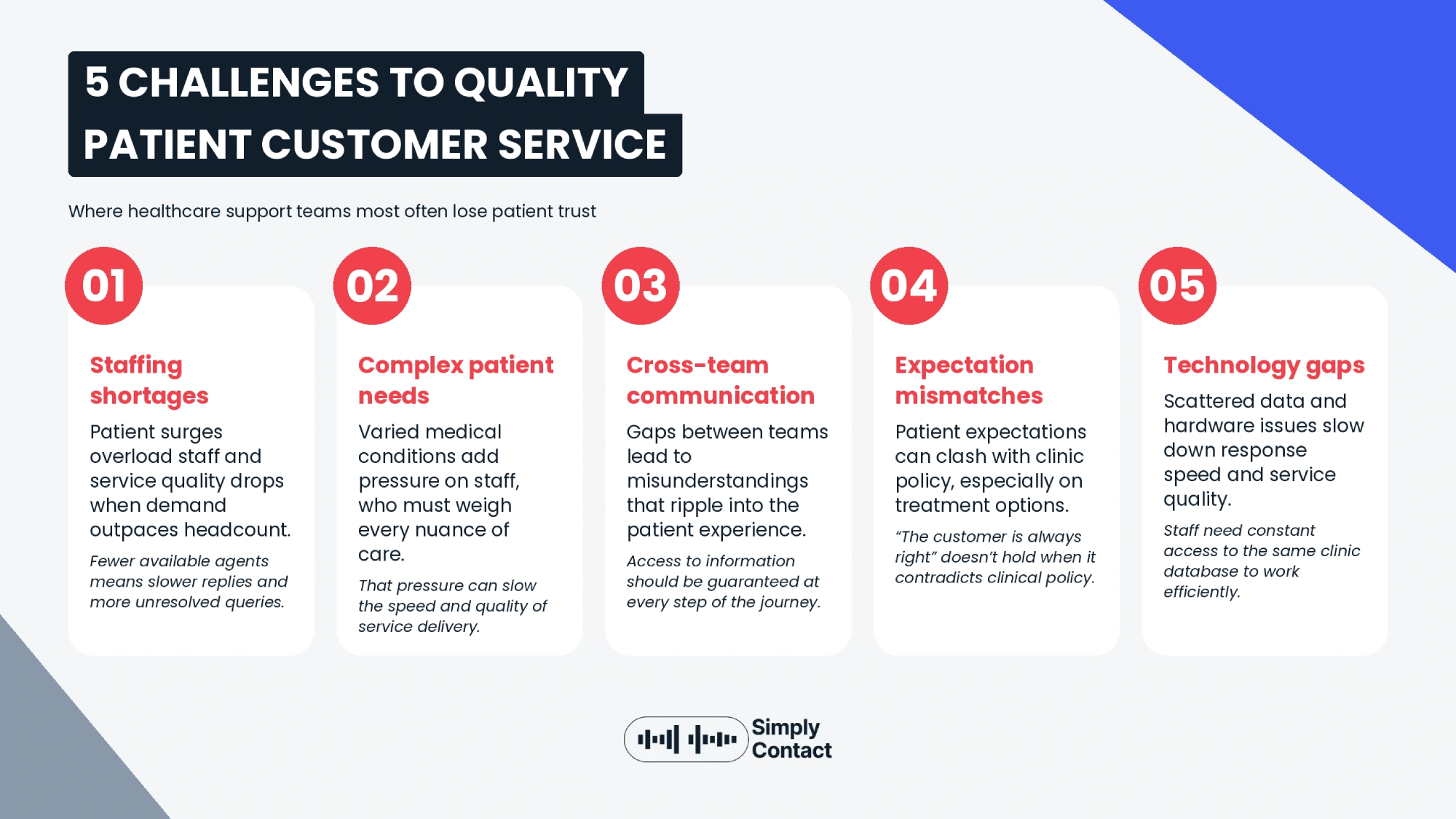
Staffing issues become most apparent during incidents when the number of patients grows. Employees can become overloaded, and the quality of services may decrease, leading to more unsatisfied patients due to their inability to receive prompt assistance.
Complex patients
Various medical requirements and patients’ conditions may cause additional pressure on the staff, who must consider all nuances to provide high-quality care. As a result, staff may struggle to maintain the speed and quality of service delivery.
Ineffective communication across teams
The lack of effective communication between teams may lead to misunderstandings and mistakes that will impact the overall patient experience. Effective communication and access to information should be guaranteed at every step of a patient’s journey.
Aligning with patient expectations
Aligning with patient expectations is not an easy task, especially when it comes to treatment options or the company’s limitations. The idea “the customer is always right” doesn’t work if it contradicts the clinic's policy or is a response to a patient's rude behavior.
Technological issues
The service team must be technologically equipped to provide effective and timely assistance. It includes using various software tools and maintaining constant access to all relevant information in the clinic database. Scattered data and hardware issues significantly reduce service speed and quality.
What healthcare providers often overlook about customer service in the medical field
In the medical field, one of the most common problems is that companies overlook the fact that patients are also customers. Not only do the results of treatment impact their experience, but the process itself also has a strong influence on their impression.
Value of communication
A clinic owner may think that good medical treatment speaks for itself, but in practice, the patients often judge the facility by how respected and reassured they feel. Understanding, calm explanations, and attention to detail have a great impact on the healthcare customer journey.
The role of non-clinical staff
Clinics and hospitals often focus on hiring the best medical staff but neglect investments in other positions, including customer service teams. However, receptionists and call center workers are the first to build the brand’s image and create a connection with new patients.
Lack of monitoring
In the medical field, it is more natural to track infection rates than to keep an eye on KPIs. However, we recommend regular monitoring to analyze and evaluate the callback times and first-resolution rates your clinic achieves, as well as the current patient satisfaction levels.

How to improve customer service in healthcare: Step-by-step
Drawing on our professional experience in healthcare customer service, we have developed a step-by-step guide that can significantly enhance service quality in your facility.
Step 1. Patient-friendly environment
Typical customer service is often focused on transactions, but in healthcare organizations, care must be prioritized. By encouraging empathy toward patients and cultivating emotional intelligence among staff, you can create a customer-centric environment where patients feel heard and understood.
Step 2. Hire professionals with relevant skills
If you want to provide high-quality customer service, you need to hire staff with care experience. For medical doctors, knowledge of medicine is a must; for customer service agents, soft skills such as active listening and a patient-centric approach are vital. Positive and clear communication can provide great support and reassurance to stressed and vulnerable individuals.
Step 3. Advanced technologies
High-quality equipment can simplify employees’ work and help organize the workflow better. For instance, automated solutions can reduce the amount of manual work related to ticket and email sorting. You can utilize artificial intelligence to offer patients a self-service option when they need answers to frequently asked questions or prefer automated booking.
Step 4. Analyze patients’ feedback
Feedback is the most available source of patients’ opinions and impressions from interactions with your facility. To improve customer service in healthcare, monitor patient satisfaction to evaluate the success of applied strategies. For instance, customer satisfaction (CSAT) surveys are effective when you need to check how happy customers are with service and analyze wait times.
Healthcare customer service training: building the right team
Generic customer service training doesn't prepare agents for healthcare. Real healthcare customer service training has to cover judgment under real stakes, not just tone: a script built for retail complaints falls apart the moment a caller is asking about a diagnosis, a denied claim, or whether a parent's transport to dialysis will actually show up on time.
Onboarding should cover both sides of the job from day one: healthcare-specific processes (intake, eligibility, escalation paths) alongside the compliance requirements that come with handling protected health information. HIPAA awareness isn't a policy to skim once; it needs to be built into how agents are coached on every call that touches patient data.
Scenario-based training matters more here than in most industries. Agents need practice handling distressed callers, delivering difficult news (a denied eligibility check, a delayed appointment) with empathy, and de-escalating without over-promising what the organization can't deliver. Regular knowledge checks catch gaps before they reach a patient, not after.
On Simply Contact's HATS Group account, for example, agents complete a structured mix of product knowledge tests, scenario-based modules on managing difficult and vulnerable callers, and account-specific compliance training, refreshed whenever a process or system changes. That structure is a large part of why the account has held close to zero agent attrition since launch: the training gives agents the confidence to handle emotionally difficult calls without burning out.
Ongoing coaching closes the loop. Call reviews, calibration sessions, and refresher modules keep the team's knowledge current as regulations, systems, and patient expectations shift, rather than letting training quality decay after the first few months on the job.
Examples of healthcare companies known for outstanding customer service
To see how customer service impacts a healthcare center's reputation, we invite you to review a few real-life examples of companies that succeeded by investing in customer experience.
Healthcare companies that earned their reputation thanks to CX
Cleveland Clinic
Cleveland Clinic was founded in 1921 and now ranks among the best hospitals in the USA. This healthcare organization follows a highly patient-focused approach. Transparency and empathy play key roles in their service model.
The company offers virtual visits to improve patients’ access to medical help through remote consultations. They also launched a MyChart patient portal that contains information about medical records, lab results, and appointment schedules. Cleveland Clinic also created a team of patient experience advisers to collect feedback and address the concerns for further improvements and enhanced service delivery.
Mayo Clinic

Mayo Clinic is another healthcare provider well-known for its excellent service and patient-oriented approach. The clinic was founded in 1864 and has developed a culture of prioritizing well-being and satisfaction. Their personalized care plans are oriented to patients’ needs and adjusted to specific requirements. Multidisciplinary teams contain experts from various fields to develop the most efficient care and treatment plans.
Healthcare providers who transformed their service culture
Northwell Health

Northwell Health is the largest NY healthcare system that developed the Culture of C.A.R.E. strategic initiative. Here, C.A.R.E. stands for connectedness, awareness, respect, and empathy, which form the foundation of Northwell Health's care.
This healthcare provider implemented an advanced dashboard to track and evaluate the performance of each department based on patient metrics. It applies award programs to recognize employees who focus on exceptional CX and celebrate it via media and events. Northwell Health actively invests in staff training programs to develop its skills, including communication and patient engagement.
Scottish Rite for Children

Scottish Rite for Children in Dallas is a healthcare provider that completely understands and champions the importance of customer service in healthcare. Its primary focus is on orthopedic, arthritic, neurological, and learning disorders, but it also invests in developing compassion and excellence in patient services. For instance, the company conducts regular review sessions to evaluate results and continually works on improvement and sustainability plans.
Checklist: Is your healthcare company ready for modern patient service?
☑ Multiple communication and scheduling channels
☑ Clear and jargon-free explanations
☑ Personalized experience for each patient
☑ Staff trained in empathy, active listening, and de-escalation techniques
☑ Proactive problem-solving
☑ User-friendly patient portal with access to relevant information
☑ Advanced technological tools for the support team
☑ Self-service options for patients with FAQ
☑ Feedback monitoring and evaluation
When to outsource healthcare customer support
Not every clinic needs to outsource, but a few signals reliably mean the in-house team has hit its ceiling. Call volume that spikes around enrollment periods, flu season, or a new location launch and leaves patients on hold. Support hours that stop at 5pm while patient questions don't. A growing patient base that includes non-English speakers your current team can't serve without delay. Any one of these is a staffing problem; together, they're usually a sign it's time to bring in a partner built for healthcare volume.
Compliance is where healthcare outsourcing differs most from other verticals. HIPAA compliance means every agent handling patient data operates under access controls, audit trails, and breach-notification protocols audited to the same standard clinics themselves are held to, not a lighter external version of it. Simply Contact also holds ISO 27701 certification, the international standard for privacy information management, covering how patient data is handled, stored, and protected across the entire outsourced operation, not just the call itself.
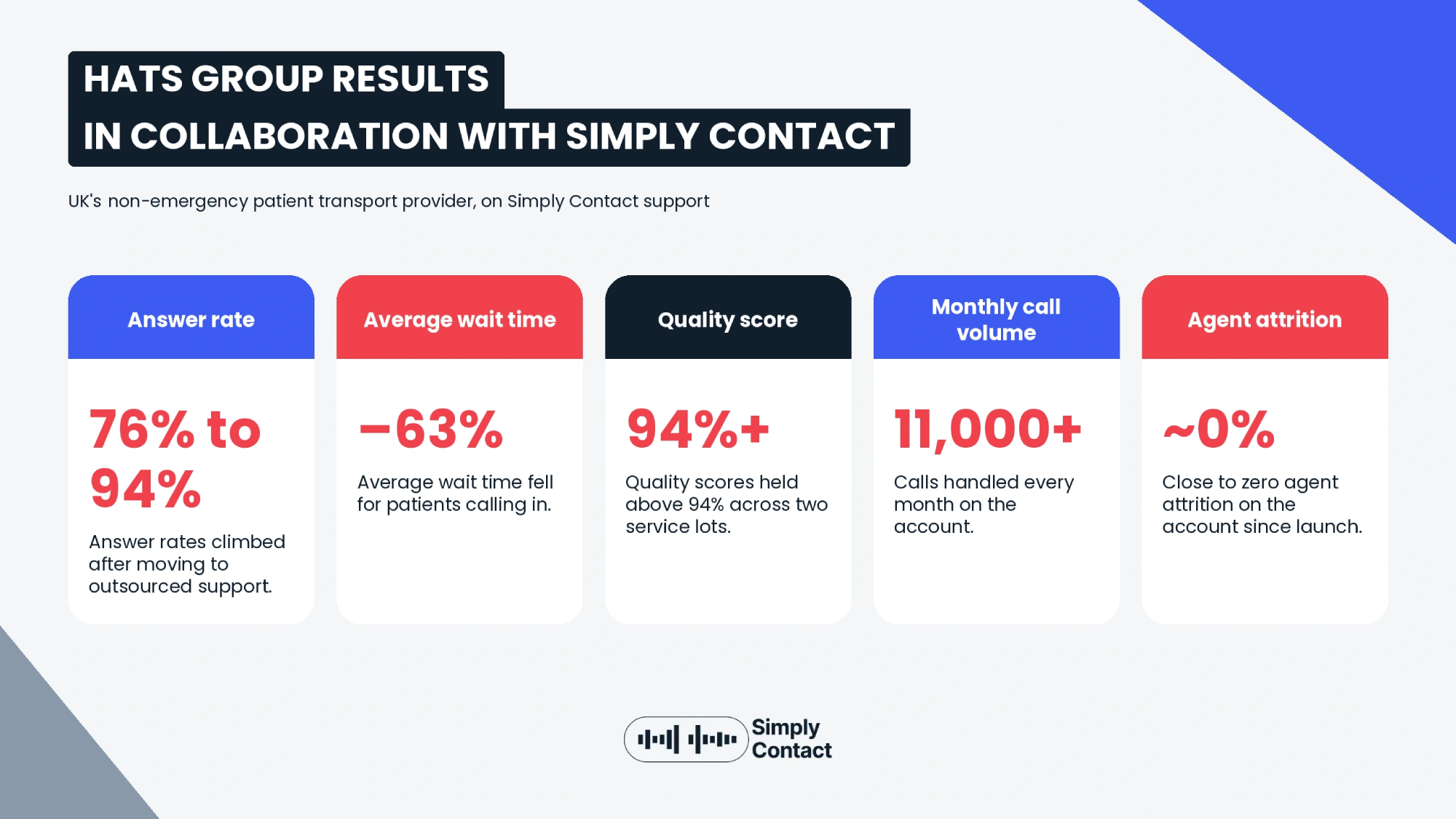
The clearest proof of what this looks like in practice is Simply Contact's work with HATS Group, the UK's largest non-emergency patient transport provider. Over the past year, answer rates climbed from 76% to 94% and average wait time fell 63%, while quality scores held above 94% across two lots handling more than 11,000 calls a month, with close to zero agent attrition on the account since launch.
Conclusion
As you can see, customer service in healthcare is not just another option but an integral part of the patient journey. Service teams create a positive impression of the company and build a bridge of trust with new patients. In their hands is the creation of a friendly environment, filled with compassion and understanding, where patients will feel safe. It can reduce stress and increase satisfaction, and patients who are positively impressed will return for care, trusting the facility with their lives.

Newsletter
Subscribe
Subscribe to our newsletter to receive valuable industry insights and the latest research reports.