


Article
Luxury Customer Experience: What High-End Brands Do Differently
In luxury, the product is assumed to be exceptional. Customers paying $3,000 for a bag or $500 for a skincare set have already decided the product is worth it. What they're evaluating, often without articulating it, is whether the experience of buying and owning that product matches the brand promise.
That's where luxury customer experience is won or lost. A single poorly handled return, a generic email response, or an agent who doesn't know the product can erase years of brand equity in a single interaction. Luxury customers have long memories, high visibility (many are influencers, buyers, or networked in ways that amplify their experience), and no obligation to stay loyal when an alternative brand treats them better.
Luxury customer service is a different operating model built on anticipation, personal knowledge, and zero tolerance for the generic.
What makes luxury customer experience different from standard CX
The instinct is to frame luxury CX as standard customer service done better: faster responses, more polite agents, nicer language. That framing misses the point, and brands that operate from it consistently underperform their own positioning.
Luxury customer experience is a different operating model in four specific ways.
- Generic responses are not an option. A customer who contacts a premium brand about a delayed order and receives a templated "we're sorry for the inconvenience" response has just experienced a mismatch between what they paid for and what they received.
- Every interaction carries brand equity risk. The economics of luxury support are asymmetric. A single high-AOV customer who churns after a poor experience represents significant lost lifetime value. That same customer sharing their experience multiplies the damage. Premium customer service in this sector operates with that asymmetry in mind at every contact.
- Customers invest identity, not just money. Buying a luxury product is a statement about taste, status, or self-image. When something goes wrong, the customer's response carries emotional weight that a standard CX framework isn't built to handle. De-escalation requires genuine empathy, not just courtesy.
- Anticipatory service is the expected standard. The Ritz-Carlton's service model is the most cited example of this for good reason: their staff are trained to notice and resolve needs before a guest raises them. The operational translation for ecommerce luxury CX is proactive communication, informing a customer their order might be delayed before they check tracking, reaching out after a complex return to confirm it was received, flagging a product restock to a customer who previously enquired. Luxury customer experience is built on removing the moments where a customer has to ask.
Key elements of luxury customer experience
The operational pillars of high-performing luxury CX aren't abstract. They're specific design decisions that either exist in a support operation or don't.

- Hyper-personalization. This goes beyond knowing a customer’s name. Agents handling luxury customer service need access to purchase history before the interaction opens, what the customer has bought, when, what issues they’ve had, what they’ve previously been offered. Preferably, the agent handling an ongoing relationship is consistent: a customer who has spoken to the same agent twice shouldn’t be rerouted to a stranger on their third contact. Net-a-Porter has long been referenced for its personal shopping model, where high-value customers have named contacts within the brand; the support analogue is a dedicated agent who knows the account.
- Exclusivity signals. Dedicated phone lines for VIP customers, priority routing that removes queue time, and named agents who can be contacted directly—these are operational signals that tell a customer they're valued without saying it explicitly. The alternative contradicts every message the brand sends through its marketing.
- Proactive communication as standard. No surprises on orders, deliveries, or returns. If a delivery will be delayed, the customer hears from the brand before they notice. If a return has been received but the refund will take five days, the customer receives confirmation that removes the uncertainty. White-glove service in the communication layer means the customer is never left to wonder.
- Brand-consistent tone across every channel. A luxury brand's voice has to be consistent whether the customer is reading an email response, a live chat conversation, or a social DM. The gap between a brand's marketing voice and its support voice is one of the most common and damaging inconsistencies in luxury CX. Burberry's omnichannel model, which aligns in-store and digital brand voice explicitly, is a reference point for what consistent delivery looks like in practice.
- White-glove service as default. In luxury, white-glove service is the baseline standard applied to every interaction. What that means operationally is covered in detail in the section below.
Luxury customer service in ecommerce: specific challenges
High-end ecommerce adds operational complexity that physical retail doesn't face in the same form.
| Challenge | What Happens | Why It’s a Problem |
|---|---|---|
| High-AOV returns | Expensive items require insured shipping, careful handling, authentication | Standard return processes feel inadequate → customer anxiety and higher risk |
| VIP client recognition at scale | High-value customers enter standard queues | Lack of prioritisation undermines exclusivity and loyalty |
| Brand voice under pressure | Peak periods push agents toward speed over tone | Inconsistent or rushed responses damage luxury brand perception |
| Multilingual support & brand voice | Serving global customers across languages and cultures | Literal translations miss nuance → diluted brand identity |
| White glove after-sales service | Returns, complaints, and follow-ups define long-term loyalty | Requires skilled agents → high cost but critical for retention |
White-glove customer service: what it means in practice
White-glove customer service is a phrase that gets applied to almost any slightly elevated support experience. Used precisely, it means something specific: a support model where the customer's problem is fully owned from first contact to resolution, with no transfers, no repeated explanations, and no gaps in communication.
Operationally, what is white glove service in a support context?
It means dedicated agents assigned to specific client segments or individual accounts. It means VIP contacts bypass the queue entirely and reach a named agent or a priority line. It means when an issue arises, the agent who takes ownership of it sees it through, doesn't transfer it to another team and hope the handoff works. It means proactive outreach after a problem: the agent follows up to confirm the resolution held, without waiting for the customer to come back.
White glove customer service in practice also means the agent has the authority to act. A model where every non-standard resolution requires manager approval is standard support with a senior layer. The agent handling a high-value return or a sensitive complaint needs the ability to offer a goodwill gesture, expedite a process, or make a decision without escalating. That authority has to be designed into the operating model, not improvised case by case.
The Ritz-Carlton's $2,000-per-employee empowerment rule is the hospitality reference point. The ecommerce equivalent is an agent who can offer a complimentary next-day delivery upgrade, a partial refund, or a replacement shipment when the situation warrants it. The ceiling matters less than the existence of the authority.
How to scale luxury customer experience without losing quality
Scaling is where luxury CX most visibly fails. The brand builds a reputation on exceptional, personal service. Headcount grows. New markets open. Seasonal volume doubles. And the support experience that defined the brand at 10,000 customers becomes inconsistent at 100,000.
The tension is structural. Hiring agents who genuinely embody a luxury brand's voice and service standards takes time. Training them takes longer. Doing that at the speed most growing luxury ecommerce brands need is where the model breaks.
White glove service at scale requires three things:
- Agent training built around brand voice. The difference between an agent who sounds like the brand and one who sounds like a call center is in the specificity of the training. What does this brand’s tone sound like? What phrases would never appear in a response? What judgment calls does the brand want agents to make independently? These questions have to be answered in writing, tested in role-play, and reinforced through ongoing quality assurance (QA).
- QA as a continuous operational process. Spot-checking is how quality is monitored at scale in standard operations. In luxury CX, QA needs to cover a higher proportion of interactions and the feedback loop has to be fast enough to correct drift before it becomes a pattern. QA that produces a monthly report is not the same as QA that flags a tone issue and corrects it within the same week.
- Outsourcing as a system design choice. The brands that scale luxury customer experience successfully treat outsourcing as a way to access pre-trained, compliance-aware teams without building the entire operation from scratch. That only works when the provider has genuine luxury and premium sector experience: agents who have handled high-AOV returns, sensitive complaints, and VIP account management before arriving at your account. Outsourcing to a generalist provider and expecting them to absorb a luxury brand's standards through a two-day onboarding is how quality gets diluted.
Tips to build customer support strategy for luxury brands
Luxury brands cater to a market that demands top-notch products, and it's well-known that these brands consistently aim to raise their quality standards. However, providing luxurious customer service isn't limited to just offering expensive products priced in the hundreds or thousands of dollars.
Luxury brands, regardless of their size, can develop and execute a strategic customer support plan to deliver exceptional customer experiences. With this in mind, here are some key customer service tips and practical strategies that luxury brands ought to consider:
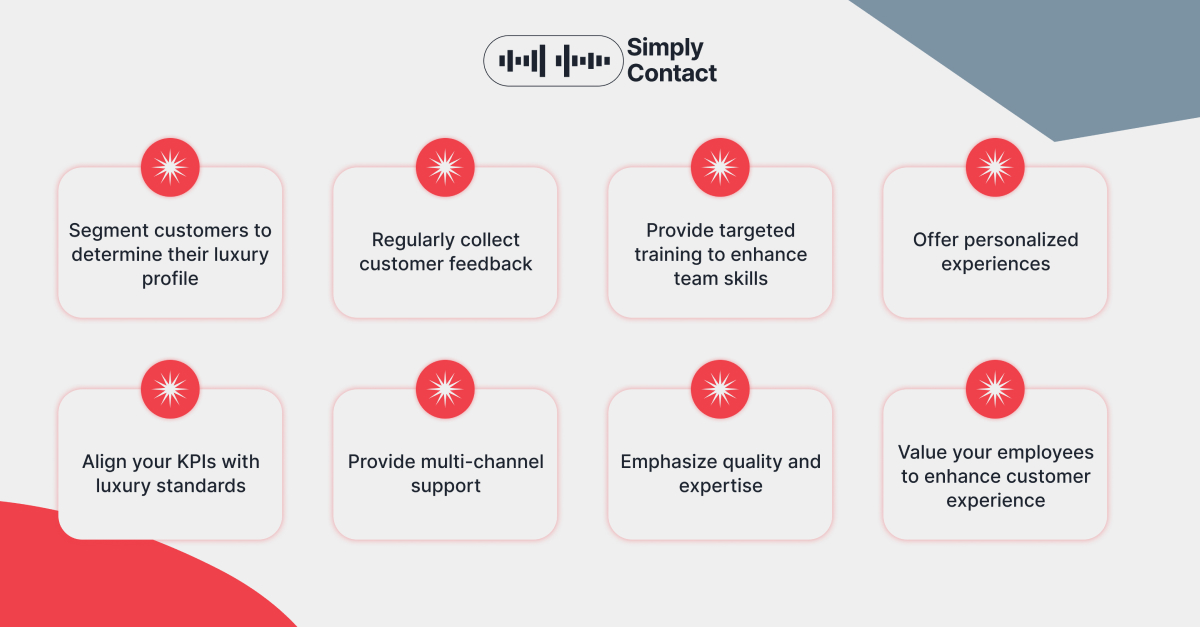
Regularly collect customer feedback
What matters most is how your customers view your business, not just how you think they should. The key is to ask many questions.
Use customer surveys to collect feedback on customer satisfaction, experiences, and brand recognition. Also, ensure that customer complaints are promptly addressed and resolved, showing noticeable improvements.
Provide targeted training to enhance team skills
Understanding customers—their thoughts, behaviors, and preferences—is essential for your employees, just as it is for you.
Role-playing simulations and exercises are great ways for your customer support team to practice interactions, especially with VIP customers. Investing in customer service training programs can also significantly improve their skills.
It's important for employees to feel connected to their work. Having a clear purpose helps them relate better to their roles and customers.
Offer personalized experiences
Personalization is key in the luxury industry. Therefore, luxury brands must create a customer support strategy that allows agents to personally address customers, anticipate their needs, and tailor their interactions.
Collecting detailed information on customers’ purchase history and preferences is important to offer customized assistance and outstanding experiences. For most customers, the overall buying experience matters as much as, if not more than, the product or service itself.
Customers expect to feel special and valued when purchasing furniture or a car. An effective way to enhance luxury customer support is to introduce customer loyalty programs that offer various purchasing benefits.
Align your KPIs with luxury standards
The key performance indicators for the luxury market are distinct from those in other sectors. Luxury brands should focus on customer service metrics that are specific to the luxury market. These KPIs might include:
Index of expectations fulfillment
It's beneficial for luxury brands to understand customers' expectations before purchasing and then evaluate whether those expectations were met or exceeded.
Exclusive Event Satisfaction Score
Establish a framework for measuring luxury shoppers’ experience and perception.
Customer word-of-mouth value
Measure the influence of your current customers' recommendations on attracting new customers and generating additional sales.
Purchase Exclusivity Index
Determine the ratio of limited-edition or exclusive items a customer buys in relation to their total purchases.
Provide multichannel support
Customers across all industries value businesses that listen and address their concerns as if they were their own. At Simply Contact, we take this to heart by providing omnichannel customer support, ensuring that no matter how customers choose to reach out, they're heard and assisted promptly and efficiently.
Social media is a powerful tool for luxury customer service, allowing businesses to hear what their customers are saying and respond quickly. Replying promptly to tweets, reviews, and comments online is one way to show you're there for your customers.
But don't stop at social media. Offering support through live chat, email, and phone calls is crucial, especially in the luxury market, to meet the varied communication needs and preferences of your customers. Remember, it's essential to maintain consistent response times and quality of service across all these channels.
Emphasize quality and expertise
Luxury brands should remember that their customers expect top-notch quality and expertise in both their services and products.
It's essential to have a customer support team that is knowledgeable about your brand's high-quality materials, products, heritage, and craftsmanship. They should have this information readily available and be capable of providing detailed answers to any customer inquiries.
Value your employees to enhance customer experience
A great customer experience for luxury brands starts with how they treat their employees.
Empowering your staff and treating them with the same respect and consideration as your customers will motivate and appreciate them. This positive attitude will be reflected in their customer interactions, contributing to a superior customer experience.

How Simply Contact supports luxury and high-end ecommerce brands
Simply Contact’s approach to luxury and premium ecommerce support is built on the specific requirements that distinguish this sector: brand-voice agent training, not generic customer service scripts; multilingual delivery from European centers for language and cultural alignment with EU luxury customers; PCI DSS compliance for handling high-value payment interactions; and QA practices recognized at industry level.
The advisory board includes senior CX leaders from Zalando, FREE NOW, and Grammarly, brands that operate at scale with high service standards. That network informs how Simply Contact designs support operations for premium clients, rather than applying the same model across verticals.
If you're scaling a luxury or high-end ecommerce brand and the support quality isn't keeping pace, the conversation worth having is about operational design, what your current model is built for, and what it would need to look like to hold brand standards at the volume you're heading toward. Speak to the Simply Contact team about your luxury CX operation.
Conclusion
Many luxury brands are cautious about outsourcing customer support. The concern is legitimate. If your support partner treats every interaction as a ticket to close, your brand suffers. Generic BPOs are not built to deliver the VIP customer experience your clients expect or the white-glove service your brand promises.
Simply Contact operates differently. Our onboarding process is proprietary and deep: agents learn your product, your language, your client archetypes, and your service philosophy before going live. We build an anticipatory service model into every engagement: understanding your customers well enough to resolve needs before they escalate, not just respond after the fact. Our European delivery model brings cultural alignment and regulatory compliance that matters specifically for luxury clients and their customers.
Luxury-grade customer support can be outsourced safely. It requires a partner who understands that in this segment, how you say something matters as much as what you say.

Newsletter
Subscribe
Subscribe to our newsletter to receive valuable industry insights and the latest research reports.