



Article
What Is a BPO Call Center? Definition, Benefits, and Best Practices
As customer operations grow more complex, many businesses reach a point where building every support function in-house becomes expensive and difficult to scale. A BPO call center offers an alternative by providing trained teams, established processes, and technology through an external partner.
But BPO can cover much more than phone calls. Depending on the provider, companies can outsource customer support, technical assistance, back-office processes, multilingual service, and other operational tasks.
This guide explains how BPO call centers work, when outsourcing makes sense, the main advantages and risks, and what to look for when choosing a provider.
What is a BPO call center?
A business process outsourcing call center is a third-party service provider that will manage your customer communications and business processes as an outsourced contractor. A traditional call center focuses primarily on voice interactions, while a BPO provider can take responsibility for a broader mix of customer-facing and back-office processes.
When turning to a business process outsourcing call center, you can fully delegate technical support, customer experience operations, whole-process tasks, and even data entry responsibilities. At the same time, your BPO partner could set up an entire custom communications system just for you, with CRM, AI, chatbots, and other integrations.
BPO contact centers take things beyond regular voice support, offering advantages like:
- multilingual support
- 24/7 support availability
- access to trained professionals with relevant service and industry experience.
BPO call center vs. traditional call center
In order to understand which type of call center you need in your context, it’s important to know both the big and subtle differences. So let’s settle it.
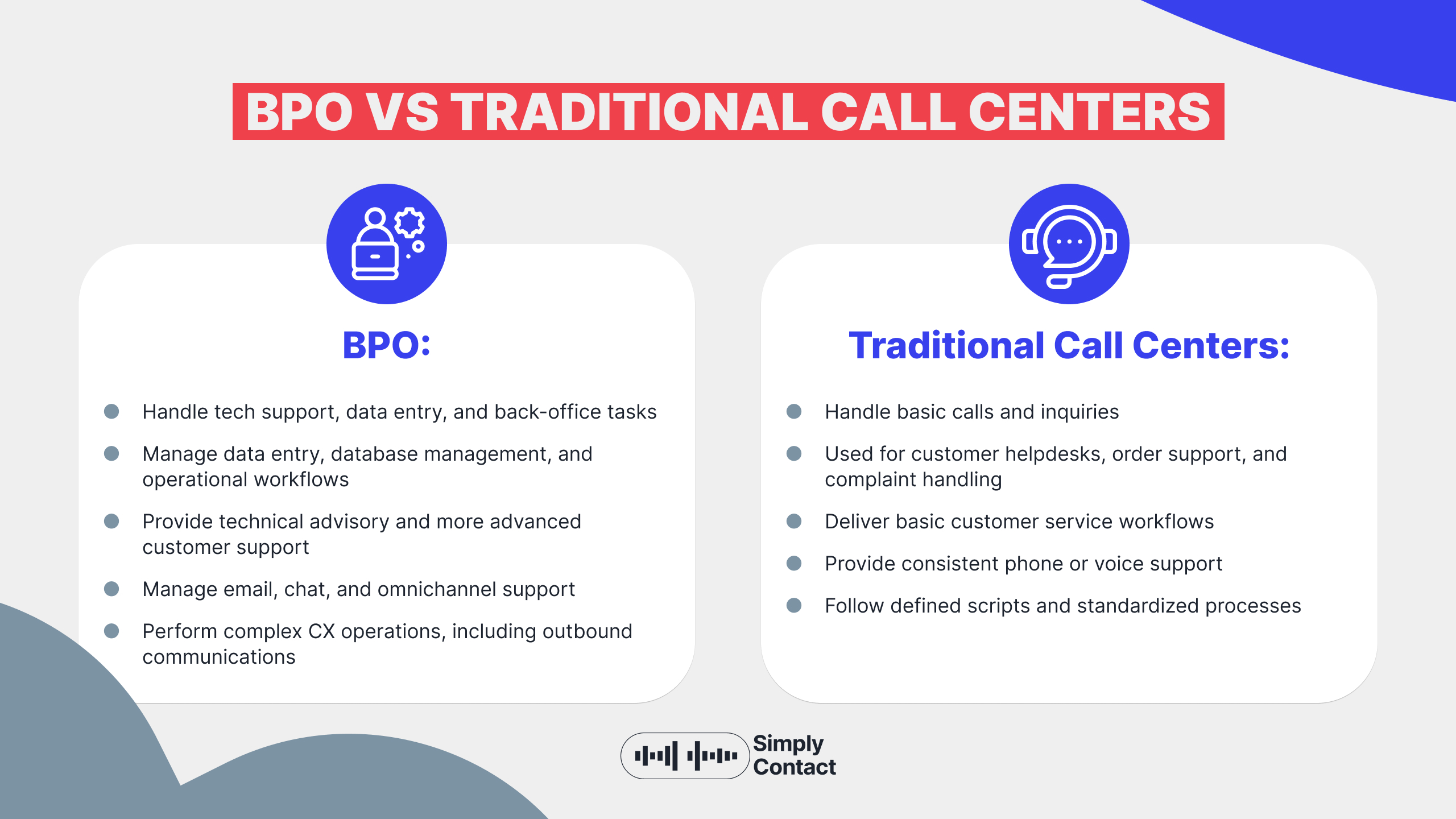
Call centers: basic calls and inquiries
Regular call centers are contracted for common tasks like customer helpdesks, order support, complaint handling, or basic customer service workflows. Their main objective is to provide consistent phone or voice support, addressing client questions or issues through defined scripts and processes.
BPO call centers: tech support, data entry, and CX operations
BPO call centers are more feature-rich, if you will. They are outsourced centers that run back-office tasks, handle data entry or database management, provide technical advisory, manage email/chat support, and perform complex CX operations (e.g., outbound communications and omnichannel troubleshooting).
How does a BPO call center work?
An average BPO contact center has an infrastructure, specialists, and technology in place to provide a fully integrated external support. Here’s how the business process outsourcing works once you decide to partner up with a BPO:
- Partner selection and onboarding: Companies usually search for BPOs that can fill their support crew gaps. A fitting BPO vendor will set up a workflow backed by service-level agreements and choose a tech stack for integration. That may include CRM systems, call routing software, and custom data-handling protocols.
- Agent training: The BPO provider immerses call center agents in the client’s products and brand tone, trains them with support scripts, and teaches them how to use specialized software.
- Day-to-day operations: The BPO handles inbound and outbound calls, live chats, and email support, as well as tech support, complaints and disputes, orders, and other customer interactions. They may also manage AI-driven chatbots or hybrid human-AI support flows for continuous or 24/7 support coverage.
- Performance monitoring and optimization: The CRM systems you connect provide AI analytics, dashboards, and performance metrics. The BPO can use that to monitor agent output and customer satisfaction, with insights to optimize over time.
Why you might need a BPO call center
There are several go-to reasons why businesses turn to a BPO provider in the first place. You may simply lack the resources or expertise necessary to set up support in-house. But even if you already house a support team, your company can scale its range of services and target audience.
As you scale and more customers come, each expecting top-notch individual service, a BPO agency can help actually meet and scale in line with that demand. More specifically, you’ll need BPO call center services:
- When customer volumes grow too fast: Rapid expansion or seasonal demand can overload in-house teams. BPOs allow unloading them by scaling on-demand, without recruitment hassle and additional infrastructure investments.
- When you need multilingual or around-the-clock support: BPO is helpful for servicing global or international customers. Globally enabled BPO providers have agents that cover multiple time zones and languages, staying online 24/7.
- When your team lacks CX expertise or AI tools: You can avoid integrating CRM systems, AI analytics, chatbots, and all the ensuing staff training. Instead of building an in-house support infrastructure, you can partner with a BPO and leverage their tech, managed by their experts.
- When you need to reduce costs without losing quality: Outsourcing can reduce operating costs when the delivery model, staffing, and quality controls are well matched to the business.
Types of BPO call centers
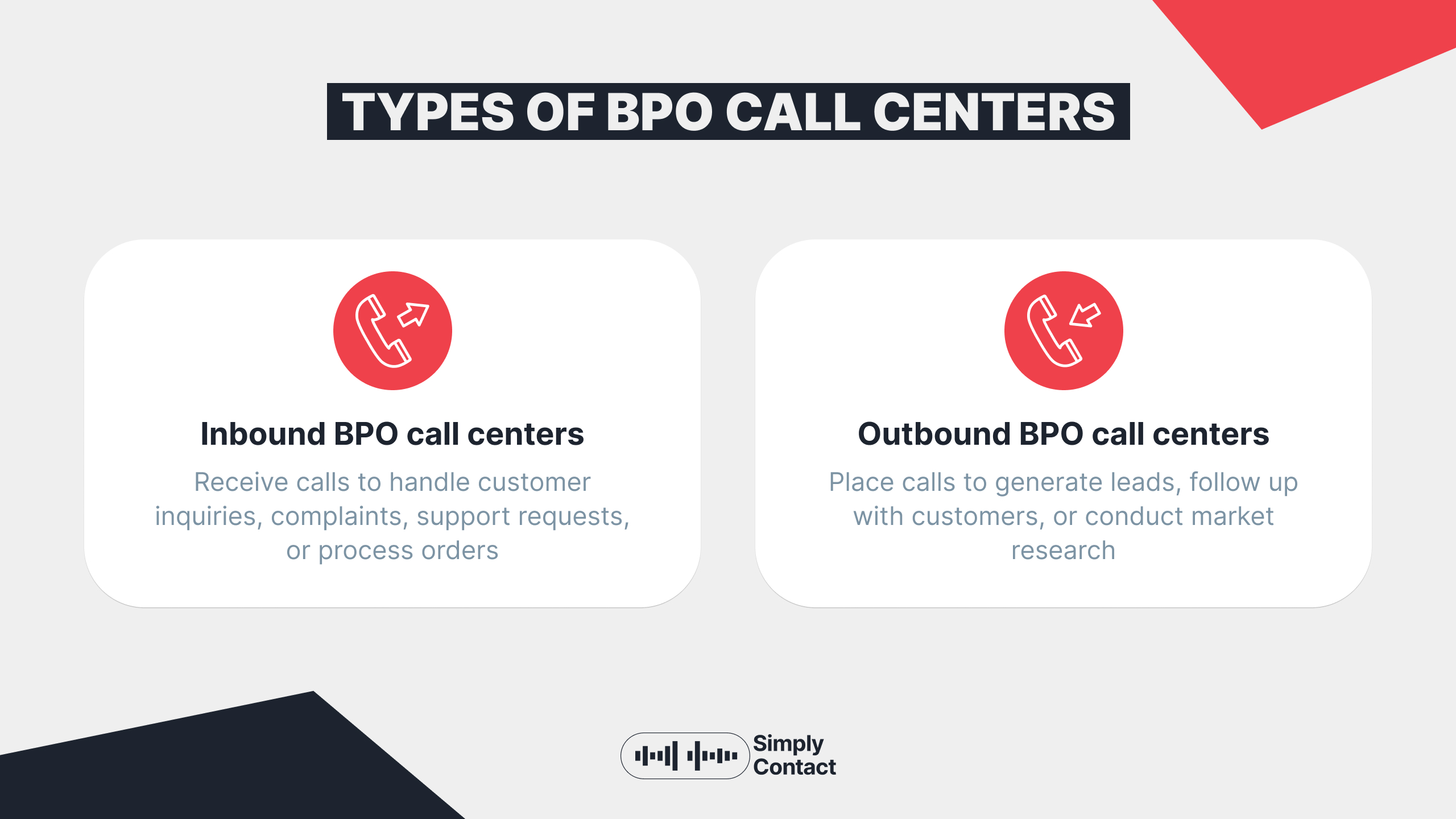
Contact center BPO responsibilities are adjusted to the client’s direct needs, so the providers are usually flexible and adaptable. But we can formally subdivide BPOs into two common types by the direction in which they can provide customer and back-office support:
Inbound call center
Handles customer-initiated contact: inquiries, complaints and disputes, support requests, order processing, service queries, technical support, returns, etc. A business usually wants to outsource to such BPOs when it struggles to handle inbound activity. For example, there can just be too many customer-facing communications coming from across multiple regions.
Outbound call center
Focuses on proactive outreach: sales calls, lead generation, surveys, customer feedback gathering, follow-ups, telemarketing, appointment scheduling, data collection, market research, and other outbound tasks. A business can leverage outbound BPOs to scale their marketing, sales, or outreach operations without expanding internal staff.
Considering inbound vs outbound call centers, note also that many BPO providers work both ways. These are full-cycle outsourcing agencies that service enterprises and can adjust to the client’s evolving needs.
Pros and cons of a BPO call center
BPOs are certainly useful and can even be business-transforming when employed correctly. But they are not for every business out there. You should pick a BPO partner ready to take your priorities, close your gaps, and achieve milestones for your business.
Now, let’s make it as objective as possible and answer not just what is a BPO call center and how it can help you — but also what its appeals and challenges are.
Pros
Cost reduction
Outsourcing to a BPO call center can be a major cost-saver, reducing overhead. No need to invest in infrastructure, hiring, training, or technology.
Scalability and flexibility
Businesses can scale operations up or down, recruitment-free, based on demand. For example, a BPO can be contracted during busy seasons or before scaling.
Access to trained professionals
BPO providers employ pre-screened agents with diverse expertise, and often provide ongoing training.
24/7 availability
With global staffing and operations across time zones, BPO call centers can offer round-the-clock coverage. This is essential for companies with international clients or users.
Enhanced customer satisfaction
A well-managed BPO operation can improve response times, resolution quality, and service consistency through dedicated staffing, training, and performance management.
Integration of AI-powered tools
BPOs leverage AI-powered tools, CRM systems, chatbots, and analytics to deliver faster, more consistent, and higher-quality support.
Cons
Loss of brand control
Business process outsourcing can block the direct oversight of customer interactions. If external agents fail to fully internalize your brand voice, tone, or company culture, inconsistent service may ensue.
Communication issues
Language barriers, cultural differences, or time-zone mismatches are common challenges and potential roots of misunderstandings. Offshore providers should be careful to match the cultural proximity of BPO staff.
Security risks
Hiring an outsourcing company may imply sharing customer data with a third-party vendor. If the BPO lacks strong data protection or General Data Protection Regulation (GDPR) compliance, this can expose the business to privacy breaches and regulatory risk.
Hidden or variable costs
While outsourcing promises savings, some unexpected costs can still hit, like additional training, overhead for complicated workflows, or quality audits. Overreliance on a vendor might also lead to vendor lock-in.
Inconsistent quality
Because agents aren’t your direct employees, maintaining consistent quality across time zones can be challenging. Especially if the BPO has high turnover or must process many clients simultaneously.

Best practices for your BPO call center
Outsourcing to BPO contact centers can help preserve costs while keeping in touch with customers and growing the value of your business — but only if done right. The BPO call center meaning can be different for new clients who turn to such services blindly and those who prepare with some know-how.
If you want to maximize the results of your turning to BPO services, there are a number of proven best practices that you should consider. Namely, make sure to:
Set measurable KPIs
To get visible results, you should first define exactly what you would like to see as a result of business process and customer service outsourcing. For this, you can use various performance metrics that will help you measure the efficiency of certain BPO aspects. The most common and explicit metrics that you can use include:
- AHT — average handle time:
- CSAT — customer satisfaction:
- FCR — first-call resolution:
- ART — average response time:
Maintain transparent communication between the client and the BPO team
To keep a hired BPO partner fully involved with your business specifics and well under control, be sure to prepare for regular check-ins, shared dashboards, and two-way feedback. This will help avoid miscommunication issues and stay on the same page in terms of performance metrics. E.g., clients can view live dashboards to monitor agent load and call resolution rates.
Leverage AI for monitoring and analytics
In a specialized call center, BPO processes are heavily tech-driven, with AI automation rapidly becoming the norm. Commonly, all tasks are centralized via CRM platforms, and their monitoring and management can be automated with AI tools. You should feel free to leverage all of these abilities.
Particularly, AI analytics helps get a real-time outlook on all BPO workflows and bring quality control to a much more sensitive, insightful level. AI can gather data autonomously and report your BPO’s performance metrics, summarize agent efficiency, and provide customer sentiment analysis.
Choose partners with multilingual expertise and GDPR compliance
Language compatibility is very important. A competent BPO provider should be able to service your target audience and consider regional and cultural specifics. If you work with foreign markets, it’s best to pick a provider with multilingual expertise and global support capabilities.
Security of data and interactions should be your next big priority. Check that the provider follows applicable data-protection requirements such as GDPR and maintains relevant security standards or certifications, such as the International Organization for Standardization (ISO) 27001 and the Payment Card Industry Data Security Standard (PCI DSS) where required.
Seek flexibility and scalability
One of the biggest advantages of outsourcing to a BPO is the ability to scale operations up or down depending on demand, without the burden of hiring, infrastructure, or fixed overhead. But for that to work, you will need a BPO partner that can quickly adjust staff levels and reshape the support team when required. Make sure to discuss this with your candidate at the stage of service-level agreements.
How to choose the right BPO partner
Selecting a perfectly fitting outsourcing partner requires careful vendor selection. Look for an agency with demonstrable experience, multilingual expertise, and established processes. More importantly, seek readiness to adjust to your tasks and workflow nuances. We adapt thanks to a powerful tech infrastructure, strict compliance standards, and years of delivering CX services globally.
BPOs: The next-stage contact centers?
BPO call centers give businesses a way to extend customer support and operational capacity without building every team, process, and system internally.
The model works best when outsourcing goals are clear and the provider is aligned on service standards, technology, security, and measurable performance. The right choice depends less on finding the largest provider and more on finding one that fits the complexity and scale of your operation.
FAQ
What does BPO stand for in a call center?
BPO stands for Business Process Outsourcing, which characterizes that a call center is not simply call or voice contact-oriented — it can also handle technological and overall more complex tasks. BPO contact centers can thus take up entire customer and tech support channels, handling all the communications and inquiries separately.
How does a BPO call center work?
Call center BPO outsourcing allows specialized external teams to take over parts of a company’s customer service or business processes. A business partners with an external vendor, and that vendor provides trained agents, tools, and infrastructure for calls, chats, and emails, as well as workflow support.
What’s the difference between a regular call center and a BPO call center?
What is a BPO call center if we compare it to a traditional contact center? The principal difference is that a BPO agency will also handle the day-to-day operations of its client, whereas regular call centers only work with calls and contacts. BPOs, in turn, allow outsourcing the ongoing management of customer interactions, technical support, and even certain non-voice back-office tasks.

Newsletter
Subscribe
Subscribe to our newsletter to receive valuable industry insights and the latest research reports.