



Article
European Airline CX Benchmark 2026
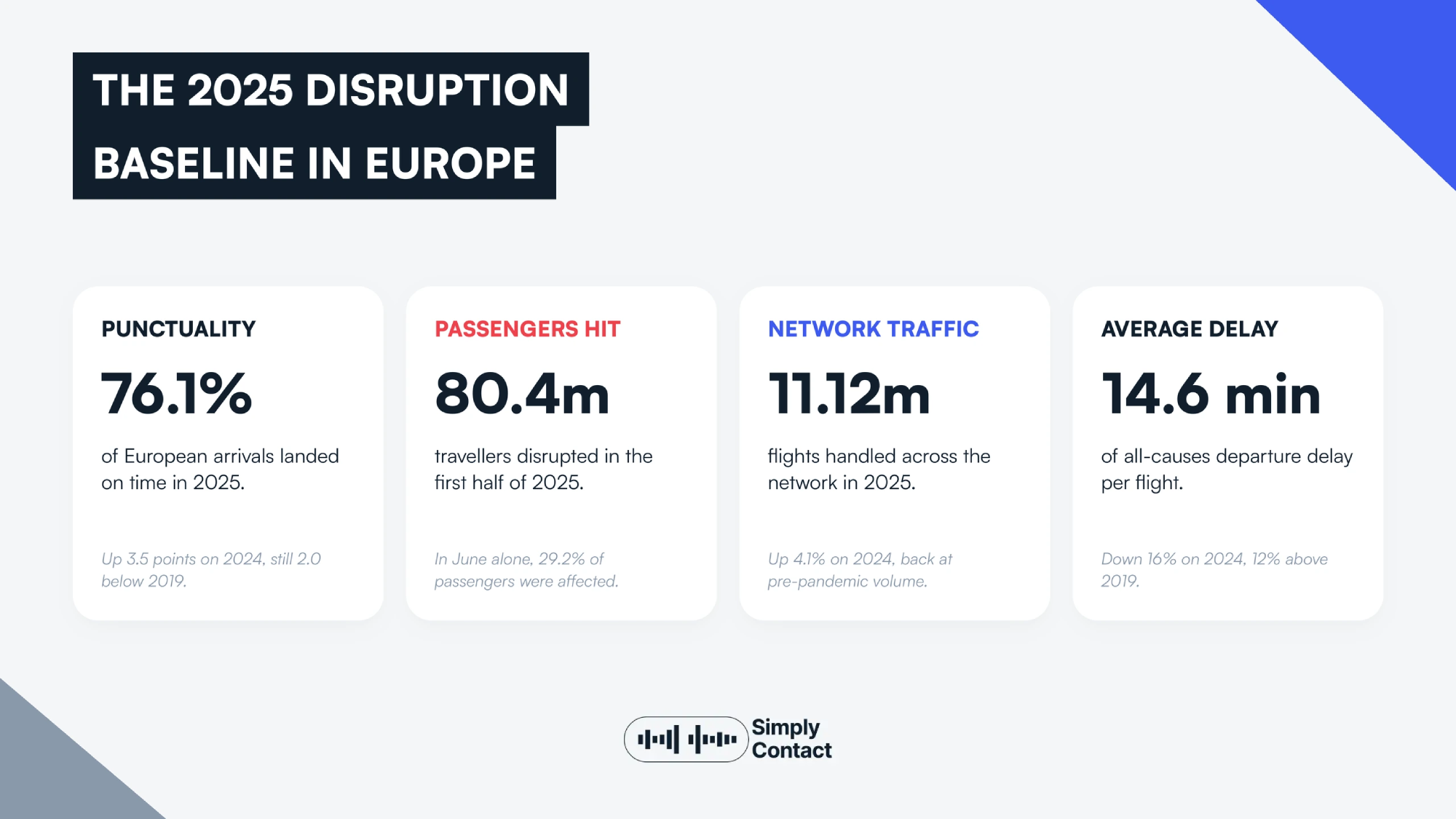
In the first six months of 2025, 80.4 million travellers in Europe had a flight delayed or cancelled. In June alone, 29.2% of European passengers were affected — close to one in three.
Those are not crisis numbers. They are the normal operating conditions of European aviation, and have been for several years running. Eurocontrol handled 11.12 million flights in 2025 and delivered 76.1% arrival punctuality, its best result since the pandemic. That still leaves roughly a quarter of scheduled arrivals landing more than fifteen minutes late.
This is the point most CX programmes get wrong. Disruption at this scale is not a service failure to be apologised for. It is a known, recurring, forecastable input into the support operation — and the airlines that hold on to passengers through it are the ones that treated it as an operational readiness question rather than a customer service one.
The European Airline CX Benchmark 2026 sets out what the disruption baseline actually is, what it costs, and what separates the support models that absorb it from the ones that buckle.
Airline customer experience trends: the 2026 baseline
Any airline customer experience benchmark starts with the operational reality the support function inherits, because that sets the floor on contact volume before anyone picks up a call.
Eurocontrol’s 2025 review puts the network at 11.12 million flights, up 4.1% on 2024 and back at pre-pandemic volume. Arrival punctuality reached 76.1%, up 3.5 points year on year and achieved while traffic grew. Departure punctuality was weaker, at 70.1%. Average all-causes departure delay fell 16% to 14.6 minutes per flight, though that still sits 12% above 2019. En-route ATFM delay fell 21%, to 1.7 minutes, still nearly double the EU-wide target of 0.9.
Against a decade rather than a year, that improvement reads differently. IATA’s December 2025 analysis found European ATFM delays rose 114% between 2015 and 2024 while flight numbers grew just 6.7%, taking total delay minutes from 14.2 million to 30.4 million. Staffing and capacity accounted for 87% of the 2024 total, and two states, France and Germany, for more than half of it.
That is the real shape of these airline customer experience trends: a good year on a decade of structural degradation. Disruption here is forecastable, which is exactly why it can be staffed for.
Punctuality and disruption by market
The network average hides a wide spread. AirHelp put the first-half 2025 disruption rate at 33.4% in Portugal and 31.1% in Greece, against 22.7% in Germany. Cirium’s 2025 rankings had Iberia Express top in Europe at 88.94%, ahead of SAS at 86.09%.
Passenger sentiment splits along similar lines. Qualtrics XM Institute’s study of 23,730 consumers across 23 markets put Dutch airline satisfaction at 73%, among the lowest it measured, against a global high of 90% in India.
Airline customer experience benchmark: the digital gap
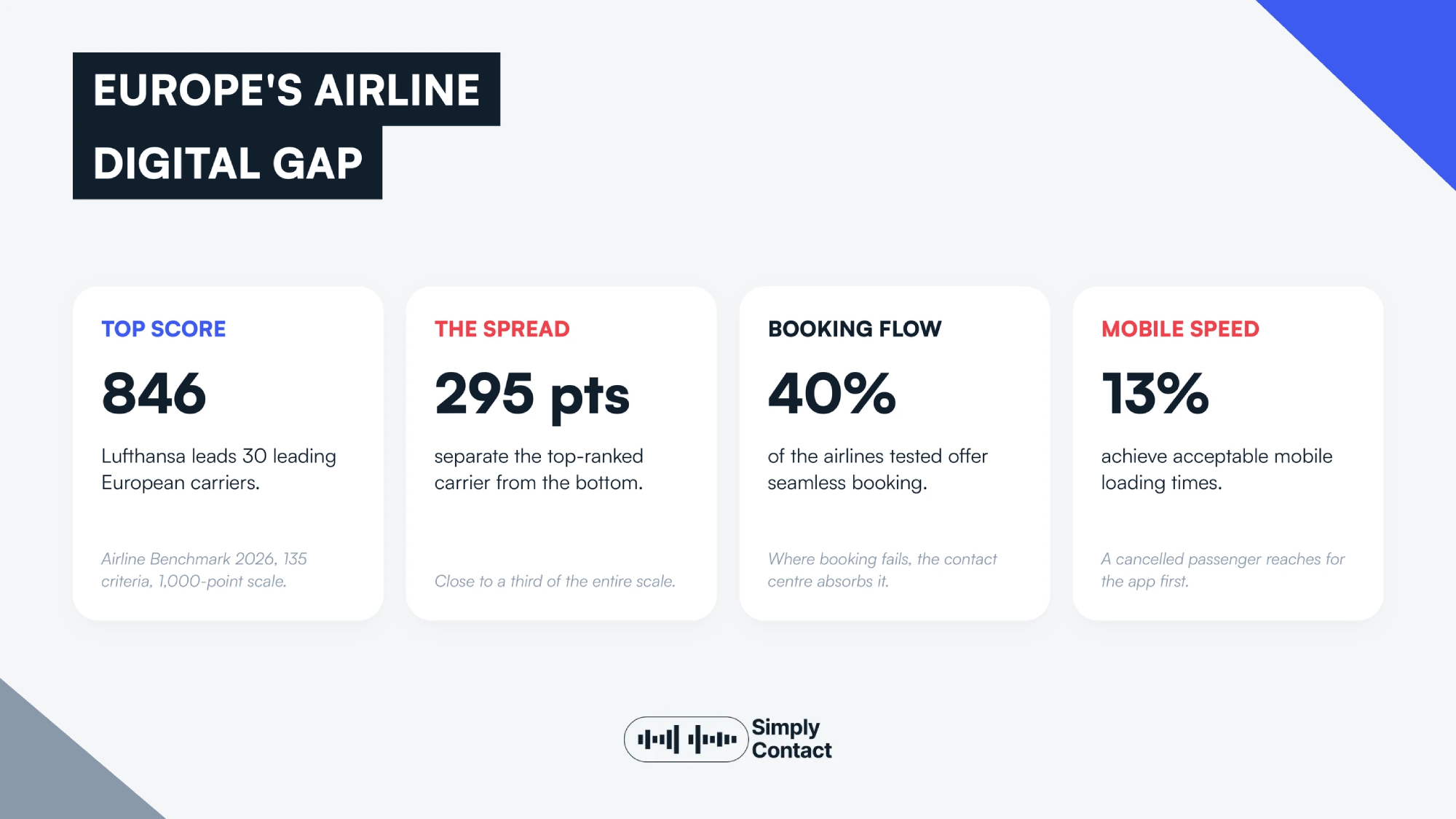
Service quality is now largely decided by an airline’s digital estate, and the spread there is wider still. The Airline Benchmark 2026, published by NetFederation with team neusta, tested 30 leading European carriers against 135 criteria on a 1,000-point scale.
| Rank | Airline | Score |
| 1 | Lufthansa | 846 |
| 2 | TUI fly | 797 |
| 3 | Norwegian | 796 |
| 4 | Iberia | 790 |
| 5 | Eurowings | 769 |
295 points separate the top-ranked carrier from the bottom of that list of 30, close to a third of the entire scale. Only 40% of the airlines tested offer a seamless booking process, and just 13% achieve acceptable mobile loading times.
That last figure matters more than it looks. A passenger whose flight has just been cancelled reaches for the app first; when the app is slow, the contact centre absorbs the demand.
What disruption really costs airlines
EC261 sets compensation at €250, €400 or €600 per passenger depending on distance, on top of duty-of-care obligations covering meals, accommodation and transport during the disruption itself. IATA estimates the regulation costs the industry around €8 billion a year.
Set that against the industry’s own margin. IATA’s December 2025 outlook forecasts a 3.9% net margin and $7.90 of net profit per passenger for 2026. One €600 payout consumes the profit on roughly 76 passengers.
The visible compensation bill is only part of the exposure. A European Commission study found that just 38% of eligible passengers manage to exercise their rights, and AirHelp’s data puts the share who ultimately receive payment at 22%. BEUC estimates airlines are sitting on around €3.2 billion that is owed but unpaid.
That gap is not a saving. It is deferred liability with two exits. It leaves as a claims agency filing on the passenger’s behalf, at a worse cost per case once legal and administrative overhead is added. Or it leaves as churn, from a passenger who concluded the airline had made claiming deliberately hard.
The reform closes the gap
In June 2026 the Council and Parliament agreed the first substantial revision of EU air passenger rights in more than twenty years. Compensation thresholds and amounts survive largely intact. The claims process does not. Airlines will have to acknowledge a claim immediately, respond within 30 days with payment or a justified refusal, and proactively tell passengers how to claim within four days of arrival. Standardised EU-wide forms become mandatory, and passengers get a nine-month window to file.
The rules apply from mid-2027. For any airline whose claims handling currently depends on friction, that is roughly a year to rebuild a process that will shortly be measured against a 30-day clock.
The cost nobody measures
Underneath the compensation line sits failure demand: contacts that exist only because something earlier went wrong or went unexplained. A passenger who cannot see their rebooking status calls. When the call is not answered, they email. When the email is not acknowledged, they call again.
Most airlines never see this, because contact volume gets reported as one number rather than split into demand the airline created and demand it did not. Splitting it is the most useful instrumentation a disruption-exposed support operation can add, and it costs nothing beyond the discipline of tagging.
Why recovery matters more than avoidance
No airline avoids disruption. Weather, ATC constraints and technical faults guarantee every carrier has a bad day. What varies is what happens next.
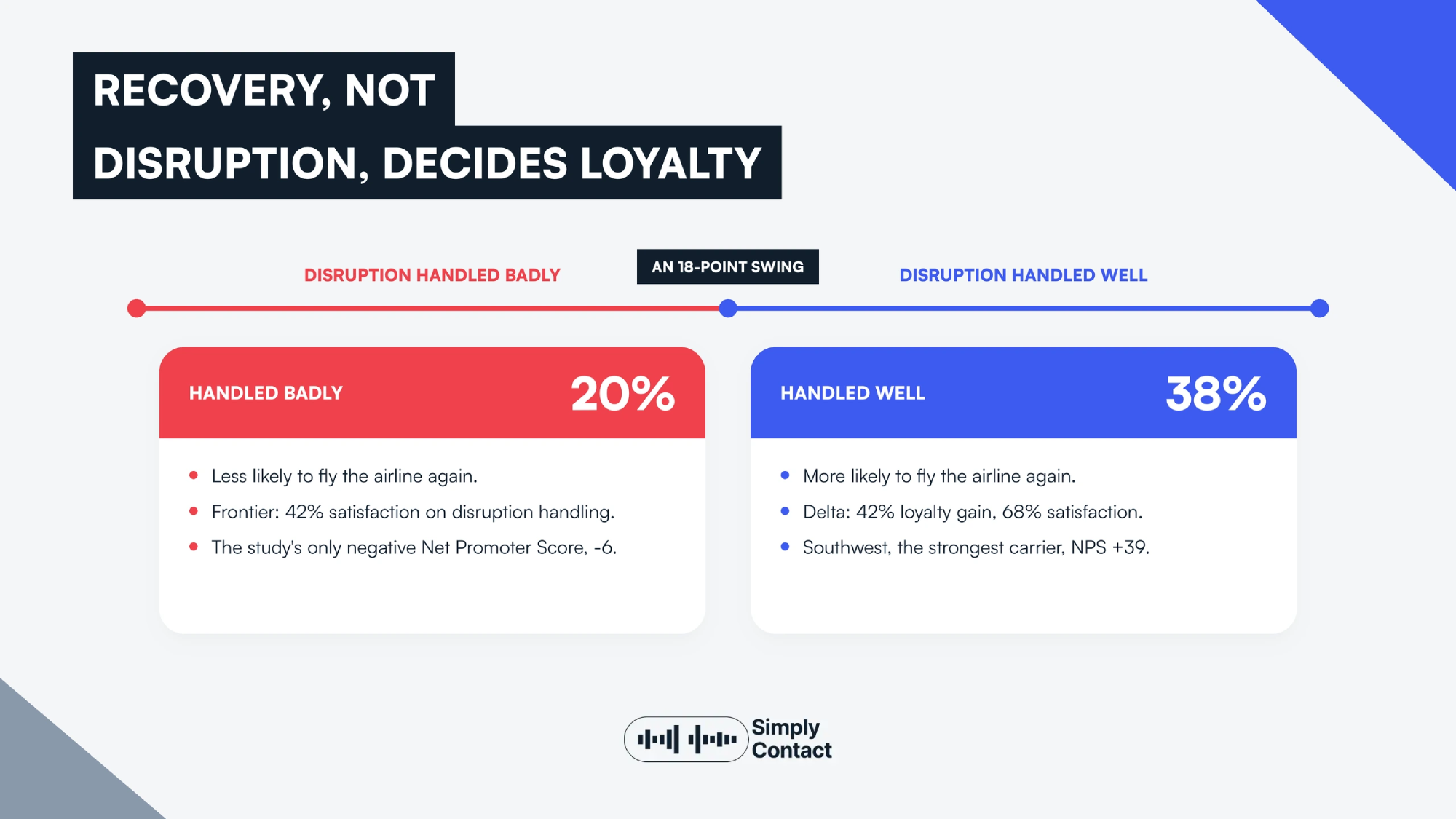
Sogolytics surveyed 1,014 travellers across the six largest US carriers for its 2026 CX rankings. Nearly a third, 32%, had experienced a delay of 30 minutes or more, a cancellation or a missed connection. Among those passengers, a well-handled disruption left 38% more likely to fly the airline again. A badly handled one left 20% less likely. That is an 18-point swing, created entirely by the quality of the recovery rather than the disruption itself.
The carrier-level detail sharpens it. Delta converted 42% of disrupted passengers into increased loyalty, with 68% satisfaction on disruption handling. Frontier managed 30% and 42%, and was the only carrier in the study with a negative Net Promoter Score, at -6, against Southwest’s +39.
Flight disruption customer service is the loyalty variable
This is why flight disruption customer service should be treated as a retention channel rather than a cost line. The passenger who has just been disrupted is the one whose next booking is genuinely in play. Very few other interactions in the airline relationship carry that weight.
The recovery window is also short. It opens when the passenger learns something has gone wrong and closes once they have made their own arrangements, usually within hours. Everything that decides the outcome happens inside it: how fast the airline made contact, whether the first person reached could actually change the booking, and whether the compensation position was stated plainly or buried. Recovery that performs on all three is rare enough to be a differentiator, as our review of the airlines with the best customer service found.
Broader satisfaction data points the same way. The American Customer Satisfaction Index put airlines at 76 in 2026, up 3% and close to an all-time high, with the largest single gain coming from a 15% improvement in the usefulness of flight information provided by airlines. The industry’s biggest satisfaction gain came from telling passengers what was happening.
Where the standard playbook breaks down
Most airlines answer disruption exposure with the same three moves, and each addresses a symptom rather than the system.
Hiring seasonal agents. Adding headcount for a forecastable peak scales the existing process, and it scales the failure demand inside that process along with everything else. Whatever share of contacts is avoidable stays the same share; the operation just works through more of it, with a less experienced cohort and a longer ramp.
Deploying a chatbot without escalation design. Self-service is not the problem. Self-service with no clean handover is. A bot that cannot resolve a rebooking and cannot hand off cleanly adds a step in front of a queue that was already the bottleneck, and it does it at exactly the moment the passenger has least patience for one.
Treating voice as pure volume. Passengers reach for voice when self-service has already failed them, which means the voice queue during a disruption event is a concentrated stream of the highest-value, highest-risk cases in the entire operation: stranded connections, compensation disputes, duty-of-care obligations. Staffing it on average handle time alone optimises the wrong variable.
The digital data in this benchmark shows how these compound. Only 13% of major European carriers hit acceptable mobile load times, and SITA reports that baggage tracking under IATA Resolution 753 has only just passed 50% industry adoption, with full compliance targeted for 2027. Roughly half of passengers still cannot answer “where is my bag?” without contacting someone. Every one of those contacts lands in a queue already carrying delay and cancellation traffic.
What connects all three mistakes is that each treats disruption as an exception. Seasonal hiring assumes the peak is temporary. A bot without escalation assumes most cases are simple. Volume-based voice staffing assumes calls are interchangeable. From our experience, none of those assumptions holds: disruption is annual, the cases that reach voice are the complex ones by definition, and the value of each interaction varies enormously.
What an operationally ready support system looks like
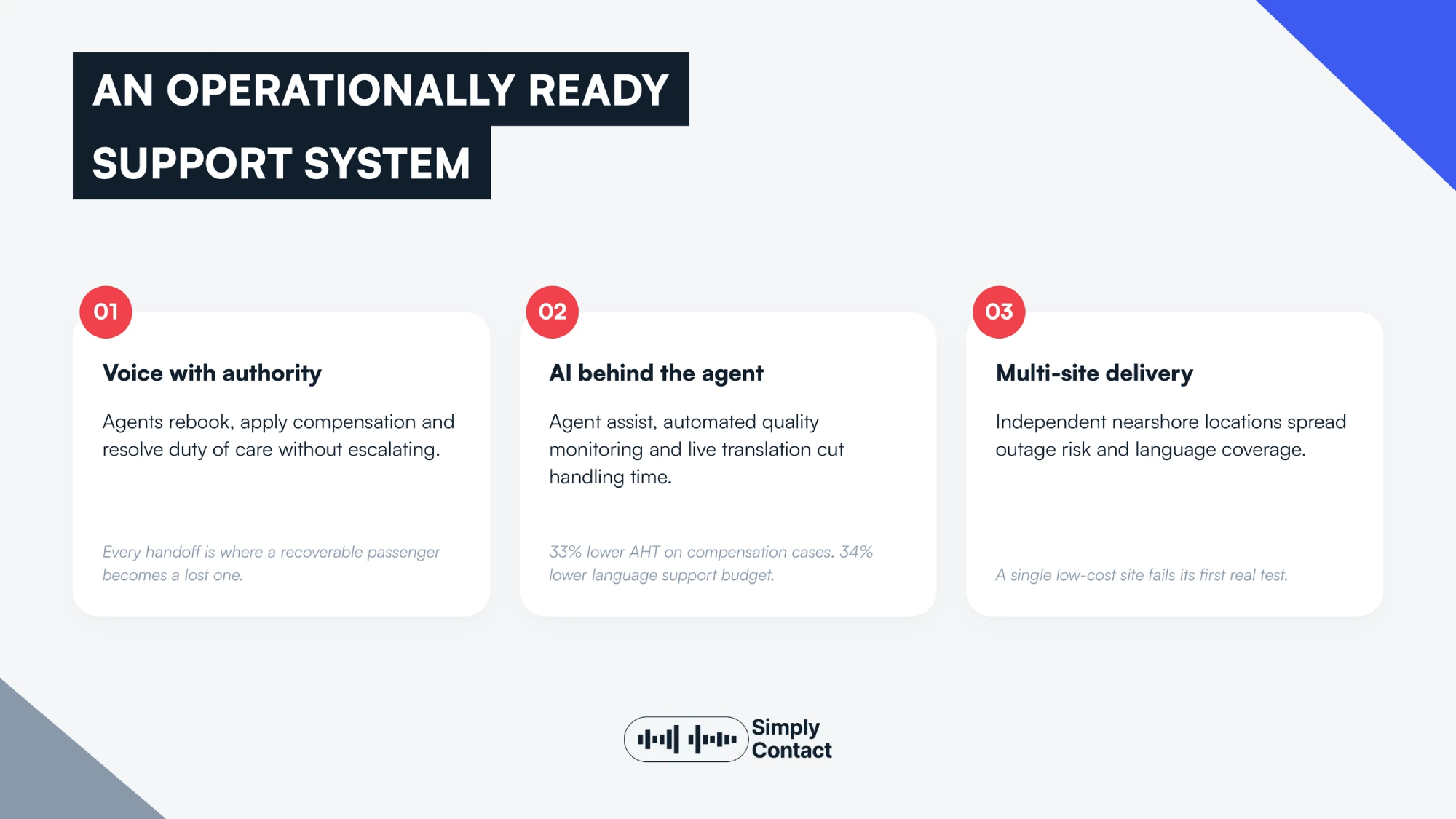
An airline support operation designed around the disruption baseline above is structurally different from one designed around a normal day. Three things distinguish it.
Voice as a controlled, high-stakes channel
Voice needs authority, not just capacity. An agent handling a disruption call should be able to rebook, apply a compensation decision within a defined range and resolve a duty-of-care question without escalating. Every escalation adds a handoff, and every handoff is where a recoverable passenger becomes a lost one. This is the core reason airline call center outsourcing decisions made on cost per minute tend to disappoint: the metric rewards the opposite of what recovery requires.
AI as assistive infrastructure
The models that hold up under load put AI behind the agent rather than in front of the passenger. Agent assist, automated quality monitoring and live translation cut handling time without removing the human judgement that compensation and duty-of-care decisions need. Robotic process automation applied to compensation case handling has cut average handle time by 33% in Simply Contact’s aviation work, and AI translation reduced one European airline’s language support budget by 34% while native speakers stayed on voice.
The distinction that matters in evaluating aviation BPO services is whether the AI layer is assistive or substitutive. A vendor proposing AI as headcount reduction is proposing to remove capacity from the exact channel that carries the retention risk.
Multi-location delivery as resilience
Single-site delivery concentrates disruption risk in one place. A regional outage, a weather event or a local infrastructure failure takes the whole support operation down with it, usually at the same moment it is taking flights down. Multi-site nearshore delivery across independent Central and Eastern European locations spreads that risk, and spreads language coverage with it, which matters for a passenger base running across dozens of markets. This is also why airline call center outsourcing built on a single low-cost site tends to fail its first real test, a point covered in our guide to setting up a contact centre for the travel industry.
Any aviation BPO service provider should be assessed on three questions: whether voice capacity flexes fast enough to absorb a peak of several times baseline volume, whether the AI layer is genuinely assistive, and whether delivery sits across enough independent sites to survive a disruption of its own. Airline contact center outsourcing and airline customer support outsourcing decisions made on rate card alone miss all three. Aviation customer service BPO done properly treats disruption readiness as the design constraint and lets cost efficiency follow from it.
Case in point: Wizz Air
Simply Contact has run Wizz Air’s customer support since January 2020. The operation covers 10 languages with over 120 agents handling around 6,000 calls a day, across voice, email, live chat, social, WhatsApp and app store reviews.
Two design decisions did most of the work. The first was bilingual recruitment — pairing Polish, French, German or Ukrainian with English so a single agent covers more than one market, which is what makes it possible to hold 85% agent utilisation across both peak and off-peak rather than carrying idle capacity through the winter. The second was blended channel routing: agents move between channels as real-time demand shifts, so a spike in voice during a disruption event pulls capacity from lower-urgency queues rather than from nowhere.
The operation was also staffed with domain depth at the top. Simply Contact placed a project manager with more than fifteen years of aviation experience on the account, which is what allows front-line agents to handle claims, crisis hotlines and complaint management rather than routing them onward.
The results: 80% of calls answered within 35 seconds, 95% of cases resolved within 30 days, and a 30% reduction in average handling time. Calls handled per hour rose from 9 to 11 overall and from 4 to 5 in the claims department. Abandon rate held between 5% and 10% through the seasonal swings.
The handle-time figure is worth reading carefully. It reflects cases being closed completely on first contact rather than agents being pushed to go faster — which is the difference between reducing cost and reducing failure demand. The partnership has now run for more than five years, across multiple disruption cycles.
European Airline CX Benchmark 2026: what it means for Heads of CX and COOs
The reframe this benchmark argues for is simple to state and harder to budget for. Passenger experience during disruption is not a service metric to lift. It is an operational readiness question, and should be resourced against how often disruption happens rather than how often anyone would like it to.
The 2027 deadline makes that concrete. A 30-day resolution clock and mandatory notification turn a diffuse liability into something measured, reported and enforced. Airlines with a claims process built on friction have about a year to rebuild it.
Three questions are worth taking into the next planning cycle:
- Does the current model treat voice as a controlled recovery channel or a generic queue?
- Is AI deployed as a safety net for agents, or as a headcount reduction with an untested escalation gap?
- And does delivery sit across enough independent locations to survive a regional disruption of its own?
None of them can be answered from a CSAT dashboard. They need contact data split by cause, the voice queue examined during a real disruption event rather than an average week, and an honest read on how much of last year’s volume the airline created itself.
Sources
- EUROCONTROL, European Aviation Overview — 2025 Review (January 2026): eurocontrol.int
- AirHelp disruption analysis, first half of 2025, via Aviation.Direct: aviation.direct
- Cirium, On-Time Performance Review 2025: cirium.com
- NetFederation / team neusta, Airline Benchmark 2026: airline-benchmark.com
- IATA, Airline Profitability Stabilizes with 3.9% Net Margin Expected in 2026 (9 December 2025): iata.org
- IATA, European Air Traffic Control Delays Double Over Last Decade (9 December 2025): iata.org
- BEUC, The Revision of the Air Passenger Rights Regulation (2025), citing European Commission study MOVE/B5/2018-541 and AirHelp (2023): beuc.eu
- Council of the EU, Council and Parliament reach landmark agreement on stronger EU air passenger rights (15 June 2026): consilium.europa.eu
- Euronews, Air passenger rights reform: what the new rules mean for you (21 July 2026), citing IATA and BEUC: euronews.com
- Sogolytics, CX Rankings: U.S. Airlines 2026: sogolytics.com
- American Customer Satisfaction Index, Travel Study 2026: theacsi.org
- SITA, Baggage IT Insights 2026: sita.aero
- Regulation (EC) No 261/2004: eur-lex.europa.eu
- Qualtrics XM Institute, Customer Experience in the Airline Industry by Country (2024): xminstitute.com
- Simply Contact, Wizz Air case study, Wizz Air partnership announcement and travel & aviation BPO services — internal operational data

Newsletter
Subscribe
Subscribe to our newsletter to receive valuable industry insights and the latest research reports.