



Article
BPO Trends in Financial Services: What’s Shaping Outsourced CX in 2026
Five years ago, the financial services BPO conversation was largely about cost reduction. Today it covers AI integration, regulatory compliance, data residency, and customer experience quality simultaneously. The companies planning outsourcing strategy for 2026 are working with a more complex picture than their predecessors did.
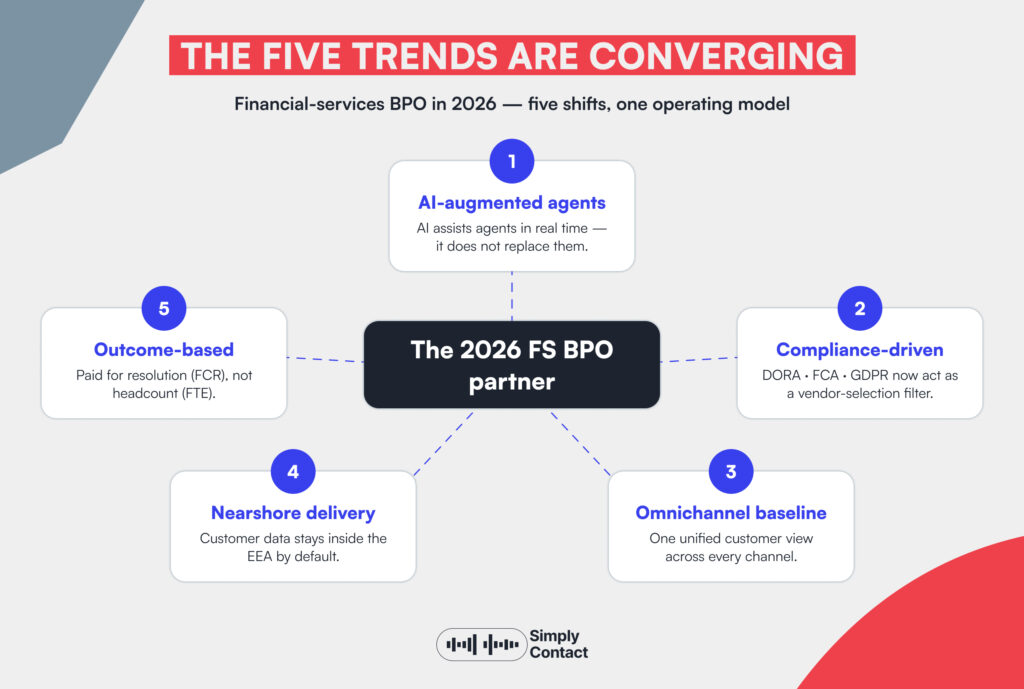
The BPO trends that you should be tracking right now cluster around five shifts: AI-augmented agents replacing pure automation plays, compliance becoming a vendor selection criterion rather than an afterthought, omnichannel CX moving from differentiator to baseline expectation, nearshore delivery gaining ground in European markets, and outcome-based contracts replacing FTE headcount models.
Each of these is already in motion. This article covers what each trend means in practice and what it should change about how financial services buyers evaluate partners.
Key takeaways
- AI-augmented agents, where AI assists humans rather than replacing them, produce better compliance and CSAT outcomes than full automation in financial services contacts.
- Regulatory tightening under DORA, FCA rules, and GDPR is making compliance infrastructure a BPO vendor selection filter, not a contract condition.
- Nearshoring is growing in European financial services because of data residency requirements, time zone alignment, and language coverage.
Financial services BPO: where the market stands
The global BPO market in banking and financial services was valued at approximately $328.37 billion in 2025 and is projected to reach USD 695.77 billion by 2033, growing at a CAGR of 9.9% from 2026 to 2033. This growth is driven by three structural pressures: rising in-house labour costs in Western markets, accelerating digital transformation that creates new contact volume, and a regulatory environment that requires documented compliance infrastructure most mid-market firms don't have internally.
The emerging financial services outsourcing trends are a direct result of those pressures. Cost reduction remains a driver, but it is no longer sufficient on its own. A provider who is 30% cheaper than the in-house alternative but cannot demonstrate FCA compliance documentation, ISO 27001 certification, or a working DORA third-party risk assessment is no longer a viable option for a regulated firm.
The BPO industry trends data for financial services specifically shows a split between legacy providers scaling on headcount and specialist providers building compliance and technology infrastructure. Mid-market banks and fintechs are increasingly choosing the latter, even at a higher per-seat cost, because the total cost of managing a non-compliant or technologically stagnant provider exceeds the premium.
BPO automation trends: AI-augmented agents in financial support

From an operational perspective, what we consistently see is that AI delivers the most value in financial services when it is embedded into the workflow, not layered on top of it. In practice, the strongest improvements come from using AI to support agents in real time, for example, through knowledge retrieval, guidance prompts, and quality assurance support. The key shift is consistency, accuracy, and auditability of decisions. In financial services, those factors often matter more than pure efficiency.
The BPO automation trends story in financial services is not about replacing agents with AI. It is about AI making agents faster, more accurate, and more consistently compliant.
The use cases that are producing measurable results now:
- Real-time compliance prompting. Agents handling regulated products like payment disputes, mortgage queries, insurance claims, receive real-time prompts when a conversation approaches territory that requires specific language or a mandatory disclosure. The agent makes the statement; the AI ensures they don't forget to make it.
- Sentiment detection and escalation triggers. AI monitors conversation sentiment in real time and flags contacts where customer frustration is rising toward complaint territory. The agent or supervisor can intervene before the contact becomes a formal complaint, which matters both for CSAT and for FCA complaint volume metrics.
- Knowledge retrieval. Rather than agents searching multiple systems mid-conversation, AI surfaces the relevant policy, product information, or account detail in real time based on the conversation content. Simply Contact implemented an AI knowledge management system that reduced agent questions to supervisors by 50%, lifted CSAT by 8%, and improved cost efficiency by 16%, without changing the underlying team structure.
- Post-interaction QA. AI scores 100% of interactions against the QA scorecard, flags outliers for human review, and produces trend data across the full contact population. The shift from 5% sample-based QA to full-coverage AI QA changes what compliance monitoring is actually capable of detecting.
What these use cases share: the human agent remains in the conversation. The AI removes friction and reduces error rate. For financial services contacts specifically, where a misstatement to a customer carries regulatory consequences, that division of labour produces better outcomes than pure automation.
BPO trends in financial services: compliance-driven outsourcing
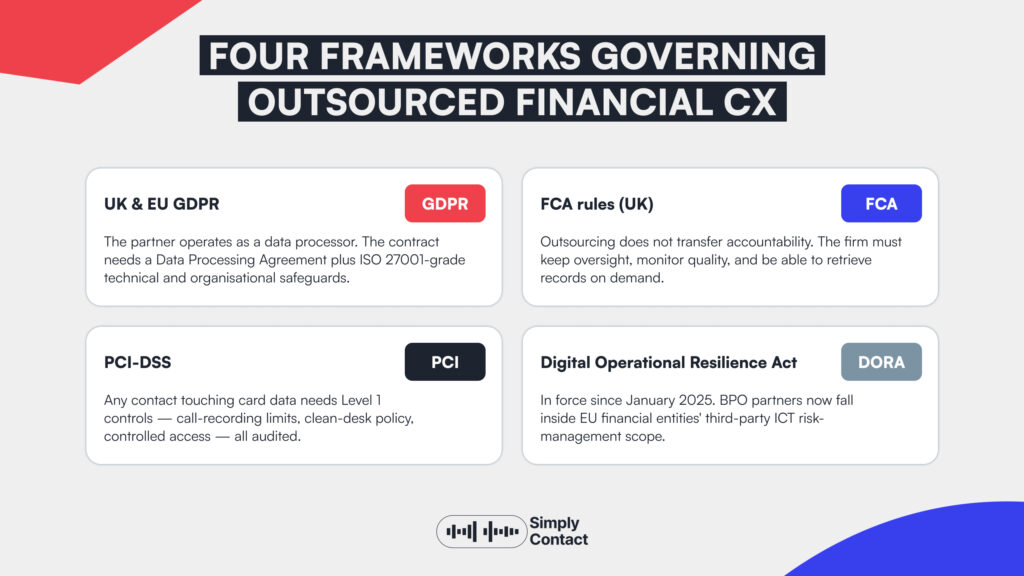
Compliance has moved from being a contract clause to a vendor selection filter. The BPO trends financial services compliance picture is being shaped by three regulatory developments.
- DORA (Digital Operational Resilience Act) came into force in January 2025 and requires EU financial entities to conduct third-party ICT risk assessments across their supply chain—including BPO providers who access digital systems or handle electronic customer data. For the first time, outsourcing a contact centre operation in the EU triggers a formal due diligence obligation with documentation requirements.
- FCA outsourcing rules in the UK require regulated firms to maintain oversight of third parties delivering services on their behalf, with documented audit access and the ability to retrieve data and transition away from the provider within defined timescales. The FCA has increased its scrutiny of outsourcing arrangements since 2023, and firms that cannot demonstrate adequate oversight have faced enforcement action.
- GDPR enforcement has hardened. The combination of stricter enforcement and the Schrems II legacy means that financial services firms with EU customers are actively choosing BPO providers based on data residency, specifically, whether customer data stays within the EEA rather than transferring to a jurisdiction requiring additional legal structures.
The practical result: providers who hold ISO 27001 and ISO 27701 certifications, operate PCI-DSS compliant environments, and can produce DORA-compliant third-party risk documentation are winning business that was previously price-competitive. Compliance infrastructure has become a moat for providers who built it and a barrier for providers who didn't.
Omnichannel CX has become a baseline expectation
The BPO industry trends around channel coverage have settled into a clear picture: a financial services provider that offers excellent phone support but inconsistent chat, no messaging app coverage, and slow email response is offering phone CX with other channels attached.
Customers move between channels within a single service journey. A customer who starts a mortgage query on live chat, calls to follow up, and then emails documentation expects the phone agent to know what was discussed on chat. When that continuity breaks (and it breaks constantly in fragmented channel models), it produces exactly the kind of contact experience that generates FCA complaints and churn.
What omnichannel BPO looks like in practice in financial services is a single unified view of the customer across all channels, consistent QA standards applied across each channel (not just phone), and staffing models that allocate agents across channels based on real-time demand rather than fixed channel-specific teams. The customer service levels framework matters here: each channel needs defined standards, not an aggregate CSAT score that masks channel-specific underperformance.
The operational test: if a customer who contacted via chat on Monday calls on Wednesday, does the agent have the chat transcript visible? If not, the omnichannel claim is architectural.
Nearshoring is gaining ground in European and UK financial services
The BPO trends around delivery location in European financial services have shifted since 2022. Three factors are accelerating nearshore adoption at the expense of offshore.
- Data residency. GDPR and DORA both create compliance advantages for operations where EU customer data stays within the EEA. Nearshore delivery centres in Poland, Ukraine, or other Central and Eastern European markets keep data inside the EEA by default. Offshore operations require Standard Contractual Clauses, Transfer Impact Assessments, and ongoing legal maintenance that adds cost and regulatory exposure.
- Time zone alignment. Real-time governance of a contact centre operation is meaningfully easier when the client and provider share working hours. FCA oversight requirements, which include the ability to monitor operations and access recordings, are practically easier to fulfil when the operation runs in the same time zone as the compliance team.
- Language and cultural proximity. Multilingual coverage for the UK, German, French, Dutch, and Nordic markets from nearshore European agents produces better customer outcomes than equivalent coverage from non-native speakers operating on language training alone. Native-speaker agents for European languages are more available and less expensive in Central and Eastern Europe than in Western Europe, without the cultural distance of offshore operations.
Simply Contact operates across Poland and Eastern Europe, with delivery certified to PCI-DSS, ISO 27001, ISO 27701, GDPR, and HIPAA, the compliance package that European financial services clients specifically require. See the nearshore BPO vs offshore comparison for a fuller analysis of how these models differ operationally.

Financial services outsourcing trends: the shift to outcome-based contracts
The financial services outsourcing trends most visible in contract structures in 2026 involve a move away from FTE-based pricing toward outcome-based models. The change reflects a maturing buyer market.
Anna Mazur adds: “We are increasingly seeing clients move away from traditional FTE-based models because they don’t reflect how modern operations actually behave. In practice, two teams with the same headcount can produce very different outcomes depending on process design, automation layer, and agent autonomy. In several cases, we have seen clients reduce total operational cost while increasing per-agent hourly rates, simply because resolution rates improved and repeat contacts decreased. This is where outcome-based models become much more aligned with reality, they reward efficiency and quality.”
Under a seat-based or FTE model, the provider's incentive is to maintain headcount. Under an outcome-based model, the provider's incentive is to resolve contacts efficiently, maintain CSAT, and reduce repeat contact rates. These incentive structures produce different operational behaviour.
What outcome-based financial services contracts look like in practice:
| Metric type | Input metric (legacy model) | Outcome metric (current model) |
| Speed | Average speed to answer (ASA) | First contact resolution rate (FCR) |
| Quality | QA score on sampled calls | QA score across 100% of interactions |
| Customer experience | CSAT (monthly average) | CSAT by contact type and channel; repeat contact rate |
| Compliance | Training completion rate | Compliance language hit rate across all interactions |
| Cost efficiency | Cost per FTE | Cost per resolved contact |
Buyers who retain FTE-based pricing models while adding outcome SLAs alongside them are creating a hybrid that preserves the wrong incentive. The transition to outcome-based contracts requires renegotiating the base pricing model, not just appending performance metrics to an existing headcount agreement.
What these BPO trends mean for financial services buyers
The five trends above point toward a specific type of BPO partner: one who has built compliance infrastructure independently (not because a client asked), has AI tooling integrated into the operation rather than proposed as a future roadmap, runs outcome-based reporting as standard, and can demonstrate real performance data from financial services or adjacent regulated industries.
Questions worth asking vendors during evaluation:
- On AI: Is AI integration live in your current operations, or is it on the product roadmap? Can you show QA data from AI-scored interactions for an existing financial services client?
- On compliance: Which certifications are current, and when were they last audited? Can you walk through your DORA third-party risk documentation? What is your process for a data breach notification to a UK or EU-regulated client?
- On nearshoring: Where specifically is the delivery location? Does customer data leave the EEA at any point in your infrastructure? What is the time zone of your management team relative to our operating hours?
- On outcomes: How are your current financial services client contracts structured, FTE or outcome? What does your standard performance dashboard show, and how frequently can we access it?
Red flags in proposals: compliance certifications listed without audit dates; AI described as "available" rather than "deployed"; CSAT averages without channel or contact-type breakdown; no mention of DORA or FCA oversight requirements for a UK or EU financial services engagement.
The BPO in financial services guide and the banking and financial services BPO overview cover the structural questions in more detail. For the compliance angle specifically, the banking customer experience trends post address what's changing in the customer-facing layer.
The five trends are converging
AI augmentation, compliance infrastructure, omnichannel delivery, nearshore location, and outcome-based contracts are not independent trends in financial services BPO, they are components of the same operational model. A provider with AI tooling but no compliance infrastructure creates risk. A nearshore provider with outcome-based contracts but no omnichannel capability leaves gaps. The BPO industry trends 2025-2026 reward providers in financial services who have built all five together, not those who have built one well.
For financial services buyers, the practical implication is that RFPs written around single criteria (price, location, language coverage) will select providers who have optimised for that criterion at the expense of the others. The evaluation has to cover the full picture.

Newsletter
Subscribe
Subscribe to our newsletter to receive valuable industry insights and the latest research reports.