



Article
BPO in Financial Services: Key Benefits and What to Outsource
Financial services firms are under pressure from three directions at once. Fintech challengers move faster with leaner operations. Compliance requirements from the FCA, GDPR, PCI-DSS, and DORA keep getting more specific. And customers expect 24/7 availability in multiple languages, on every channel, with response times measured in seconds rather than hours.
Building an in-house support operation that meets all three of those demands simultaneously is expensive, slow, and operationally complex. Financial services outsourcing addresses the gap: external partners who specialise in regulated-sector CX bring compliance infrastructure already in place and scale without the overhead of continuous internal hiring.
This article covers what CX-focused BPO in financial services actually includes, why firms choose it, and what to look for in a partner.
Key takeaways
- BPO in financial services covers a wide range of functions. This article focuses specifically on customer-facing operations: inbound support, complaints, onboarding queries, and escalation handling.
- The compliance argument for outsourcing is often stronger than the cost argument: a certified partner reduces regulatory exposure rather than adding to it
- Financial services call center outsourcing works best for volume-heavy, structured contact types, complex advisory and regulated sales interactions stay in-house
- GDPR, FCA rules, PCI-DSS, and DORA all apply to outsourced operations. The right partner is already operating inside those frameworks.
- Choosing a BPO partner for financial services comes down to certifications, domain experience, quality metrics, and what happens when something goes wrong
What BPO in financial services covers
BPO in financial services splits into two distinct categories, and the distinction matters when evaluating whether to outsource.
| Category | Back-office financial BPO | Customer-facing financial services BPO |
| Primary focus | Internal operational processes | Direct customer interactions |
| Typical activities | Loan origination, mortgage documentation, KYC verification, account reconciliation, fraud investigation workflows | Support calls, live chat, complaints handling, onboarding assistance, billing enquiries, card disputes, account access support |
| Customer visibility | Low — customers rarely see these processes | High — customers interact with agents directly |
| Main success metrics | Accuracy, compliance, processing speed, operational efficiency | CSAT, First Contact Resolution (FCR), response times, customer retention |
| Regulatory considerations | Compliance with documentation and processing requirements | Higher interaction risk, as agents communicate directly with customers about regulated products and services |
| Common outsourcing drivers | Cost reduction, scalability, process efficiency | Customer experience improvement, 24/7 support coverage, multilingual service, operational flexibility |
The scope of what financial firms typically outsource varies by firm size and risk appetite. Most start with contained, high-volume contact types: account status queries, transaction confirmations, card loss reporting, password resets, basic onboarding support. Over time, firms with confidence in their partner expand scope to complaints handling, retention contacts, and more complex escalations.
What stays in-house: regulated advisory conversations, discretionary decisions about credit or coverage, and anything where the interaction itself constitutes a regulated activity under FCA or equivalent rules.
Why financial services companies choose outsourcing
Financial services outsourcing is not primarily a cost-cutting decision, though cost is part of it. The drivers that appear most consistently in decisions to outsource are more operational than financial.
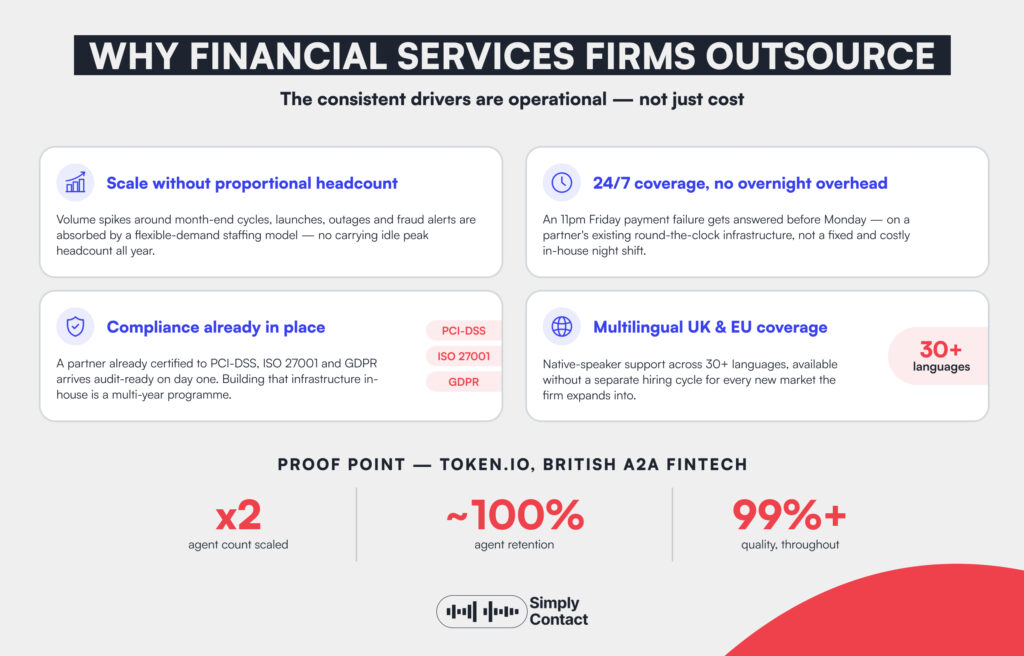
Scale without proportional headcount
Retail banks and payment providers have contact volumes that spike hard around events: month-end billing cycles, product launches, system outages, fraud alerts. Staffing for peak volume in-house means maintaining headcount that is underutilised for most of the year. Outsourcing financial services customer support means volume is absorbed by a partner whose staffing model is built around flexible demand rather than fixed headcount.
Token.io, a British A2A fintech, chose to partner with Simply Contact for this reason. Their operation needed to double in agent count while maintaining near-100% internal quality scores and consistent compliance discipline. The result: x2 growth in agents with retention close to 100% and quality scores above 99% throughout.
24/7 coverage without overnight headcount overhead
Fintech customers don't keep banking hours. A customer whose payment fails at 11pm on a Friday needs a response before Monday morning. Building a genuine 24/7 operation in-house, with adequate staffing, quality oversight, and management coverage overnight, is expensive. Outsourcing financial services support to a partner with existing overnight infrastructure solves this without the fixed cost.
Compliance expertise already in place
Regulated firms aren't just looking for agents who are fast and polite. They need agents who understand what they can and cannot say, who flag potential compliance issues rather than improvising around them, and who operate inside documented QA processes that satisfy regulatory audit requirements.
A certified BPO call center partner who already holds PCI-DSS, ISO 27001, and GDPR certifications arrives with that infrastructure in place. Building it from scratch in-house is a multi-year programme.
Multilingual coverage for European and UK markets
Fintechs expanding across the EU face a practical problem: each new market requires support in that market's language. Hiring native-speaker agents for 10 languages in-house is only viable at significant scale. Outsourcing financial services CX to a multilingual contact centre gives access to native-language coverage across 30+ languages without separate hiring cycles for each market.
Financial services call center outsourcing: what gets handled
Financial services call center outsourcing typically covers the following contact types.
| Contact Type | Description | Complexity |
| Account and balance queries | Status checks, balance confirmations, transaction history requests | Low — High-volume enquiries with structured responses |
| Card and payment support | Lost or stolen cards, failed payments, and dispute initiation | Medium — Defined processes with compliance-focused communication |
| Onboarding queries | Document requirements, verification status, and account opening guidance | Medium — Product knowledge required, no regulated advice provided |
| Complaints handling | Inbound complaints, FCA response timeline tracking, and resolution follow-up | High — Regulatory requirements and documentation standards apply |
| Live chat and email support | Customer support delivered across digital channels for all contact types | Varies — Same process discipline and quality standards as voice support |
| Escalation routing | Identifying cases requiring specialist or compliance review and directing them appropriately | Medium — Judgment required with clearly defined escalation paths |
| Outbound retention | Proactive engagement with at-risk or inactive customers to improve retention | Medium — Requires product expertise and strong communication skills |
Financial services customer support outsourcing for complaints handling is the contact type that most firms approach with the most caution and for good reason. FCA rules specify maximum response timelines for complaints (3 days for a summary resolution, 8 weeks for a full response). An outsourced team handling complaints needs to work within those timelines and document every interaction in a way that satisfies regulatory audit.
Simply Contact collaboration with an online banking platform demonstrates what this looks like in practice: 18 agents handling front-office chat support and back-office document verification, 1,000 processed applications per day, 24/7 coverage across three languages. That operation requires agents who understand verification procedures, know what documentation is acceptable, and escalate exceptions through a defined path.
BPO in financial services and regulatory compliance
Compliance is not a feature of financial services CX outsourcing. It is the operational context within which everything else happens.
The regulatory frameworks that apply to banking and financial services BPO engagements in the UK and EU include:
- GDPR / UK GDPR. Any outsourced operation processing personal data of EU or UK residents operates as a data processor under the controller's GDPR obligations. The contract must include a Data Processing Agreement. The partner must be able to demonstrate adequate technical and organisational measures, including ISO 27001 certification.
- FCA rules (UK). Firms authorised by the FCA remain responsible for the conduct of third parties delivering services on their behalf. Outsourcing does not transfer regulatory accountability. The FCA expects firms to have oversight arrangements in place, including the ability to monitor quality and retrieve records. An outsourced team means the BPO partner must operate within the firm's documented quality framework.
- PCI-DSS. Any contact handling payment card data (including agents who may hear card numbers spoken over the phone) must operate within PCI-DSS Level 1 compliance requirements. Scope includes call recording restrictions, clean desk policies, and controlled system access. A PCI-DSS certified partner has these controls in place and audited.
- DORA (Digital Operational Resilience Act). In force from January 2025, DORA requires EU financial entities to manage ICT risk across their supply chain, including outsourced service providers. For banks and fintechs with EU customers, BPO partners now fall within the scope of DORA's third-party risk management requirements.
In practice, how compliance is maintained in an outsourced CX setup comes down to five things: certified infrastructure (PCI-DSS, ISO 27001, ISO 27701), documented agent training with audit trails, call center quality assurance that covers 100% of interactions rather than a sample, defined escalation paths for compliance-adjacent contacts, and a governance model that gives the client visibility into what's happening at any time.
A banking and financial services BPO partner who can't produce documentation on all five of these is not a viable choice for a regulated firm.
How to choose the right BPO partner in financial services
The evaluation criteria for a financial services outsourcing partner differ from general BPO selection in a few important ways.
- Certifications are a baseline. PCI-DSS, ISO 27001, ISO 27701, and GDPR compliance are the minimum requirements for handling financial services contacts. A partner without these certifications is disqualified before the conversation starts.
- Domain experience in regulated industries. Agents who have worked in financial services CX bring product knowledge, compliance awareness, and pattern recognition that generic agents don't have. Ask specifically about experience in banking, fintech, insurance, or payments and ask for evidence.
- Quality metrics at scale. CSAT, FCR, AHT, and QA scores should be available at the agent level across the full contact population. A partner who reviews 100% of interactions produces more reliable quality data than one reviewing 5%.
- Scalability without quality degradation. The in-house vs outsourced question in financial services often comes down to whether the partner can scale quickly without the quality dropping. Ask about onboarding speed, training infrastructure, and how they've handled volume spikes for existing financial services clients.
- Escalation architecture. In financial services, knowing what to escalate and doing it correctly is as important as resolving contacts. Ask how escalations are designed, how they're tracked, and how the client gets visibility into escalated contacts in real time.
- Language and cultural fit for your markets. If you're operating across the UK, Germany, France, and the Netherlands, you need native-speaker coverage for each. Ask specifically about agent profiles for your target markets.
The how to outsource customer service guide covers the full evaluation process in more detail. For financial services specifically, the compliance and quality criteria should be weighted more heavily than cost in the initial assessment.
Financial services BPO works when compliance is built in from the start
Financial services outsourcing done correctly reduces regulatory exposure rather than adding to it. The right partner already holds the certifications, already has the QA infrastructure, and already trains agents on compliance language before they handle live contacts.
The risk is outsourcing to a partner who treats compliance as a documentation exercise rather than an operational discipline and discovering the difference when something goes wrong on a customer call.
Simply Contact works with financial services clients including fintechs and payment providers across the UK and Europe, certified to PCI-DSS, ISO 27001, ISO 27701, GDPR, and HIPAA. Explore our customer support outsourcing model for regulated industries, or get in touch to discuss your operation.

Newsletter
Subscribe
Subscribe to our newsletter to receive valuable industry insights and the latest research reports.