



Article
Back Office Management: Key Functions & Best Practices
A refund that takes fourteen days instead of three. A claim processed with an error because the intake was incomplete. A compliance audit that finds gaps in documentation nobody maintained. These are back office failures, and they show up in customer satisfaction scores, escalation volumes, and regulatory exposure. These do not appear in call queue reports.
This article covers what back office management is in a contact center context, what its core functions are, how workforce management works differently in the back office than in the front, and when outsourcing back office support services produces better outcomes than in-house management.
What is back office management in a contact center?
Back office management in a contact center context is the oversight and coordination of all operational work that happens away from the customer-facing interaction. Where the front office handles real-time contacts (calls, chats, emails) while the back office processes what those contacts generate or require.
Back office operations typically include:
- Case and order processing following a customer contact.
- Data entry, verification, and record updating.
- Claims handling and refund processing.
- Compliance documentation and audit support.
- Internal reporting and escalation tracking.
- Quality assurance reviews on completed cases.
The distinction from the front office is about workflow type. Front office work is real-time and event-driven: an agent responds to a contact as it arrives. Back office work is async and queue-based: a case enters a work queue and is processed according to priority rules and SLA targets. That difference in workflow type requires different management disciplines, different staffing models, and different measurement frameworks.
Back office management is the function that keeps those queues moving at the right pace with the right quality. When it works, the front office can make commitments it will keep. When it does not, the front office makes promises the back office cannot deliver on.
Back office support services: core functions that enable CX
| Function | What it covers | Why it connects to CX quality |
| Case and claims processing | Handling customer claims, refund requests, order disputes, and administrative cases generated by front office contacts. Processing to agreed SLA and error rate standards. | A claim processed in 3 days produces a different experience than one processed in 14. The front office conversation is forgotten; the wait is remembered. |
| Data management and verification | Updating customer records, verifying submitted information, maintaining data accuracy across CRM and case management systems. | An agent working with inaccurate customer data cannot resolve contacts correctly. Back office data quality directly determines front office resolution quality. |
| Compliance and documentation support | Maintaining records required for regulatory reporting, audit trails, and risk management. Applicable across financial services, healthcare, telecoms, and any regulated environment. | Compliance failures carry financial and reputational consequences. Back office compliance support is the operational layer that prevents both. |
| Escalation documentation and case transfer | Capturing full context when complex cases are escalated between tiers or between departments. Maintaining case ownership records and SLA tracking through the escalation. | A poorly documented escalation produces a customer who has to repeat themselves. A well-documented one produces resolution at the next contact. |
| QA and case auditing | Reviewing completed cases for accuracy, compliance, and process adherence. Identifying error patterns and feeding findings back into training and process updates. | QA in back office operations is the mechanism that prevents error patterns from compounding. A 2% error rate on 10,000 cases a month is 200 failures reaching customers. |
Back office workforce management: scheduling and capacity planning
Back office workforce management requires a different planning approach from real-time call center WFM. In a call center, the primary challenge is matching agent availability to contact arrival, minute by minute. In the back office, contacts have already arrived. They are sitting in a queue. The planning challenge is ensuring the right number of agents are working the right queue types to clear volume within SLA targets.
Forecasting async workload
Back office WFM starts with volume forecasting at a longer time horizon than voice WFM. A front office team forecasts contact arrival by 15-minute interval. A back office team forecasts case volume by day and week, based on front office contact patterns, seasonal trends, and known upstream events such as billing cycles, regulatory deadlines, or product launches.
The planning output is a staffing model that ensures sufficient case processing capacity to meet SLA commitments across all case types, even as the mix shifts between simple and complex work.
Scheduling for queue-based work
Unlike a voice agent who must be available when a contact arrives, a back office agent can be scheduled against a work queue that has depth. That makes scheduling more flexible in theory, but harder to optimise in practice. The scheduler needs to know which agents can handle which case types, how long each case type takes on average, and how the SLA target varies by case priority.
Cross-training agents across multiple case types is the primary tool for scheduling flexibility. An agent who can handle both standard claims and compliance documentation can be reallocated between queues as daily volume shifts without adding headcount.
SLA tracking and adherence
Back office workforce management must include real-time visibility into queue depth and SLA risk. A queue that is building faster than it is being cleared needs an intervention before it breaches SLA, not after. SQM Group data shows that back office delays are a leading cause of repeat inbound contacts: passengers, customers, or policyholders chasing updates they should not need to request. Dashboards that show live queue depth, average case age, agents working each queue, and time to SLA breach by case type give supervisors the information to reallocate in real time. The customer service metrics guide covers how to build the measurement framework that supports this visibility.
Common challenges in back office operations
Manual and paper-based workflows
Back office operations in many mid-market companies still run on email queues, spreadsheet tracking, and manual data entry. These workflows produce high error rates under normal volume and collapse under spikes. The average data entry error rate for manual processing is 1–4% per field, which compounds across a case with multiple data points. Automation of structured, repetitive case types is the highest-return improvement available in most back office environments.
Siloed data and systems
A back office team that cannot see the front office contact history, or that works in a case management system not connected to the CRM, operates on incomplete information. Errors from siloed data include processing a claim that was already resolved, applying the wrong product terms to a case, and failing to flag a customer with a prior complaint history for priority handling.
No equivalent of call metrics for measuring productivity
Front office productivity has clear metrics: contacts handled, average handle time, first contact resolution rate. Back office productivity is harder to measure because case complexity varies significantly. A team processing ten complex compliance cases looks unproductive against a team processing fifty standard claims. Without case-type-adjusted throughput metrics, back office workforce management cannot distinguish between a productivity problem and a volume-mix problem.
High error rates under volume spikes
Back office operations are typically sized for average volume. When volume spikes (following a product issue, a seasonal peak, or a front office campaign) case queues build faster than teams can process them. Under time pressure, error rates rise. The case that takes five minutes when processed carefully takes three minutes when rushed, but produces a 40% higher error rate that generates re-work volume and customer contacts.
Staff attrition and knowledge loss
Back office roles have historically high attrition in contact centers. When experienced agents leave, they take process knowledge that is not documented: how to handle the exception case, which data fields to cross-reference, how a specific claim type is typically disputed. Undocumented process knowledge is the primary back office continuity risk. Customer service levels documentation is the mechanism that converts individual knowledge into organisational knowledge.
Best practices for effective back office management
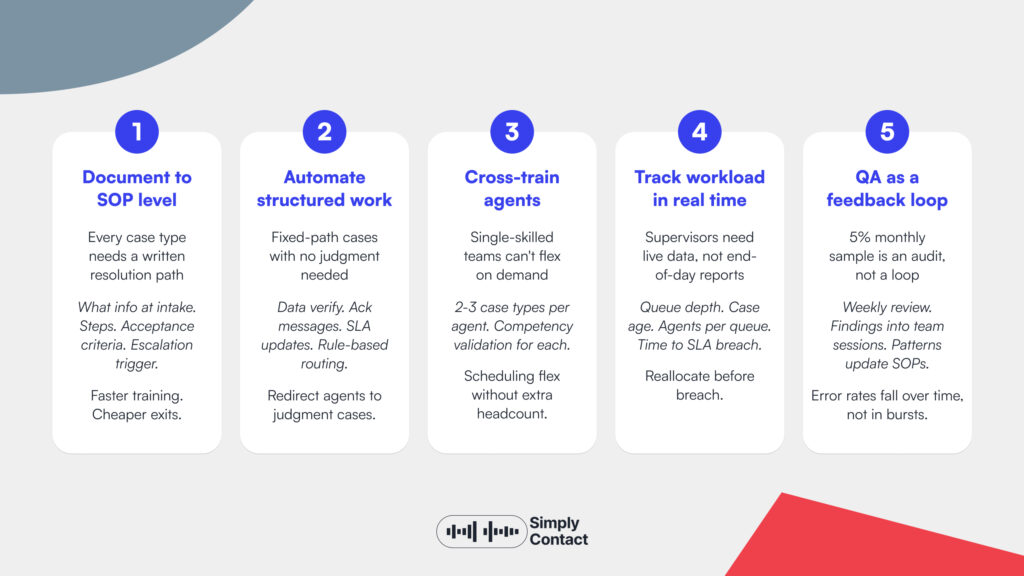
Document every process to SOP level
A standard operating procedure for each case type should cover: what information is required at intake, what the processing steps are, what the acceptance criteria are for a completed case, and what the escalation trigger is when the case falls outside the standard path. SOPs that exist at this level of detail make training faster, make QA meaningful, and make attrition less costly.
Automate the structured, repetitive work
Case types that follow a fixed decision path with no judgment required are candidates for automation. Standard data verification, acknowledgment message generation, SLA-triggered status updates, and rule-based routing are all automatable with tools available at mid-market price points. The goal is not to eliminate back office agents but to redirect them to the case types that require judgment. Back office process outsourcing providers often bring this automation infrastructure as part of the engagement, which is one reason outsourced operations sometimes outperform in-house ones on error rate.
Cross-train agents across case types
A back office workforce that is single-skilled (each agent handles only one case type) cannot be reallocated when queue mix shifts. Cross-training agents across two or three case types provides scheduling flexibility without additional headcount. The investment is a structured training programme and a competency validation process for each case type.
Track workload in real time
Queue depth by case type, average case age, agents allocated per queue, and time to SLA breach should be visible to supervisors in real time, not in an end-of-day report. Real-time visibility enables reallocation decisions before SLA breaches rather than after. See the front office vs back office guide for how integrated workload tracking connects both operational layers.
Run QA as a continuous feedback loop
QA on a 5% sample reviewed monthly is not a feedback loop. It is a retrospective audit. QA that reviews a meaningful proportion of completed cases weekly, feeds findings into weekly team sessions, and updates SOPs when patterns emerge is the mechanism that actually reduces error rates over time.
When back office outsourcing makes sense
Back office outsourcing produces the clearest operational benefit when one or more of these conditions apply:
- Volume growing faster than internal capacity. Hiring, training, and equipping a back office team takes three to six months from decision to productive capacity. An outsourcing partner can deploy trained agents against a new case type in weeks. When growth is outpacing internal hiring cycles, back office outsourcing companies close the capacity gap faster than in-house scaling allows.
- Compliance complexity exceeding internal expertise. Back office operations in regulated environments (financial services, healthcare, telecoms) require agents trained in the specific compliance requirements of each market. Building that training internally takes time and carries compliance risk during the ramp period. A specialist provider already certified to relevant standards (GDPR, PCI DSS, HIPAA, ISO 27001) reduces this risk.
- 24/7 coverage across time zones. A back office team operating business hours creates SLA risk for cases that arrive overnight or during weekends. An outsourcing partner with around-the-clock capacity and time zone distribution provides continuous coverage without overnight staffing costs.
- Inconsistent quality across case types. When error rates vary significantly between case types or between agents handling the same case type, the root cause is usually undocumented process or insufficient QA. An outsourcing partner who operates at consistent quality standards across all case types brings the discipline that in-house operations often lack when back office functions have grown organically rather than by design.
What to look for in back office outsourcing companies
The difference between back office outsourcing companies that improve operations and those that replicate existing problems is the depth of their process infrastructure. Simply Contact's operation for METRO Cash & Carry demonstrates what this looks like in practice: 98% of contacts resolved within 120 seconds, a 95% excellent quality rating across 12,000 monthly contacts, and consistent performance across five channels simultaneously. That consistency depends on the back office infrastructure: documented case handling, integrated CRM, and QA coverage applied uniformly. Evaluate specifically:
- Documented SOPs for case types comparable to yours.
- QA processes that operate at a meaningful sample rate.
- Technology integration capability with your existing CRM and case management systems.
- Compliance certifications relevant to your sector.
- SLA structures with financial consequences for breach. A provider without skin in the outcome has no operational incentive to maintain it.
Back office outsourcing example
Simply Contact's back office operation for Wizz Air covers refund processing, regulatory claim handling, and compliance documentation alongside the front office contact programme. The back office team operates with the same SLA discipline and QA oversight as the voice operation, with case processing integrated into the front office workflow so escalations transfer with full context. The 95% case closure rate within 30 days is the back office metric that supports the front office's ability to close contacts with confirmed next steps rather than pending promises.
The back office function is just as critical in retail CX. Simply Contact's operation for Yves Rocher, one of Europe's largest cosmetics retailers, supported an outbound sales and customer engagement programme handling 2,600 calls per day. The back office layer that managed data accuracy, contact documentation, and CRM updating was what allowed the front office team to sustain a 10% sales conversion increase without quality degrading as volume scaled.
Back office management is what CX promises are built on
The front office makes the commitment. The back office keeps it. A contact center that invests in agent training, omnichannel technology, and CSAT measurement while leaving its back office undermanaged is building quality on an unstable foundation.
Effective back office management requires the same discipline applied to front office operations: documented processes, measurable productivity, real-time visibility, and continuous QA. The tools and metrics look different, but the operating logic is the same.
Get in touch to explore how Simply Contact's back office support services deliver that discipline across claims processing, compliance documentation, data management, and escalation handling.

Newsletter
Subscribe
Subscribe to our newsletter to receive valuable industry insights and the latest research reports.