



Article
Front Office vs. Back Office: What’s the Difference?
Every business depends on two fundamental operational systems: the front office and the back office. The front office creates customer experiences while the back office operates as the core system that supports all operations. Each function can operate effectively independently, yet they achieve their maximum potential when working together. This article explores individual characteristics of the front and back office and explains why achieving a balance between them leads to enduring business success.
Front office vs. back office: An overview
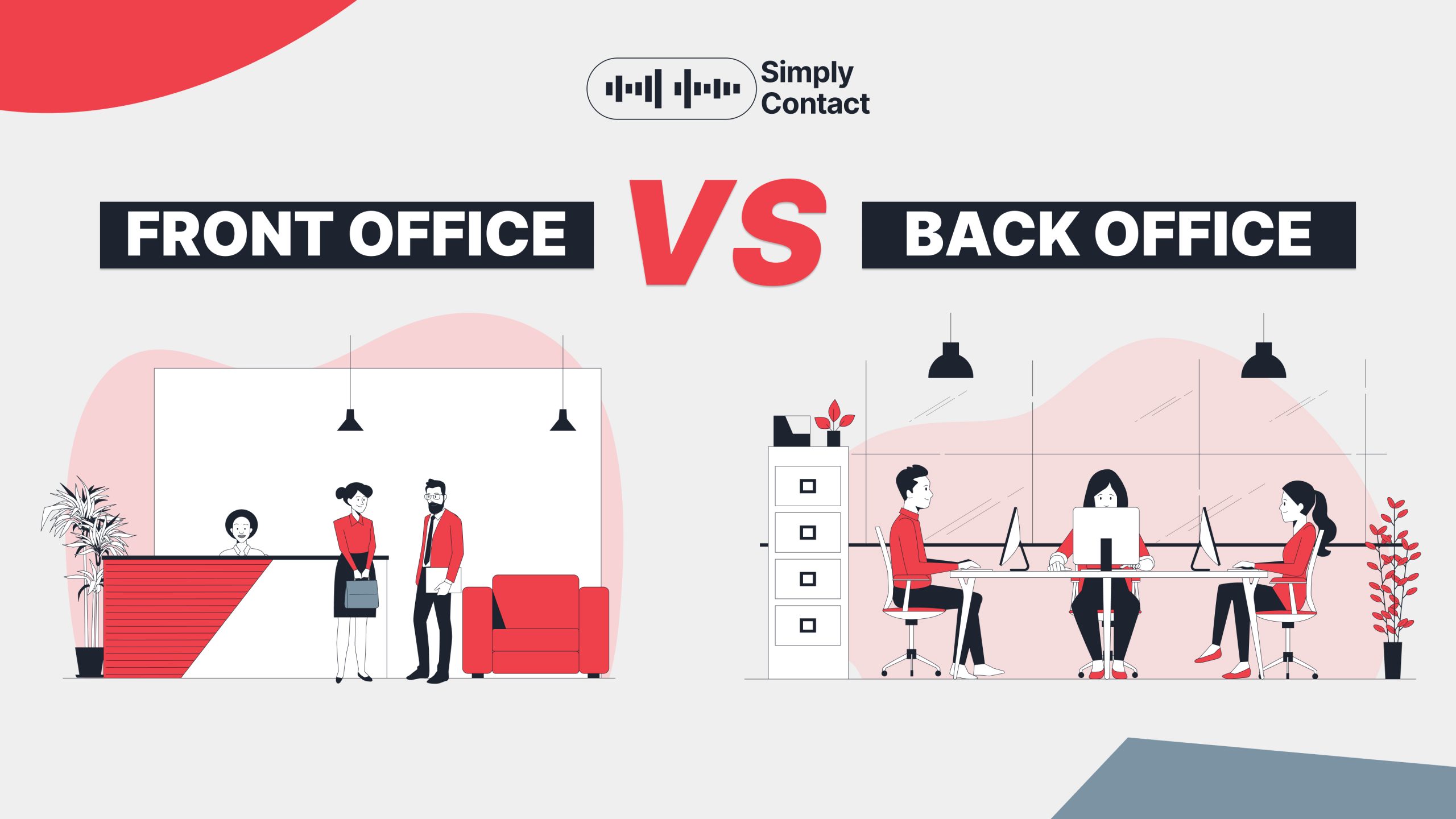
An organization consists of two separate operational areas that work independently with their own distinct responsibilities and skill sets. Let's explore what front office and back office mean.
What is front office?
The front office of an organization handles all people-facing interactions through customer service, sales, and customer relations. The organization builds customer relationships, secures deals, and generates revenue through this department.
Some key points about the front office
Front office staff serve as the initial point of contact for visitors. They directly influence customer satisfaction, a positive impression, and customer loyalty. Front office staff perform duties that reach beyond basic reception work. These employees handle client relations, manage client accounts, or even coordinate meetings and oversee order processing.
Front office success depends on employees who have excellent interpersonal abilities and a welcoming attitude. The front office staff create positive customer interactions, which directly impact business revenue growth and expansion.
What is back office?
The back office section of a business handles administrative work, financial operations, and operational management from behind the scenes. The back office operates without direct customer contact yet maintains essential business operations through its work. The back office handles all data management activities, compliance work, payroll processing, and IT support functions.
Some key points about the back office
The back office functions as the organizational base that delivers operational tools and systems that enable front office success. For example, if you outsource customer service, your outsourcing provider can offer back-office services, among others.
A company's back office serves as its core operational center. Although invisible to customers, it performs tasks crucial for maintaining operational continuity.
Back office employees in product-based companies actively participate in product development, from research and design to production, to guarantee accurate and efficient product creation. The back office team provides essential support to both the front office and other departments in the company. This makes them an indispensable link in a company's structure.
The work of back office staff remains invisible to customers, yet they play an essential role in maintaining business organization and operational efficiency, which is vital for achieving business success.
The front office and back office are characterized by different skills, responsibilities, and functions. The table below summarizes the front office vs. back office differences:
| Front office | Back office |
| Customer-facing, typically at the front of the organization. | Behind the scenes, often away from direct customer interactions. |
| Concentrated on duties that interface with clients. | Primarily responsible for administrative, operational, and support tasks. |
| Direct interaction with clients, customers, and the public. | Has minimal direct interaction with clients. |
| Aims to improve the customer experience and drive revenue. | Focuses on ensuring smooth operations and supporting other departments. |
| Highly visible to clients and the public. | Less visible to external parties; more internal-facing. |
| Commonly use CRM software, communication tools, and marketing platforms. | Use various software tools for data tracking, reporting, administrative functions. |
| Operate in a fast-paced, customer-centric, dynamic environment. | Operations are more systematic and procedure-driven. |
Front office vs. back office roles in an organization
What exactly distinguishes front office roles from back office roles, and how do their functions influence the success of the organization? Let's find out.
Front office responsibilities
Front office duties mainly involve client interactions and customer support, including:
Customer service
The goal of the front office staff is to deliver exceptional customer service. This is achieved by addressing inquiries, resolving complaints, and providing empathetic service, regardless of the channel: inbound call center services, chat support services, and all support activities that require real-time contact with a customer.
Marketing
Some front office teams participate in marketing activities, such as creating and executing strategies, advertising, promotions, and branding to attract and retain clients.
Public relations
Managing the company's public image and reputation is crucial. Front office teams handle public relations efforts, media relations, crisis communication, and public outreach of a company.
Call center operations
Front office employees handle incoming calls, i.e., direct client communication, addressing questions and resolving issues.
Record-keeping
The front office team maintains records of all data that can come in handy for future interactions: transaction history, previous interactions, other relevant data. This record-keeping helps the company in easy tracking of customers' history. Meanwhile, this shows customers that the company values and cares about their needs.
Client relationship management
Front office teams nurture strong client relationships by understanding their needs and ensuring their satisfaction.
Appointment scheduling
In some cases, front office teams also schedule appointments or meetings as needed.
Feedback collection
The front office team is the one to gather customer feedback, which is a valuable source of information. Based on feedback, the company can improve its products and services and make them more attractive to consumers.
Back office responsibilities
Let's now dive into the various responsibilities shouldered by the back office staff:
Company’s settlements
The back office team is responsible for overseeing the company's settlements. They ensure that financial transactions are completed accurately and verify that trade agreements are upheld while facilitating the transfer of assets as necessary.
Transaction verification and accuracy
Back office staff are the first to ensure the accuracy and completeness of paperwork associated with financial transactions. They conduct a final review of documents to identify errors.
Record maintenance
The back office team keeps accurate records of all financial activities, like a detailed money diary. This record helps them assess past transactions.
Managing accounting tasks
Managing the organization's finances by monitoring both incoming and outgoing funds falls within the purview of the back office. It's similar to managing your personal budget to ensure you have sufficient funds for all your needs.
IT services
Maintaining the organization's computer systems and technology infrastructure is also a key responsibility of the back office. The staff addresses company IT issues that don't need the kind of immediate, real-time resolution phone-based support requires.
Supply chain management
In businesses with intricate supply chains, the in-house back office team or back office BPO manages logistics, coordinates shipments, and enhances the overall efficiency of the supply chain operations.
| Front office responsibilities | Back office responsibilities |
| Customer interaction & engagement | Data entry and processing |
| Sales, marketing & lead generation | Research and analysis |
| Public relations & brand management | Record keeping & documentation |
| Customer service & problem resolution | Financial management & accounting |
| Call center & client communication | Administrative support and regulatory compliance |
| Market research & product knowledge | Quality control & assurance |
| Relationship building & client engagement | Human resources & personnel |
| Revenue generation & sales | Facility management and supply chain management |
What skills should front office and back office employees possess?
The difference between front office and back office skill requirements can vary depending on the specific company they work for. Nonetheless, there are essential skills that candidates should possess to excel in their respective departments.
The following table outlines the skills necessary for front office and back office employees to perform effectively in their roles. Additionally, it highlights some shared skills that contribute to their professional development.
| Skill category | Front office skills | Back office skills | Common skills for growth |
| Communication | Strong interpersonal skills, effective verbal and written communication | Precise written communication, teamwork, collaboration | Continuous learning, adaptability |
| Technical | Proficiency in industry-specific software/tools, data analysis skills | Data entry, software proficiency, attention to detail | Problem-solving, time management |
| Customer Service | Exceptional customer service, empathy, conflict resolution | Internal process knowledge, efficient task handling | Critical thinking, organizational skills |
| Organization | Multitasking, time management, appointment scheduling | Data organization, record keeping, process documentation | Project management, goal setting |
| Financial | Sales and revenue tracking, cash handling, financial analysis | Expense tracking, budgeting, financial reporting | Financial planning, forecasting |
Front office essential skills
The front office staff members who deal with customers need particular abilities that differ from those required of back office personnel. The essential skills of front office staff include:
- Communication: Front office employees should possess strong interpersonal skills and effective verbal and written communication abilities to engage with customers and colleagues.
- Technical: Most front office jobs require using booking systems, customer relationship management (CRM) software, or other company tools. It’s not usually very advanced, but employees need to be confident enough not to waste time figuring out simple tasks. Reports, data entry, and updates are also part of it.
- Customer service: Exceptional customer service skills, empathy, and conflict resolution capabilities are vital for providing a positive experience to clients.
- Organization: Front office staff must be adept at multitasking, time management, and appointment scheduling to ensure smooth operations.
- Financial: In some companies, front office staff also handle payments, receipts, or small sales tasks. It doesn’t require being an accountant, but knowing how to avoid simple mistakes with money is important.
Front office staff are the first impression of the company. If they’re polite and efficient, the whole business looks better. Training and refreshers go a long way, but experience in real situations is what really builds skill.
Back office essential skills
The back office doesn’t deal with customers directly, but it’s where the processes are kept running. Without it, the front office couldn’t really function.
- Communication: Back office staff write a lot—reports, documentation, updates. Most of their communication is with other departments. Here, clarity matters more than style.
- Technical: Data entry, software proficiency, and meticulous attention to detail are critical for back office employees as they allow for maintaining accurate records.
- Customer service: While not as client-facing, back office staff benefit from understanding internal processes, which contributes to efficient task handling.
- Organization: Data organization, record keeping, and process documentation are key skills to ensure that operations run smoothly in the background.
- Financial: The financial stability of organizations depends on back office staff who track expenses and create budgets and financial reports.
Companies should cultivate these skills in their back office staff so they efficiently manage tasks such as research, analysis, project management, quality control, inventory management, IT, technical support, etc., depending on their responsibilities in a specific company.

Organizations with distinct front and back offices
Organizations of all types and sizes maintain separate front-office and back-office operations. The following section illustrates how these offices serve as essential components in various business sectors, outlining their fundamental responsibilities.
Organizations with front offices
Here are industries where front office roles are prominent:
Retail companies
The front office of retail operations consists of sales associates and customer service representatives who provide direct customer service for better shopping experiences.
Hospitality industry
Hotels and similar establishments maintain front office operations through receptionists, concierge staff, and guest services personnel who deliver exceptional guest service.
Financial institutions
The front office of financial institutions consists of bank tellers, financial advisors, and customer service representatives who provide banking and financial assistance to clients.
Medical practices
Healthcare facilities employ receptionists, nurses, and patient coordinators who work in front office positions to handle appointments and patient interactions.
Call centers
The call center team handles customer inquiries and support requests to solve customer problems. In case a company is using AI in its support operations, basic customer interactions can be handled by chatbots, so agents can concentrate on resolving complex issues.
Organizations with back offices
Back office departments are available in various organizations. However, they particularly serve in the following areas:
Financial institutions
The back office teams in financial institutions are tasked with managing internal operations, including accounting, compliance, and IT support.
Manufacturing companies
The back office of manufacturers is responsible for overseeing behind-the-scenes operations from maintaining technical documentation to accounting.
Corporate offices
Back office departments support various internal organizational functions, contributing to the company’s overall efficiency.
Data-entry and processing centers, as well as research and analysis firms, also rely significantly on back office staff. These professionals, including data analysts and report writers, play a crucial role in data management and deriving insights.
Summary
In any organization, both front and back office roles are essential for smooth operations, so understanding the difference between front office and back office is essential. Front office teams manage customer interactions, directly influencing customer satisfaction, while back office staff handle tasks like data management and order processing. This is how their true power is achieved: the front office relies on accurate information from the back office, and the back office benefits from insights gathered by the front office.
At Simply Contact, we specialize in harmonizing the functions of both offices. With 12+ years of experience, we ensure both sides work seamlessly together, improving efficiency and customer experience at your company.

Newsletter
Subscribe
Subscribe to our newsletter to receive valuable industry insights and the latest research reports.