01 Oct, 2020
|
Updated: 18 Nov, 2025

Running a call center isn’t just about paying agents. Salaries, training, software licenses, facilities, and compliance stack into a cost structure that shifts every time volume or complexity changes. Leaders weighing outsourcing often focus on hourly rates while overlooking factors that can swing total call center costs far beyond the sticker price.
How much does it cost to outsource a call center, and how do different outsourcing models distribute expenses? The answer is less obvious once you break the pieces apart.
Internal call centers accumulate costs across multiple layers of the operation, not just headcount. Below are the core budget drivers that shape the cost of running support in-house, and why many organizations eventually look outward.
In-house operations require ongoing hiring, competitive pay, and training. According to Glassdoor, the average agent salary is around $39,000-$63,000 per year in the US and £18,000-£24,000 per year in the UK, with recruiting costs of about $3,000 per hire and $1,000 in annual training. High turnover increases replacement expenses.
Internal operations involve call center platforms, data security tools, network equipment, and hardware. Call center software costs about $40 per user per month, while security tools add roughly $1,600 per company per month, in addition to phones, headsets, internet, and infrastructure.
A physical space adds rent, utilities, furniture, maintenance, and supplies. Depending on your location, a small call center office rental starts at $250 per person per month and can go up to $1,800 per person per month. Remote setups can reduce this but introduce complexity during onboarding.
Management labor, insurance, accounting, legal costs, and required certifications affect the budget. Some industries require audits and data privacy measures, with fines for non-compliance.
Many businesses that want to avoid these expenses and access experienced talent without overspending partner with outsourcing companies. External providers handle staffing, infrastructure, training, and compliance.
Typical outsource call center pricing starts at about $7 per hour, with cost depending on region and support complexity. Companies avoid fixed infrastructure costs and pay only for delivered service capacity. Below, we will explore how much does it cost to outsource customer service and the nuances you should keep in mind when comparing prices.
The undeniable benefit of outsourcing is its cost-effectiveness compared to maintaining an in-house contact center. However, if you’ve already spent some time researching the topic of call center outsourcing costs, you know that it isn’t a flat rate purchase. So what impacts the final amount? Below are key variables that define the cost of outsourcing investment.
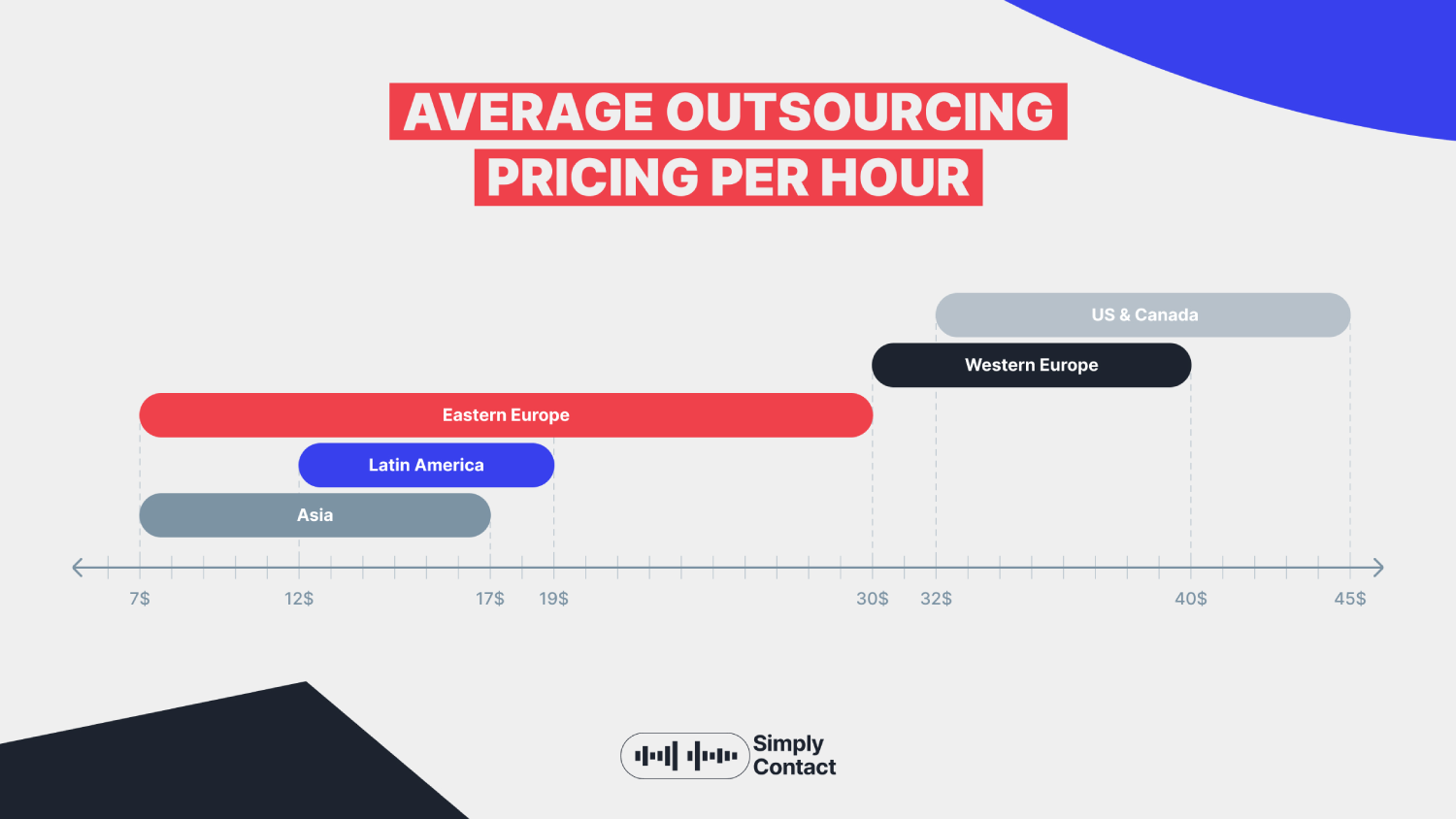
Labor rates vary significantly by region. For example, hourly call center price in the United States and Canada often ranges from $32–$45, compared to Asian markets at $7–$17. Western Europe, with higher labor costs, can reach $30–$40 per hour, while Eastern Europe falls between $7–$30. The diagram below, based on a report by Site Selection Group and our own experience, depicts these variations in customer service outsourcing pricing by region.
Providing round-the-clock coverage requires multiple shifts and higher staffing levels. Under hourly billing, this becomes expensive due to constant agent availability, especially during periods of low activity.
English is one of the most spoken languages in the world, which results in high competition and affordable rates for support in this language with most providers. The same applies to other popular languages such as Spanish, German, and French. With rarer languages, however, call center pricing can vary widely based on their popularity. Multilingual support increases cost because providers must supply agents proficient in additional languages. Some regions also require native fluency for compliance.
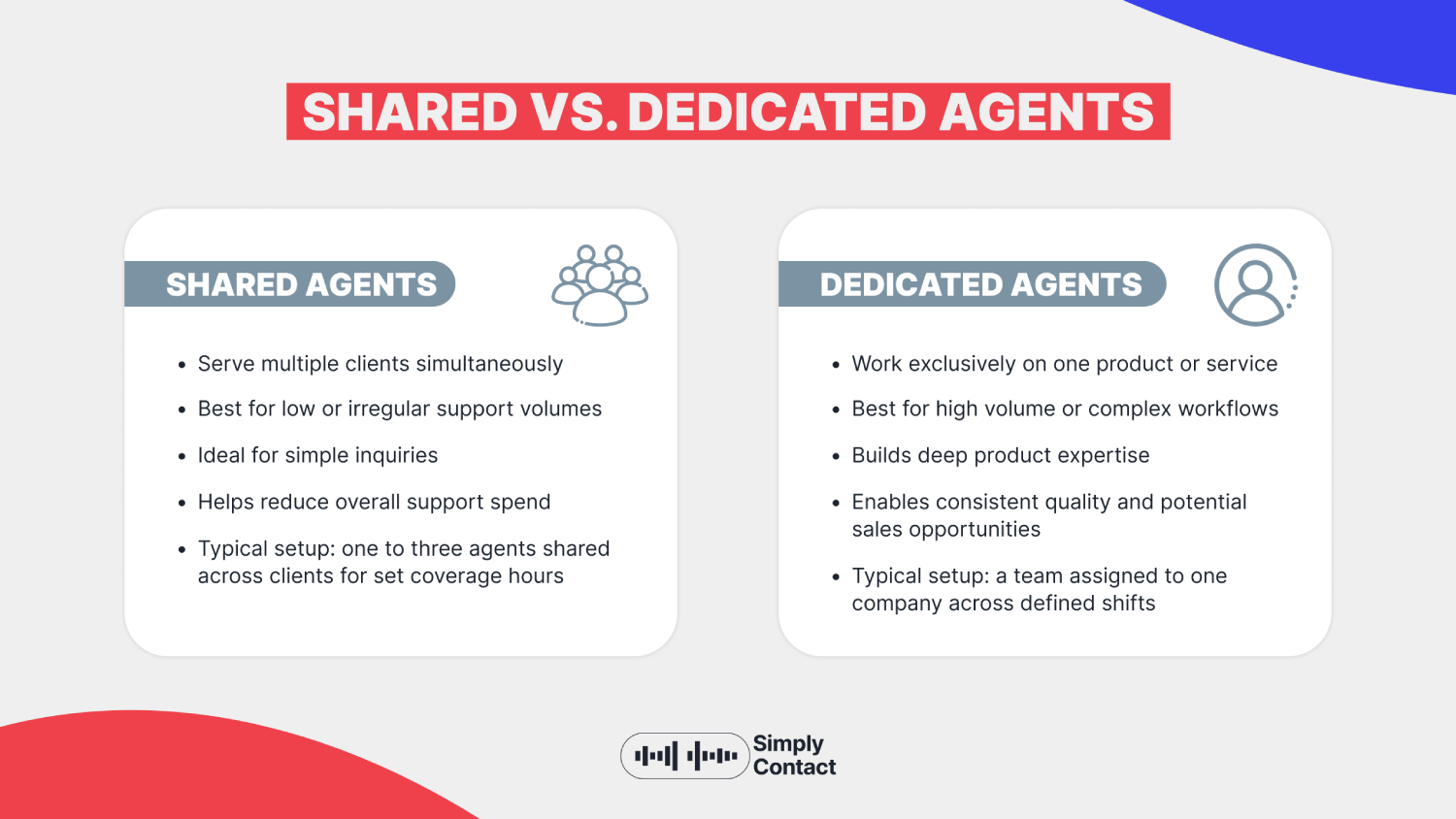
A dedicated team in a call center costs more but develops deeper product familiarity and can improve upsell potential. Shared teams are cheaper but split attention among multiple clients. The choice depends on your needs. Below, we will explore both options in more detail.
Specialized onboarding, product knowledge, or compliance training increases setup cost. Providers may include this in call center services pricing or charge separately. It’s important to keep it in mind to avoid unpleasant surprises.
Details like these rarely surface in generic comparisons or rate cards and become clear only in direct conversations with vendors.
Get a call center cost breakdown based on your specific requirements and discover how Simply Contact delivers premium support that fits your budget.
Contact us
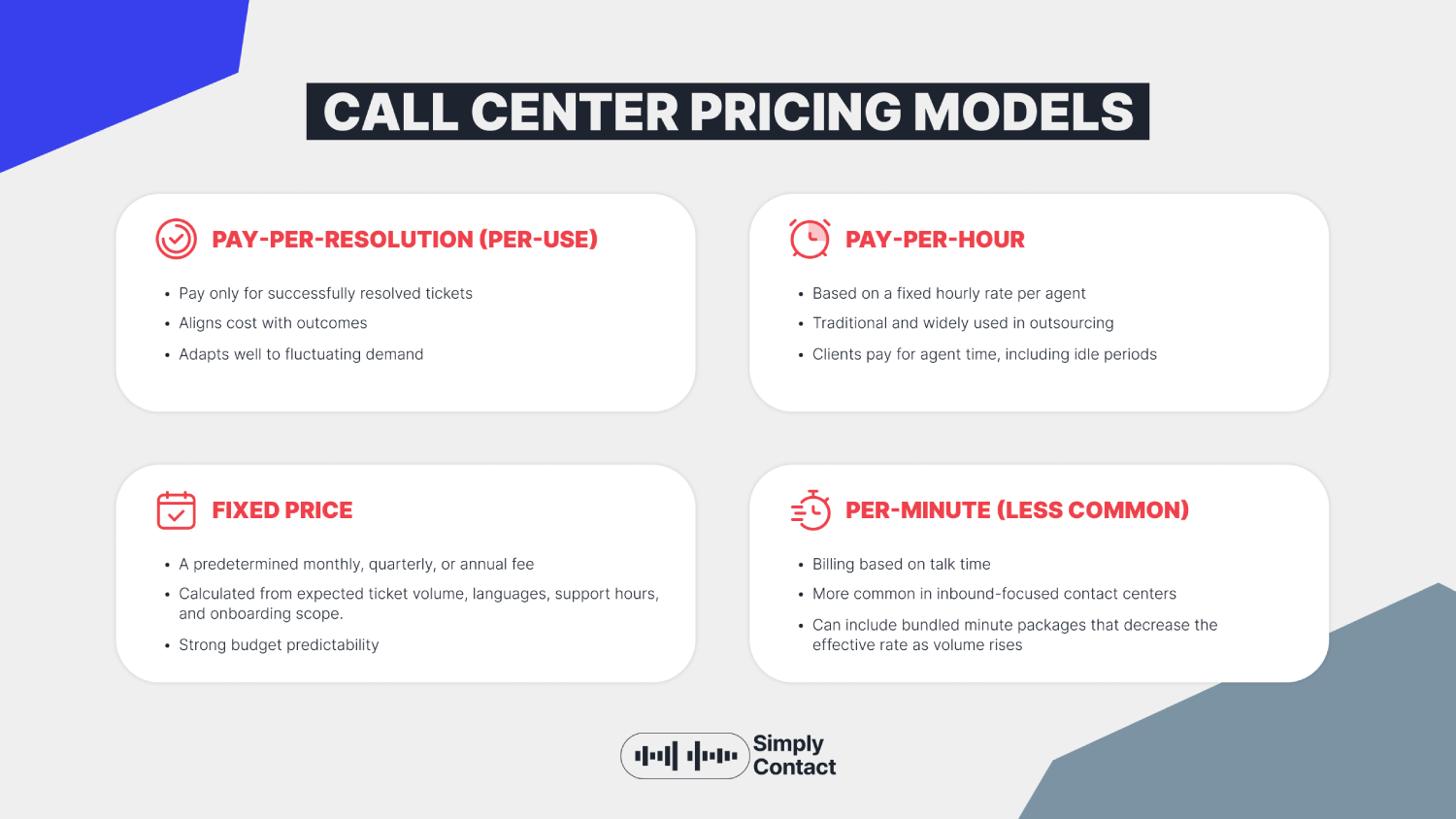
The factors above are objective, high-level ones. But they’re just one part of the equation. Another one is about how each given company approaches its call center outsourcing pricing. How providers charge for their services can dramatically alter the total cost of an engagement. Some models reward efficiency and fluctuate with demand, while others trade flexibility for predictability.
Understanding how each structure distributes risk, idle time, and volume variability helps determine which approach fits your support profile. The models below illustrate the most common outsourcing customer service cost structures based on capacity and outcomes.
Clients pay only for successfully resolved tickets. Call center cost per call typically ranges from $3 to $9 per resolution, with averages around $5. This model aligns cost with outcomes and adapts efficiently to fluctuating demand. The average cost per contact call center benchmark helps businesses compare pricing models and understand how resolution-based billing fits their budget. Prepaid credits are common. Unused credits may expire depending on the provider.
A traditional model where clients are billed a fixed hourly rate per agent. U.S.-based support often costs $32–$45 per hour, while Asian vendors range from $7–$17. The drawback is paying for idle time when ticket volume is low, and 24/7 coverage becomes expensive.
A predetermined monthly, quarterly, or annual fee. Providers assess expected ticket volume, languages, onboarding needs, and support hours to quote a rate. This contact center pricing model offers budget predictability but often includes a risk premium to protect providers from unexpected spikes.
Some inbound contact centers charge per minute of talk time, typically between $0.50–$1.75, depending on the country and service type. Bundled minute packages reduce the per-minute rate as volume increases.
The most common pricing models in outsourced contact centers are pay-per-resolution and pay-per-hour. Ultimately, the best choice depends on your specific support needs and how you prefer to balance cost and flexibility.
Another critical factor that significantly impacts outsource customer service cost, yet is not captured by hourly rate comparisons, is the choice between a shared or a dedicated team of agents.
Shared agents work across multiple clients and are best suited for organizations with lower, irregular, or unpredictable support volumes. If your business receives modest daily ticket counts, sees occasional spikes, or operates with relatively simple inquiries, a shared model keeps call center costs down without committing to full-time capacity. A shared team can consist of one to three agents with a fixed monthly fee, regardless of call volume.
Example: A small e-commerce startup shares two agents with other businesses for 10/5 email support. These agents handle password resets and order tracking for multiple clients throughout their shift.
On the contrary, dedicated agents focus exclusively on your product or service. This model works for companies with higher volume, more complex workflows, or technical requirements. A dedicated team builds deeper product knowledge, improves consistency, and creates opportunities for cross-selling and upselling due to familiarity with customer behavior. While it involves higher call center costs, it delivers better quality and more stability.
Example: A fintech company employs a dedicated team of six agents across two shifts for 16/7 phone and chat support. This team is trained exclusively on the company’s platform to handle complex, security-sensitive technical issues.
To choose between these two options, consider:
If your volumes fluctuate heavily—for example, during retail peak seasons—flexible scaling becomes valuable. Some providers allow changing team size month-to-month. Simply Contact can work on both shared-agent project models for smaller projects and dedicated-agent projects. Our projects can range from 0.5 FTE to hundreds of FTEs.
Call center pricing matters, but relying on the hourly rate alone can be misleading. Open-source directories and comparison platforms rarely show how pricing is structured. For example:
Additionally, some providers can offer blended channel handling. With this approach, a single agent manages multiple channels simultaneously, optimizing idle time across touchpoints. This goes beyond traditional hourly billing, lowering effective cost per interaction, but makes direct comparisons misleading.
Simply Contact’s strategy ensured that 80% of calls were answered within 35 seconds and significantly lowered call center outsourcing costs for Wizz Air.
Case study
Summing up, purely rate-based decision can result in:
A stronger selection method focuses on:
Evaluate the total cost of operation, not just the hourly number. The cheapest option can become the most expensive once hidden fees, inefficiencies, and idle capacity appear.
Selecting an outsourcing provider also means choosing a long-term business partner, and building a successful partnership requires many conditions, with cost being only one of them. The most effective collaborations are built on a foundation of operational excellence, strategic flexibility, and shared values, which together determine the long-term return on your investment. Below is the list of factors we suggest you consider while evaluating potential partners.
A low hourly rate is irrelevant if agents lack the tools or training to resolve issues quickly. Evaluate the provider's average handle time, first-contact resolution rate, and required number of customer follow-ups to gauge true efficiency.
Inadequate technology, poor knowledge base systems, or weak quality assurance processes create hidden costs. These gaps lead to longer training cycles, more escalations, and inconsistent service that requires ongoing management intervention.
An outsourcing provider must adapt to volume spikes, new product launches, or channel expansion without requiring a full contract renegotiation. Rigid contracts can stall growth and incur significant change fees.
Standard reports often lack depth. Require access to custom analytics that track your specific key performance indicators, enabling data-driven decisions to optimize support workflows and resource allocation.
Agents with firsthand familiarity reduce escalations, shorten interactions, and resolve issues on the first contact. Without domain expertise, calls take longer and compliance risks rise.
Support agents represent your brand. A mismatch in communication style, customer handling philosophy, or work culture can damage customer relationships and brand reputation, leading to increased churn.
Ultimately, the actual outsource customer service cost is measured in the long-term value delivered to your customers and your business.
Simply Contact structures pricing to cover the full operational support layer from day one. Recruitment, onboarding, trainers, and team leads are already included in the service package. If you want to learn about call center outsourcing costs at Simply Contact, you can be confident there are no hidden fees or surprise add-ons tied to setup, configuration, or seasonal changes.
A flexible operational model maximizes cost-efficiency: agents can switch between channels based on demand, reducing idle time across voice, chat, and email. Bilingual capability extends coverage without doubling headcount.
Summing up, here’s what is already included in Simply Contact’s pricing:
When comparing call center costs, internal operations carry recruitment expenses, salaries, benefits, training, management, software subscriptions, hardware, office space, utilities, and compliance overhead. Terminating and replacing agents is also expensive due to turnover. For example, according to Nextiva, average staffing costs for a 20-person call center can reach $694,000 annually. As a result, leaders start wondering how much does it cost to hire a call center.
Outsourcing providers supply infrastructure, trained teams, quality assurance, and coverage models without requiring the client to manage any of it. This lets companies pay only for delivered capacity, excluding idle time or underutilized seats. Major brands outsource because it scales up or down quickly, adapts to seasonality, and grants access to experienced support specialists instead of continuously training new internal hires.
In practice, outsourcing is usually more cost-effective:
Flexibility is the differentiator: internal teams must be staffed at peak levels year-round, while outsourced operations are able to scale with demand. The result is a lower total cost of ownership and a higher level of operational resilience.
Cost of outsourcing is an important factor when choosing a BPO provider. However, hourly rates only tell a fraction of the story. The most cost-effective option isn’t the cheapest on paper, but the one that prevents waste, adapts quickly, and protects both quality and brand trust. Make sure you consider all nuances when conducting your own call center outsourcing cost comparison.
At Simply Contact, we specialize in creating personalized customer support solutions that drive business growth and customer satisfaction. Let us help you elevate your customer experience and stand out from the competition.
Get fast answers to any remaining questions
Thank you.
Your request has been sent successfully.