


Article
SaaS Customer Retention: How Support Operations Reduce Churn
Most SaaS churn post-mortems reach the same conclusion: the product wasn't good enough. The user couldn't figure something out, didn't see enough value, found a cheaper alternative. Product, pricing, positioning are the variables that get scrutinised. Support operations rarely make the list.
That's a diagnostic error. According to Microsoft, 96% of users cite customer service as a primary factor behind loyalty decisions. Separate research puts 80% of customers who switched brands pointing to poor service experiences as the cause. The product may have been fine. The support interaction that happened three weeks before renewal wasn't.
SaaS customer retention is, in large part, a support operations problem and the companies that treat it that way retain customers at rates the product-focused ones don't reach.
Key takeaways
- 96% of users cite customer service as a primary loyalty factor, support friction drives churn independently of product quality.
- Customer retention rate, gross revenue retention, and net revenue retention measure different things; most SaaS teams track the wrong one for operational decisions.
- The six support levers that reduce churn most reliably are onboarding quality, proactive outreach, tiered SLAs, escalation design, feedback loops to product, and AI-assisted routing.
- Outsourced SaaS customer support, when built with proper product training and QA, can outperform in-house teams that are stretched across too many functions.
- Retention is a system. Support is the customer-facing part of it that operates every day.
Why SaaS customer retention is a support operations problem
The standard framing of SaaS customer retention puts product at the centre. Retention goes up when feature adoption goes up. Churn goes down when time-to-value shortens. Net revenue retention improves when expansion revenue exceeds contraction. All of this is true.
What it misses is the role of friction. A user who hits a billing problem three days before renewal and can't get a response within 24 hours doesn't experience that as a product failure. They experience it as a signal about how much the company values their time. That signal matters more at renewal than the last feature shipped.
The practical implication for SaaS businesses is that saas customer retention strategies built around product improvements alone are working on roughly half the problem. The operational half (response times, resolution quality, onboarding support, how complaints are handled) runs in parallel and contributes to churn independently of what's in the release notes.
The retention metrics SaaS teams must track
Retention and customer satisfaction metrics in SaaS are not interchangeable, and using the wrong one for operational decisions leads to the wrong interventions.
| Metric | What it measures | B2B SaaS benchmark | What drives it operationally |
| Customer Retention Rate (CRR) | Percentage of customers who renew in a period | 85–90% median | Onboarding quality, support resolution rate, escalation handling |
| Gross Revenue Retention (GRR) | Revenue retained from existing customers, excluding expansion | 85–90% for B2B SaaS | Churn and downgrades — measures how well you're holding the base |
| Net Revenue Retention (NRR) | Revenue retained including expansions and upsells, minus churn | Top performers exceed 120% | Expansion motion, account management, product adoption post-onboarding |
CRR and GRR are where support operations have the most direct influence. Both are primarily about preventing loss rather than driving growth. When support quality drops, CRR and GRR are the metrics that show it first, often weeks before it appears in churn reporting.
NRR above 100% means a SaaS business is growing from its existing base even if it acquires no new customers. Getting there requires low gross churn as the foundation. Support is part of how that foundation holds.
Support-driven SaaS retention strategies that work
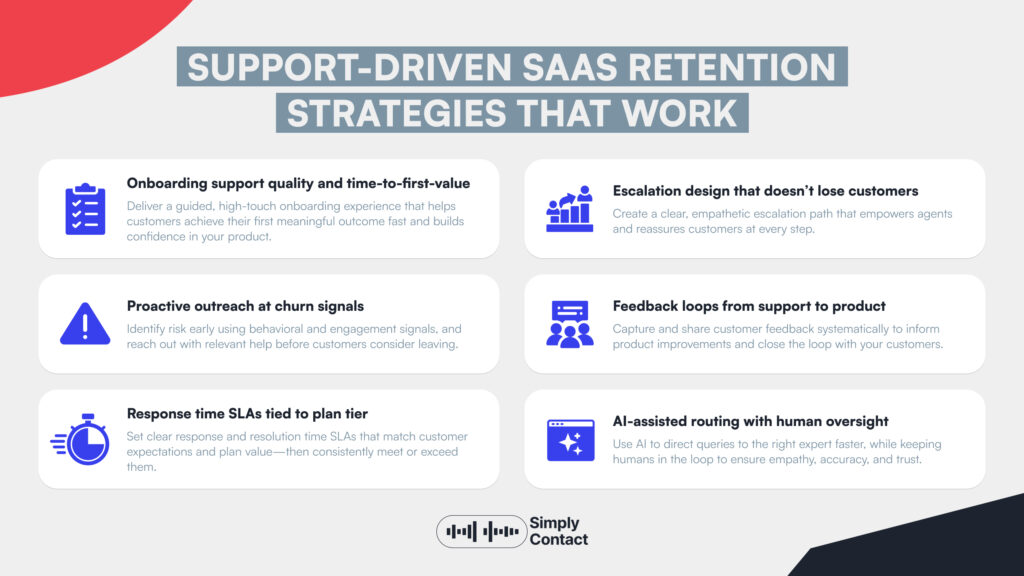
The following six operational levers have the clearest evidence linking them to improved SaaS customer retention. Understanding how to reduce churn saas teams face starts here, with the operational inputs.
Onboarding support quality and time-to-first-value
The period between a customer signing and their first meaningful outcome is the highest-churn window in a SaaS relationship. Users who don't get value in the first 30 to 60 days rarely make it to renewal. Support's role here is to remove the friction that slows that first-value moment.
This means having agents who understand the product well enough to answer configuration questions, troubleshoot integration issues, and guide users through setup without escalating everything to a technical tier. For example: Simply Contact helped Howly, a UK-based IT expert platform, to scale from 3 to 22 agents within a year while achieving a 43% increase in agent productivity came from building a team with the right training depth.
Proactive outreach at churn signals
The best SaaS retention strategies intercept churn before the customer decides to leave. This requires identifying signals: usage drop-offs, unanswered support tickets, billing failures, feature adoption stalls. The goal is to trigger outreach before they compound.
Support teams that have visibility into product usage data and integration with CRM systems can make this proactive. A customer who hasn't logged in for three weeks and had an unresolved support ticket two weeks ago is at risk. A team that spots that pattern and reaches out with a helpful check-in, converts some of that risk into retained revenue.
This is one of the harder operational capabilities to build, but the SaaS businesses that reduce churn at scale tend to have it. Ditto Music's support team noted they "tend to catch undesirable trends before they become real issues" exactly this proactive signal detection, applied to an artist community rather than a SaaS user base, with CSAT moving from 51% to 88% over the partnership.
Response time SLAs tied to plan tier
Tiered SLAs are the structural solution. Enterprise and high-value accounts get sub-hour response times and dedicated support contacts. Mid-market gets same-day. Smaller accounts get community and async channels with reasonable response windows. The tier structure should be explicit in the contract, measurable in the support platform, and enforced by routing logic rather than agent discretion.
This is one of the B2B SaaS customer retention strategies that requires operational discipline to maintain. Routing rules break. Priorities drift. Without regular QA review, tier SLAs erode in practice even when they're correct on paper.
Escalation design that doesn't lose customers
Escalations are where churn happens. A customer who hits a complex issue, gets transferred twice, then has to repeat their context to a third agent has just experienced the support equivalent of losing their work. The negative sentiment from that experience is disproportionate to the actual time lost.
Well-designed escalation paths move context with the customer. The escalation agent reads the full thread. The customer doesn't repeat themselves. The higher-tier contact resolves the issue in one interaction rather than continuing the chain. Context travels forward; the customer doesn't carry it. Taking ownership in customer service is the agent-level skill that makes escalation design work in practice: the disposition to stay with a problem rather than pass it.
Feedback loops from support to product
Support agents handle the complaints, confusion, and failure modes that product teams often don't see in analytics. An agent fielding ten questions a day about the same configuration step has information about friction in the product that the roadmap team doesn't have.
The mechanism for turning that into action is a structured feedback loop: weekly tagging of recurring contact types, a regular sync between support operations and product management, and a documented process for support-originated feature requests to reach the prioritisation process. Without the structure, the insight stays in the ticket queue and never improves the product.
AI knowledge assistant in customer support illustrates what happens when this loop is closed at the agent level. Implementing a proper knowledge system reduced questions to supervisors by 50%, improved CSAT by 8%, and drove 16% better cost efficiency, but because agents had faster access to accurate information and could resolve issues without delay.
AI-assisted routing with human oversight
AI-assisted routing uses intent detection to send contacts to the right agent or tier without making customers navigate a manual menu. When it works, first contact resolution goes up and average handle time falls. When it fails (misclassified intent, wrong routing rules, dead-end automation), it adds a layer of frustration before the customer reaches a person.
The "with human oversight" part matters. Fully automated flows that have no easy path to a real agent are a churn risk for complex issues. The right model uses automation to handle high-volume simple contacts efficiently, while making the path to a human agent clear and fast for anything more complex. This keeps customer support automation serving retention rather than working against it.
Why outsourcing SaaS support can strengthen retention
The assumption that in-house support teams retain customers better than outsourced ones is not well supported by the evidence. The actual variable is team quality: training depth, QA consistency, response time performance. Whether the team sits inside or outside the company is secondary.
An in-house support team at a scaling SaaS company is typically doing five things at once: handling contacts, onboarding users, writing help documentation, fielding product feedback, and covering overnight shifts with whoever is available. Stretched teams make more errors, respond more slowly, and retain institutional knowledge less reliably as they grow.
SaaS customer support outsourcing to a partner with proper product training, structured QA, and 24/7 coverage removes the stretch. The outsourced team does one job, support, and does it consistently. The in-house team retains ownership of product feedback synthesis, escalation review, and the strategic decisions about how to invest in support over time.
Simply Contact helped Token.io, a British fintech provider operating in a compliance-sensitive sector, needed a support operation where consistency was non-negotiable to deliver internal quality scores above 99% and agent retention near 100% across an extended engagement. That consistency is what SaaS retention strategies built around outsourcing can actually deliver when the vendor relationship is built correctly.
The concern that outsourced teams can't represent a SaaS brand authentically is worth taking seriously. The answer is investment in product training and cultural onboarding. An outsourced agent who knows the product as well as an in-house one, and is held to the same QA standards, is indistinguishable to the customer and provides numerous benefits of outsourcing.
How Simply Contact supports SaaS retention operations
Simply Contact works with SaaS and digital platform companies across Europe and the UK, building support operations calibrated to retention outcomes rather than volume metrics alone.
The operational approach is built around product-trained agents. Before any agent handles a live contact, they go through AI call simulation across the scenarios they'll actually face, covering 50+ languages where needed, with 100% scenario replay available for QA review. This produces 30% faster onboarding and first contact resolution readiness that is 2x higher than traditional training methods.
For a scaling SaaS company managing churn pressure, that ramp speed matters: the team is ready to retain customers before the growth curve makes support quality a bottleneck.
For teams evaluating reduce churn SaaS strategies that include outsourcing as an option, the question to ask is not "can an outsourced team understand our product well enough?" The question is "are we willing to invest in making that happen?" When the answer is yes, the retention results follow.
Retention is a system and support is where customers experience it every day
SaaS customer retention comes down to a simple question customers answer at renewal: did this company make my work easier, and did they handle it when something went wrong? The product answers the first question. Support answers the second, every day, in every ticket, every chat, every onboarding call.
The companies with the highest NRR are not necessarily the ones with the best products. They are the ones where support quality is high enough that customers rarely feel the friction that starts the churn conversation.
Build the support operation accordingly. Set SLAs and enforce them. Create feedback loops. Train agents on the product. Use automation where it helps and not where it doesn't. And if the in-house team is too stretched to do all of that consistently, outsourcing customer support to a partner who can is a retention investment.
Talk to our team about how Simply Contact builds support operations that reduce SaaS churn.

Newsletter
Subscribe
Subscribe to our newsletter to receive valuable industry insights and the latest research reports.