



Article
Insurance Claims Outsourcing: What Insurers Need to Know Before They Partner with BPO Providers
As an insurer, each incoming claim you get marks a policyholder’s trust in your brand. It shows that they feel safe enough to pay you monthly premiums. So when you delay a claim response or neglect the quality of interactions with an issuer, you risk losing reputation as their claims processor of choice.
Insurance claims outsourcing is one of the main tactics used to avoid overwhelming pressure and gain room to optimize how you deliver claims. But it’s important to strategize the flow of claims rather than endlessly pouring resources into staffing.
Many insurers still go for claims outsourcing, expecting lower costs and faster handling times like magic. Let’s set the record straight and talk about the importance of operational governance and an up-to-date approach to the insurance BPO.
Key takeaways
- Efficient claims-facing performance now holds on long-term planning instead of quick by-case solutions.
- Insurance claims outsourcing has evolved well beyond call handling and covers FNOL, adjudication support, customer communication, and workflow management.
- Insurers are increasingly outsourcing claims-related tasks due to staffing shortages, catastrophic events, growing compliance demands, and cost pressure.
- Poorly governed outsourcing relationships can create systemic risks in compliance, customer retention, and brand reputation.
- The best outsourcing partners combine human-led service with AI-assisted routing, quality assurance, and escalation management.
What insurance claims outsourcing actually covers
Insurance claims processing outsourcing allows delegating part of the claims lifecycle to a specialized external service provider. Depending on the approach and structure, an insurer can delegate either a small set of support tasks (e.g., outsourcing user support, claim status updates, or follow-ups) or seek full operational partnership (e.g., FNOL, policy confirmations, or data entry). Typically outsourced functions include:
- First Notice of Loss (FNOL)
- Claims intake and documentation
- Policy validation and eligibility checks
- Claims processing support
- Insurance customer service outsourcing
- Subrogation support
- Desk adjusting for low-complexity claims
- Call center and overload support
- Administrative and back-office claims workflows
FNOL is one of the go-to outsourced functions because it’s the highest-volume interaction point during both catastrophic events and seasonal spikes. It is also one of the most emotionally sensitive touchpoints in the policyholder’s journey.
For other, high-complexity tasks, insurers mostly prefer to make decisions internally. Final adjudication authority, fraud investigations, management of complicated litigations, and oversight of strategic compliance. All of these are usually decided in-house because they can directly affect regulatory compliance and accountability.
As such, insurers commonly hybridize their operational structures by outsourcing insurance claims handling volume only. This way, they can retain internal governance while an external partner assists with claims execution.
Today’s insurers are increasingly choosing claims outsourcing models that expand capacity without overhauling internal infrastructure every time demand spikes.
This distinction is important because even when you employ claims management outsourcing, you shouldn’t just hand off the whole claims process. Rather, you need to decide which workflows or sub-tasks to scale, specialize, or diversify.
Why insurers are outsourcing claims operations now
The insurance industry is highly active right now, with emerging claims appearing each day and usual processes only gaining momentum. Volumes of claims fluctuate unpredictably, and customers expect better service by the day. It is also becoming harder to find, recruit, and retain experienced specialists working with claims.
The demand for claims processing outsourcing and insurance BPO as a whole has accelerated among insurance carriers, MGAs, and insurtechs alike. There are several big reasons for that.
Volatility of catastrophic events
Wildfires, hurricanes, floods, and other climate-related events create sudden claims surges that can overwhelm internal teams within hours. During these periods, insurers need to optimize the staff elastically and immediately to keep claims flows going.
Intensity of operational costs
Maintaining large in-house claims teams year-round is expensive to say the least, especially when demand shifts and fluctuates. Outsourcing gives insurers an opportunity to scale resources dynamically and take on unique or complex claims without having to constantly prepare for worst-case scenarios.
Insurtech talent shortages
Insurance organizations cannot always find decent talent to replace experienced adjusters, claims processors, and customer support professionals. In turn, outsourcing partnerships help insurers access trained specialists without the full burden of internal recruiting and workforce management.
Hard-to-keep-up compliance
Claims operations now require careful handling of customer communications, documentation standards, privacy controls, and audit readiness. Insurers need partners that understand regulatory obligations rather than generic BPO vendors without insurance-specific expertise.
According to one insurance trends report for 2025, 83% of decision-makers in insurance operations consider outsourcing important to their organization’s future success. It all comes down to the big shift in perceiving insurance BPO from a pure cost-saver to a real efficiency booster of separate flows.
The real risks of getting claims outsourcing wrong
Claims processing outsourcing can help reinforce and expand operational performance, but poorly executed claims partnerships only spawn more risks.
Claims interactions frequently happen during emotionally charged moments: accidents, property damage, medical emergencies, or financial disruption. Policyholders are already under stress, which means even minor service failures (e.g., long wait times, inconsistent outreach, or impersonal claim handling) can seriously put them off.
Bad FNOL experience
First impressions during a claim can easily shape the customer’s perception of the insurer for the rest of the relationship. If policyholders feel ignored, misunderstood, or juggled between teams, your risks of churn can grow dramatically.
Compliance exposure
Claims workflows use sensitive personal and financial data, and insurers are accountable for how that data is handled, even when operations are outsourced. If you neglect this level of governance, you’re risking privacy violations, poor documentation, audit failures, and regulatory penalties.
Security gaps
Claims systems must also process medical information, payment details, identity records, and legal docs. Delegating those to an outsourcing provider that doesn't have a mature security framework is risky.
Service inconsistency
Generic BPO providers may find it difficult to maintain consistent communication quality across channels, regions, and surge periods. In insurance, such inconsistency can quickly damage the trust of the policyholders expecting reliability during moments of uncertainty.
A “total hand-off” approach
The biggest mistake insurers make is assuming that outsourcing itself solves operational problems. In reality, outsourcing amplifies whatever governance structure already exists. Weak escalation management, unclear accountability, and poor QA, in turn, are an absolute no-go for an external team.
What to look for in an insurance BPO partner
Choosing the right insurance BPO partner calls for evaluating far more than just their staffing capacity or pricing models. Based on all the above, if you are turning to BPO, claims processing, or insurance customer service outsourcing, make sure your provider of choice can offer the following.
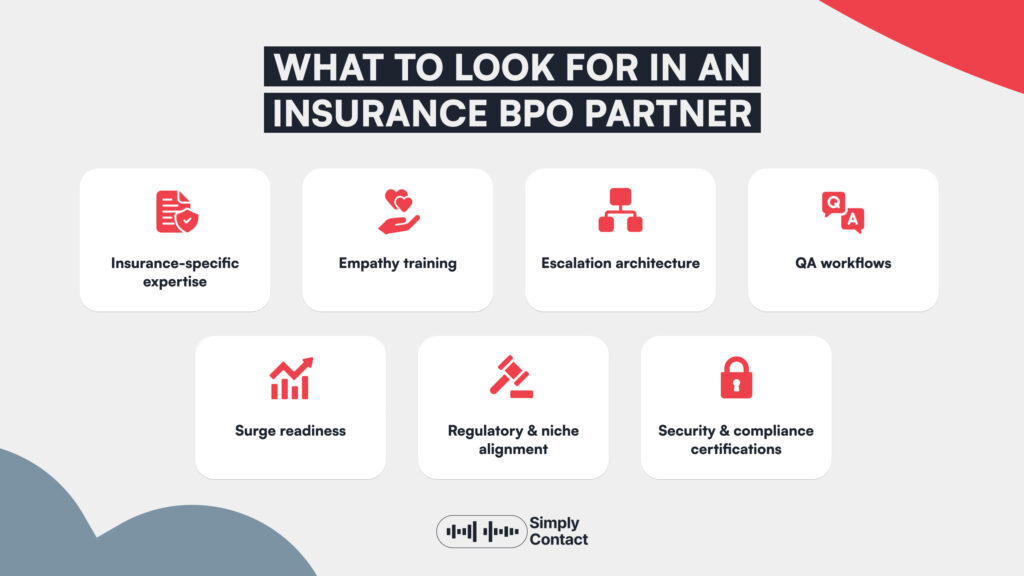
Insurance-specific expertise
This should be the starting point. Claims operations run on unique workflows, emotional sensitivity, regulatory obligations, and policyholder expectations. General outsourcing providers often underestimate these.
Empathy training
A particularly important moment for retention, claims representatives must be able to handle distressed policyholders with professionalism and empathy (especially during FNOL interactions and catastrophic events).
Escalation architecture
As a forward-thinking insurer, you must evaluate their take on escalation. Effective claims management outsourcing should offer pre-planned escalation paths that are easy to follow. These paths must clearly define how and when to delegate complex or sensitive issues to licensed specialists.
QA workflows
A reliable BPO outsourcing partner should be able to help maximize the quality of your claims service. Some of the extra useful QA workflows include auditing policyholder calls, monitoring and reviewing the claims cases, and validating compliance.
Surge readiness
How well is your claims outsourcing vendor prepared for assistance under extreme conditions? A good partner will assist your scaling during natural disasters, enrollment spikes, or unexpected claim-volume increases. All while keeping the pace and adapting claims workflows.
Regulatory & niche alignment
For health-related insurance industries, BAA-readiness and HIPAA alignment are especially important. Vendors handling protected health information must demonstrate mature governance and secure operational processes.
Security & compliance certifications
Security and compliance certifications should also be in your insurance BPO vendor evaluation checklist. For instance, proven insurance customer service outsourcing providers commonly maintain frameworks such as:
- PCI DSS v4.0.1
- ISO 27001
- HIPAA compliance readiness
- SOC 2 controls
- Documented QA and audit procedures
How to establish your claims support operations the right way
AI is everywhere, and your outsourcer should leverage it for insurance claims processing to the best of their ability. An up-to-date provider combines human expertise with automation and the power of AI engines. They should also emphasize other points of support.
Human-led, AI-assisted workflows
AI in customer support can support intelligent routing, workload prioritization and tasking, transcription, quality monitoring, and workflow acceleration. Simply Contact uses it to train professionals with simulated realistic situations covering a wide range of customer behaviors, issues, and emotional valences. It results in 30% faster agent onboarding, doubles FCR readiness, helps to manage empathetic conversations, and make decisions with far-reaching consequences.
More focus on escalation paths
Top customer support outsourcing companies have well-controlled escalation paths in place to prevent sensitive cases from becoming trapped in fragmented workflows. Thus, complex claims, compliance concerns, fraud indicators, and emotionally escalated interactions should move seamlessly to experienced specialists or internal insurer teams.
Vendor availability
Around-the-clock availability is increasingly expected as well. Today’s policyholders expect 24/7 accessibility right off the bat, especially when the claim is related to an emergency or force majeure event.
Multi-channel support
For a high-level customer experience that would instill trust and peace of mind for a policyholder, multi-channel outreach as another must. An outsourcer should help you expand support over voice, email, chat, and any additional required digital channels, powering self-service where needed. Highly reliable vendors take it further and offer omnichannel support.
Hybrid outsourcing
As mentioned at the beginning of the article, insurers increasingly value hybrid operational models where they can blend internal claims expertise with outsourced emergency support and specialized tasks’ delegation.
Conclusion
Insurance claims outsourcing has evolved from a quick operational assist used solely for cutting expenses. Now, it is reliable enough to help directly improve the way you retain customers, stabilize compliance, and build long-term brand trust.
But that’s only achievable when you structure your outsourcing partnerships strategically—with strong compliance oversight, empathy-driven service, and controlled escalation paths. With all of that in place, a claims outsourcing provider can become your powerhouse for improving both efficiency and policyholder confidence.
If you are looking for a solution-based provider trusted by established brands and ambitious startups right at this moment, you can save a ton of time and avoid risk with Simply Contact.

Newsletter
Subscribe
Subscribe to our newsletter to receive valuable industry insights and the latest research reports.