



Article
Banking and Financial Services BPO: What Banks Actually Outsource
Retail banks are under the same operational pressure as every other large-volume service business, but with additional constraints. FCA scrutiny is heavier. Data handling obligations are stricter. And the competitive threat from fintechs, which operate with a fraction of the overhead, makes cost efficiency a permanent board-level concern.
This article covers what banking and financial services BPO means, which functions banks hand over and which they keep, and what the compliance picture looks like for a mid-market institution evaluating its options.
Key takeaways
- Banking and financial services BPO focuses on customer-facing operations: inbound support, complaints, onboarding queries.
- BPO banking works best for high-volume, structured contact types where the resolution path is defined and compliance language can be trained.
- Retail banking BPO reduces cost per contact, extends coverage hours, and provides multilingual capacity, none of which require compromising on regulatory standards.
- FCA, PRA, GDPR, PCI-DSS, and DORA all apply to outsourced banking operations. The right partner is already operating inside those frameworks.
- Evaluating a banking BPO partner means looking at certifications, domain experience, quality metrics, and escalation architecture. Price comes after.
What banking and financial services BPO means
Banking and financial services BPO is the outsourcing of specific operational functions to a specialist third-party provider. The term covers a wide range, and the distinction between categories matters when a bank is deciding what to send out.
- IT outsourcing handles technology infrastructure: core banking systems, cloud migration, cybersecurity.
- Finance and accounting BPO handles internal processes: reconciliation, reporting, accounts payable. These are the categories that dominate when people talk about BPO banking in a broad sense.
The category this article covers is customer operations BPO: the functions that involve direct interaction with retail or business banking customers. Inbound call handling, live chat support, complaints management, account query resolution, onboarding guidance.
Customer operations BPO is distinct from regulated advisory. An outsourced agent can confirm an account balance, process a card dispute, or guide a customer through document submission for a mortgage application.
Banking outsourcing services: what gets handed over
The functions that banks and credit unions most commonly outsource sit in a specific band: high volume, structured resolution path, compliance-manageable, limited discretion required.
| Function | What it involves | Why banks outsource it |
| Inbound customer service | Account queries, balance checks, transaction history, product information | High volume, low complexity — expensive to staff in-house at the required scale |
| Card and payment support | Lost or stolen cards, failed payments, dispute initiation, PIN resets | Defined process, 24/7 demand, PCI-DSS controls required throughout |
| Complaints handling | Inbound complaint intake, FCA response timeline tracking, resolution follow-up | Volume-intensive, requires documented process — specialist teams outperform generalist agents |
| Onboarding support | Document requirements, verification status queries, account opening guidance | Reduces abandonment during onboarding while allowing internal teams to focus on regulated activities |
| KYC-adjacent query handling | Explaining documentation requirements, chasing outstanding submissions, status updates | Separates customer communication from verification decisions, maintaining a compliance-safe workflow |
| Escalation routing | Identifying contacts requiring specialist or compliance review and routing them with context | Reduces misrouted cases and preserves specialist capacity for complex issues |
| Multilingual digital support | Chat, email, and social media support across multiple languages | Enables coverage of multiple markets without building separate in-house language teams |
Bank outsourcing of complaints handling is the function that receives the most scrutiny from compliance teams, and for a reason. FCA rules specify a maximum 3-business-day window for a summary resolution communication and an 8-week maximum for a full response.
An outsourced team handling complaints must operate inside these timelines, document every interaction, and trigger escalation to the firm's internal complaints team when a contact exceeds the scope of what the BPO can resolve.
Simply Contact created an online banking support programme that handles 1,000 applications per day across three languages, with 18 agents covering front-office chat and back-office document verification on a 24/7 basis. The operation requires agents who understand verification procedures, know what documentation triggers a referral, and escalate exceptions through a defined path.
Retail banking BPO: supporting the customer-facing layer
Retail banking BPO typically covers the channels customers use most: inbound phone, live chat, email, and increasingly messaging apps. Each channel carries the same compliance requirements, the difference is in how conversations are recorded, monitored, and stored.
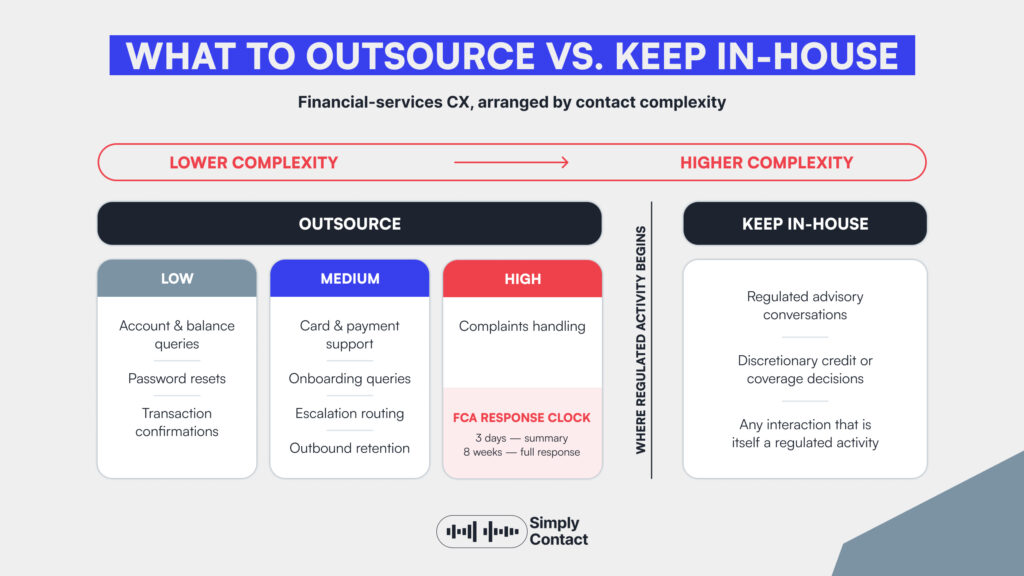
The division of labour in a well-designed retail banking BPO arrangement looks like this:
- Outsourced team handles: Routine inbound contacts. Account queries. Card issues. Standard complaints within defined resolution authority. Onboarding support up to the point of regulated decision. Digital channel coverage overnight and at weekends.
- In-house team retains: Regulated advisory conversations. Complex complaints above the BPO's resolution authority. Discretionary decisions. Escalations flagged by the outsourced team. Regulatory reporting and internal audit responses.
This division works when the escalation architecture is designed carefully. An outsourced agent who receives a contact that exceeds their resolution authority needs a fast, clear path to the right internal resource, with full context transferred. Retail banking BPO fails most often because the escalation design was not thought through when the contract started.
Benefits of BPO banking for mid-market institutions
Mid-market banks (typically those operating between £500m and £5bn in assets) face a particular operational problem. They're too large to run customer support informally, but too small to build the kind of contact centre infrastructure that large retail banks have invested in over decades.
BPO banking addresses this gap. The specific benefits that mid-market institutions cite most often:
Cost reduction against in-house equivalents
Operating a contact centre in the UK or Western Europe costs significantly more per agent than outsourcing to a European nearshore provider. The cost difference for equivalent-quality operations is typically 40–60%. For a mid-market bank running 50 support agents, that difference funds meaningful product investment.
Scalability at volume peaks
Banking contact volumes are not flat. End of the month, product launches, system outages, and economic events all create spikes that in-house teams can't absorb without either overstaffing for normal periods or degrading quality at peaks. Banking outsourcing services built around flexible staffing models handle this without the fixed headcount overhead.
24/7 coverage without full overnight infrastructure
Customers expect 24/7 availability. Building genuine round-the-clock coverage in-house, with management oversight, QA, and adequate staffing overnight, is expensive per contact in the low-volume hours. An outsourced partner running multiple clients shares that fixed overnight cost.
Multilingual capacity for EU and UK markets
Banks expanding into EU markets need support in local languages. Native-speaker coverage for German, French, Dutch, and Polish customers cannot be assembled quickly in-house. Bank outsourcing to a multilingual provider gives immediate coverage for new markets without the hiring delay.
Quality monitoring at full coverage
The best BPO banking partners review 100% of interactions through AI-assisted QA. For a regulated institution that needs to demonstrate quality oversight to the FCA, this is a meaningful operational difference. Token.io, a British A2A fintech that handles compliance-sensitive payment operations, maintained internal quality scores above 99% with near-100% agent retention across an extended engagement with Simply Contact, numbers that depend on full-coverage QA.
Compliance in banking BPO: non-negotiables
The compliance framework for banking outsourcing services in the UK and EU is specific and non-negotiable. These are the frameworks that apply and what they require of an outsourced partner.
- FCA and PRA oversight. UK banks regulated by the FCA remain responsible for the conduct of third parties delivering services on their behalf. The FCA's outsourcing rules require firms to maintain oversight, be able to audit outsourced functions, and have documented arrangements for retrieving data and transitioning away from the provider if needed. This means the BPO partner must support audit access.
- GDPR and UK GDPR. Processing personal data of UK or EU customers in an outsourced setup requires a Data Processing Agreement between the bank (controller) and the BPO provider (processor). The provider must demonstrate adequate technical and organisational controls — ISO 27001 certification is the standard evidence of this.
- PCI-DSS. Any contact that may involve payment card data (including agents who may hear card numbers spoken aloud) must operate within PCI-DSS Level 1 requirements. This includes call recording restrictions, clean desk controls, and verified system access management. A PCI-DSS certified provider has these controls in place and audited annually.
- DORA. From January 2025, the Digital Operational Resilience Act requires EU financial entities to manage ICT risk across their supply chain, including BPO providers who handle digital channels or access banking systems. For EU-regulated banks, this adds DORA third-party risk assessment to the standard outsourcing due diligence checklist.
- PRA operational resilience. For UK banks, the PRA's operational resilience policy requires important business services to remain within impact tolerances even when outsourced. This means the BPO partner must have documented business continuity arrangements, tested regularly, that the bank can verify.
A banking and financial services BPO partner who cannot produce current certifications, audit trail access, and documented business continuity arrangements is not a viable option for a regulated institution, regardless of price.
Bank outsourcing trends and what they mean for buyers
Three directions are shaping where bank outsourcing goes over the next two to three years.
| Trend | What’s changing | What it means for buyers |
| Empowering human agents with AI | AI supports agents with knowledge, translation, and quality tools. | Look for providers that combine AI efficiency with human expertise. |
| Outcome-based contracts | Success is measured by CSAT, FCR, and resolution rates, not headcount. | Focus on business outcomes rather than cost alone. |
| Nearshoring for compliance | More banks are moving operations closer to home for regulatory alignment. | Consider nearshore providers for stronger compliance and governance. |
Banking BPO works when compliance is the starting point
The banks that get the most from BPO banking treat compliance as the first filter. A provider who is already certified, already running documented QA at full coverage, and already operating within FCA and GDPR frameworks requires far less internal overhead to manage than one being brought up to standard after contract signature.
The cost and scalability benefits of banking outsourcing services are real. But they're only accessible to institutions that choose a partner who has already solved the compliance problem, so the relationship can focus on service quality rather than regulatory catch-up.
Simply Contact works with fintech and banking clients across the UK and Europe, certified to PCI-DSS, ISO 27001, ISO 27701, GDPR, and HIPAA. Talk to our team about what a banking BPO engagement looks like for your institution, or explore the customer support outsourcing model for financial services.

Newsletter
Subscribe
Subscribe to our newsletter to receive valuable industry insights and the latest research reports.