



Article
The Difference Between B2B and B2C Customer Support
B2B and B2C companies share the same basic customer service goal: solve problems and make it easy for customers to get help. But the way support works can differ significantly depending on who the customer is.
B2C teams often serve large numbers of individual consumers, while B2B support may work with fewer but more complex accounts involving multiple users, longer relationships, and higher-value transactions.
In this article, we look at the key differences between B2B and B2C customer support and what they mean for your service model.
Terms definition
For starters, let’s clearly define B2B and B2C business leading formats.
B2B: What is it?
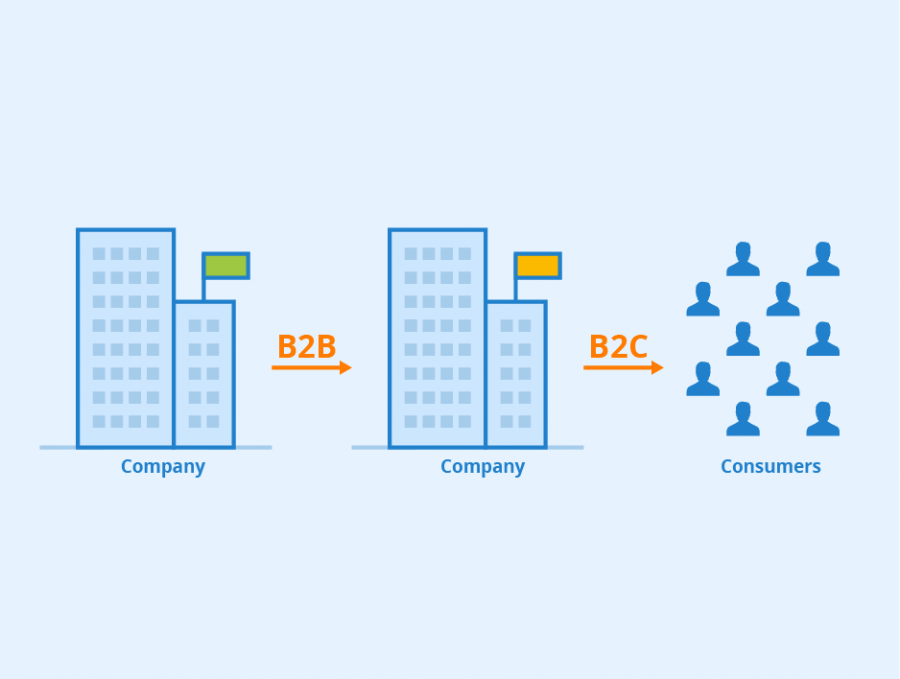
The B2B or business-to-business format is when a company offers enterprise-grade services or products to other companies. As a result, services or goods are sold, with the help of which other companies do their business in the B2C market.
B2C: What is it?
B2C or business-to-consumer is the distribution of services or goods by companies for individual buyers. B2C companies are in direct contact with the end consumer, unlike B2B providers that must always focus on the needs of other businesses.
B2B support can be managed in-house or outsourced, depending on the complexity of the product, required expertise, service volumes, and level of control the company needs.
Specifics of B2B and B2C customer support
The principles of customer support are the same for both business-to-customer and business-to-business customer services — you need to solve customer problems and answer their questions quickly and efficiently. However, there are a few differences between B2B and B2C support philosophies. Let’s take a look.
Complex questions
Usually, in the B2B area, customer problems are more complex and narrowly focused. Accordingly, they need more participation from B2B business management than B2C problems. In particular, you should ensure that your customer support agents are knowledgeable enough to provide professional assistance.
The first Call Resolution (or Customer Question) Rate (FCR) is generally lower for B2B customers than for B2C customers. This is due to the complicated issues that arise in the B2B environment.
B2B issues are often more complex and may require investigation or input from several teams, so FCR should be interpreted alongside resolution quality and overall time to resolution.
Number of clients
B2B companies generally have fewer customers than B2C companies. However, B2B providers sell large, complex, and often quite expensive products to their target audience. Therefore, customer interactions have more serious revenue implications.
If a customer of a B2C company decides to return the product, the business will lose a small amount of money. However, the financial turnover for B2B deals is several times larger. Any failure in the B2B customer support service may have a really negative impact on the company's income.
That’s why companies need to improve their customer interaction practices. Making a single mistake can undermine your business relationships and reputation.
Knowledge of customers
As you already know, the customer base for B2B and B2C is quite different. B2C teams often support a much larger customer base, so personalization usually depends on CRM data, purchase history, and behavioral signals rather than an individual account relationship.
B2B support often works with deeper account-level context, including company history, contracts, users, previous issues, and ongoing business needs.

Multiple contacts
In B2C support, interactions usually revolve around an individual customer and their own purchase, account, or service issue.
B2B support is often more complex because a single client account may include several users, each contacting support about related questions or problems. Without shared visibility, this can lead to duplicate requests, repeated explanations, or inconsistent answers.
That’s why B2B support teams need a clear view of the entire account history. Agents should be able to see previous conversations, open issues, and actions already taken so they can coordinate responses and avoid solving the same problem multiple times.
Self-service
Self-service can work well in both B2B and B2C support. B2C customers often use it for quick, repetitive questions, while B2B customers can benefit from detailed knowledge bases, documentation, onboarding resources, and account-specific help. The key is knowing which issues customers can solve independently and when they need access to a specialist.
Mobile optimization
Both B2B and B2C customers expect convenient access to support across devices. The preferred channel mix may differ, but service should remain consistent whether customers contact the company through mobile, desktop, chat, email, or voice.
B2B vs B2C customer support: Summary
B2B and B2C support share the same goal, but the operating context is different. B2C teams usually manage larger volumes of individual customers, while B2B support often involves more complex issues, multiple stakeholders, and longer account relationships.
The best support model reflects those differences without relying on rigid rules. Customer context, issue complexity, preferred channels, and expectations should determine how service is designed.

Newsletter
Subscribe
Subscribe to our newsletter to receive valuable industry insights and the latest research reports.