



Article
How to Structure Multilingual Customer Support to Serve a Global Customer Base
Wizz Air flies to over 50 countries. A passenger booking from Bucharest to London wants support in Romanian. One flying from Warsaw expects Polish. During peak summer, call volumes spike across all of these at once and drop again just as fast when the season ends.
Yet, the company still experienced a problem communicating in the right language, at the right time, without overstaffing the quiet months. After partnering with Simply Contact, a dedicated multilingual support team, 80% of calls were answered within 35 seconds. Average handle time dropped 30% on key lines. Agent utilization held at 85% through both the busy season and the slow one.
That's what providing multilingual customer support looks like when it's built correctly. This guide to multilingual customer service covers what it takes to get there: the channels, the tradeoffs, the common mistakes, and how to scale multilingual support without watching quality fall apart as you grow.
Language barriers cost more than most companies track
76% of consumers prefer buying products with information in their own language. 40% won't buy at all from companies that don't offer support in their native tongue. Those numbers come from CSA Research, surveyed across 29 countries.
The revenue impact is real but often misattributed. A customer who can't explain their problem clearly doesn't always complain, they abandon the interaction, request a refund, or just leave. Customer satisfaction scores fall. Handle times climb. Escalation rates go up. None of those symptoms point obviously to "we're not offering multilingual support," which is part of why companies underinvest in it for so long.
For any business with a diverse customer base, especially across Europe, where a single region can span a dozen languages and cross-border shopping is routine, providing multilingual customer support is the minimum requirement for a support system.
What multilingual customer support means
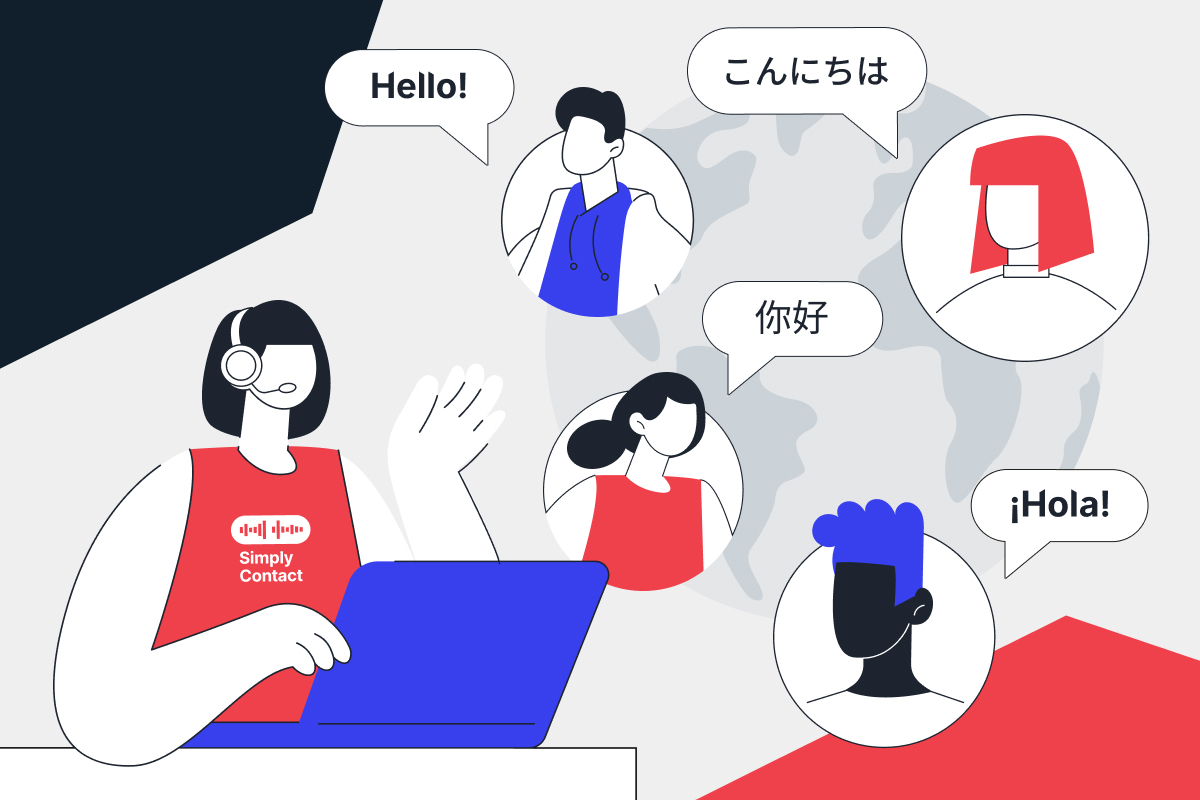
Multilingual support is often misunderstood as simply “offering service in different languages.” In reality, it’s about removing language as a barrier to a consistent, high-quality customer experience.
At a basic level, it means meeting customers where they are and allowing them to communicate in the language they’re most comfortable with, especially in moments that matter. But strong multilingual support goes further: it ensures that a customer receives the same level of clarity, speed, and resolution, regardless of the language they choose.
This is where many organizations fall short. They treat multilingual support as a staffing problem (hire more bilingual agents), when it’s actually an operational design challenge. If your processes, knowledge base, and QA standards aren’t consistent to begin with, adding more languages only amplifies inconsistency.
Another key point: multilingual support is about tone, cultural nuance, and context. A response can be technically correct but still feel off. From an operational perspective, mature organizations treat language as part of their routing and capacity strategy, not as isolated silos. That means building systems that can flex across languages, channels, and demand patterns without sacrificing efficiency or quality. Strategically, multilingual support is what enables real international growth. It impacts:
- Conversion in non-primary markets
- Customer trust and retention
- Operational metrics like resolution time and escalation rates
At its core, multilingual support means you’ve built one cohesive support system that performs equally well across all supported languages operationally and experientially.
Channels for multilingual support
Effective multilingual customer service covers every channel a customer might use to reach you. When you offer multilingual support across all of them, you provide multilingual customer service that actually matches how customers behave. When you offer multilingual support on only some channels, you've just moved the language problem sideways.
- Phone support. Voice is still the channel people reach for when something is urgent like a flight delay, a payment that won't process, an account locked at the wrong moment. Multilingual phone support is where multilingual capability gets tested hardest. There's no time to consult a dictionary. Wizz Air needed agents who could pick up a call in Romanian, Hungarian, or Polish and resolve the issue without the customer waiting. 80% of calls answered within 35 seconds, sustained through the full seasonal demand curve.
- Multilingual live chat. Chat scales more easily across languages than voice. Live chat outsourcing lets you route customers to language-matched agents without standing up separate regional teams for each market. Multilingual live chat handles a high share of tier-1 customer inquiries well: order status, account questions, basic troubleshooting and frees phone lines for the cases that genuinely need them.
- Email support. Lower urgency than chat or phone, but the quality standard is actually higher. A clumsy email support in a customer's native language tends to read worse than a clear one in English. Native-language support agents handle email well. Customer service skills like reading tone and adjusting register matter in written support just as much as in voice.
- Social media. Public comments, DMs, brand mentions – all visible, all permanent. Responding in a customer's preferred language on a public channel tells everyone watching how seriously you take your social media customer support. Ignoring non-English comments while responding to English ones is a signal too.
- Multilingual chatbots. Multilingual AI chatbots handle repetitive, high-volume support tickets across languages when they're built properly. The key word is properly. A poorly configured multilingual chatbot is a dead end that pushes customers to email or social with extra frustration already loaded. A well-built one deflects straightforward inquiries, routes complex ones to the right human agent, and handles the handoff without the customer noticing the seam.
- Messenger support. WhatsApp, Telegram, Viber, these are the preferred support channels for large portions of European and global markets. Customers use what's convenient for them. A multilingual support strategy that doesn't include messengers isn't accounting for how a big chunk of customers actually want to communicate.
Where the cost of getting multilingual support wrong shows up
Iryna Shevelova, expert in networking culture and the founder of Collabro, with extensive experience in systematization, evaluation, and service quality improvement, says that the cost of getting multilingual support wrong rarely shows up in one obvious place, it spreads across the operation and is often misread as something else.
- The first place it surfaces is in capacity and service levels. When you don’t forecast volume by language, you create structural imbalances: some queues sit idle while others constantly miss SLAs. On paper, headcount looks sufficient, but in reality, customers experience delays. The cost here is hidden in inefficiency and missed service targets.
- It also shows up in what many teams interpret as productivity issues. Handle times increase, repeat contacts go up, and resolution slows down. But the root cause is often language friction, agents spending extra time clarifying, translating, or second-guessing responses. The cost is lost capacity that never gets labeled correctly.
- A more subtle impact is operational fragmentation. Without embedding language into core systems like routing, knowledge management, and workflows, teams create local fixes. Over time, there are multiple variations by language. The cost here is inconsistency, which directly affects customer trust.
- There’s also a data blind spot. Aggregated metrics can hide underperformance in specific languages. You may see a stable CSAT overall while certain markets are struggling. The cost is delayed awareness and slower decision-making, which compounds over time.
Finally, it shows up in limited scalability. If multilingual support isn’t designed properly, every new language adds complexity instead of leverage. Expansion slows down, and operational risk increases. The cost is inefficiency, inconsistency, and reduced ability to scale.
How AI is making multilingual support faster to scale
Ramp time has always been one of the harder parts of scaling a multilingual customer support team. The cost of that ramp in supervisor hours, in slower handle times, in errors made on live calls, is real and it compounds.
AI call simulation changes that. Our approach puts agents through AI-simulated customer conversations across 50+ languages before they handle a single live call. The results from this training case are specific: onboarding is 30% faster. First contact resolution readiness is 2x higher. Every scenario is available for 100% replay, so training quality doesn't depend on who happened to be supervising that week.
For a company entering new markets, or managing a seasonal support spike without a six-month hiring lead time, that speed matters. You can build a multilingual team that's ready to handle real customer inquiries from day one, instead of learning on live contacts.
The right multilingual AI setup combines simulation for training, multilingual AI chatbots for tier-1 deflection, and human agents for everything that requires actual judgment. Each part does a different job.
- Multilingual AI handles volume.
- Human agents handle complexity.
- Multilingual support also gets faster to stand up when agents arrive already trained.
The combination is what makes delivering multilingual customer service at scale manageable rather than chaotic, and it's why companies that outsource multilingual customer support to a partner with this infrastructure get to that state much faster than those building it from scratch.
What separates good multilingual outsourcing from the generic version
The customer support outsourcing market has no shortage of providers who list "30 languages" in their pitch. In practice, that often means machine translation applied to generic agent scripts, thin coverage outside English and Spanish, and support agents who speak the language but have no real understanding of the customer's context.
There are three things that genuinely separate effective multilingual customer service from the version that just checks the box. A multilingual service built on these three things provides support that customers actually feel.
| Pillar | What it means | Why it matters in multilingual customer service | Impact on performance |
| Native speakers | Support agents are native speakers who understand nuance, tone, and regional phrasing beyond literal translation | They detect frustration vs confusion, implicit meaning, and emotional signals that non-native speakers often miss | Improves handle time, FCR (first contact resolution), CSAT, and reduces escalation rates |
| Training on realistic scenarios | Agents train using multilingual AI simulations based on real customer inquiries across 50+ languages | Prepares agents for actual live situations instead of theoretical or simplified examples | 2x higher FCR readiness from day one, fewer repeat contacts and escalations |
| Language-specific infrastructure | Routing, QA, and workforce management designed per language | Enables accurate staffing and service quality based on demand per language | Higher efficiency (e.g., ~85% agent utilization), better scaling across peak and off-peak seasons |
How to build a multilingual support strategy that holds up under growth
The sequence matters when you're building or rebuilding multilingual support.
- Start with where your customers actually are. Which languages generate the most support tickets? What channels are they coming through? Language volume varies by market, by product type, and by issue type. Your phone demand doesn't necessarily mirror your chat demand, and your biggest revenue market isn't necessarily your biggest support volume market.
- Be honest about which languages need native coverage. Some languages need native-speaker multilingual agents at every tier. Others can be handled with quality machine translation plus human review for anything complex. Treating all languages as the same problem leads to overspending on some and underserving others.
- Pick your channels in order of impact. A consumer app with a global customer base probably needs multilingual live chat and social coverage first. A B2B platform might need email and phone first. Start with the highest-volume, highest-stakes customer support channels and expand from there.
- Set targets before you start measuring. CSAT, FCR, AHT, response time – define what good looks like by language before the operation goes live. Customer satisfaction scores only mean something if you've committed to a number in advance. Otherwise you're just watching metrics drift without a reference point.
- Build for the volume you're heading toward. Multilingual support that handles 10,000 contacts a month may fall apart at 50,000 if the staffing model isn't built for it. To scale multilingual support without quality degrading, you need demand-based staffing built in from the start.
Technical support outsourcing structured this way handles growth without breaking. The same logic applies to back-office support processes behind customer-facing operations, if those don't scale, the front-end breaks anyway. Multilingual support at scale is only possible when the whole operation is designed for it.
The benefits of multilingual customer support
The key benefits of multilingual customer service aren't theoretical. They show up in specific metrics.
| Benefit of multilingual customer support | What it means in practice | Why it matters | Observable impact |
| Higher customer satisfaction (CSAT) | Customers are supported in their native language, removing communication friction and misunderstanding | Language is one of the biggest hidden drivers of poor support experiences in international businesses | Faster CSAT improvement, better qualitative feedback, fewer complaints about “not being understood” |
| Lower handle time & fewer escalations | Native-language agents resolve issues faster with fewer clarification loops and repeated contacts | Reduces friction in communication, which directly shortens resolution paths | ~30% AHT reduction on key support lines, lower escalation rates, higher first contact resolution |
| Easier market expansion | Support infrastructure is already prepared for new languages when entering new regions | Customer support becomes an enabler of growth | Faster launch in new countries with locally expected support quality from day one |
| Stronger customer loyalty & retention | Customers feel understood during critical support moments and are more likely to return | Poor-language support creates silent churn risk even when issues are eventually resolved | Higher repeat purchase rates, reduced churn after support interactions |
| Scalable multilingual operations | AI-driven training, chatbots, and demand-based staffing enable consistent multilingual coverage at scale | Prevents quality degradation as languages and volume increase | Stable performance under load, e.g. ~85% agent utilization across peak and off-peak seasons |
Stop losing customers to the language barrier
Improving customer satisfaction in a global market is a resolution problem. Translation gets you understood. Native-language agents who know the product and the customer base get issues closed.
You can't reliably resolve issues when customers are struggling to explain their problem in a second language. The right multilingual support model covers every channel, supports customers in their native language, and puts trained agents on complex cases.
Outsourcing to a team that already has the infrastructure: the training systems, the language coverage, the flexibility is usually faster and cheaper than building from scratch.
Talk to our team about what multilingual customer service looks like for your markets.

Newsletter
Subscribe
Subscribe to our newsletter to receive valuable industry insights and the latest research reports.