



Article
Customer Service Mistakes That Cost You Customers and How to Avoid Them
Most customer service mistakes are made by capable people operating without sufficient structure. The same customer service mistakes show up across industries, team sizes, and support models. A fintech startup and a retail bank can be making identical errors for identical reasons. Recognising the pattern is what changes the outcome. This article is a practical checklist for teams that want to stop treating mistakes as exceptions and start treating them as operational data.
Key takeaways
- Most customer service mistakes repeat because governance is absent.
- Scripted empathy, unaddressed bad customer service skills, and inconsistent QA are the highest-frequency failures in practice.
- Bad customer service examples from real industries share the same root causes, the industry context is different, the operational failure is the same.
- Outsourcing relocates these mistakes unless governance is shared between client and provider.
- The fix is building systems that make mistakes visible, trackable, and correctable at the pattern level.
Why common customer service mistakes keep recurring
A single agent making a mistake is a training problem. The same mistake appearing across ten agents on three different shifts is a governance problem.
Common customer service mistakes persist for a specific reason: without a QA feedback loop that closes the gap between what happened and what the team learns from it, every mistake is effectively new. The next agent who encounters the same scenario starts from the same position as the one who got it wrong last week. Nothing has changed in the system.
Bad customer service is the result of agents handling novel situations without clear guidance, or familiar situations with guidance that was written for a slightly different scenario. The absence of documented standards leaves agents improvising and improvisation produces variance, and variance produces the patterns that show up in CSAT drops, repeat contacts, and churn data.
The most common customer service mistakes to avoid
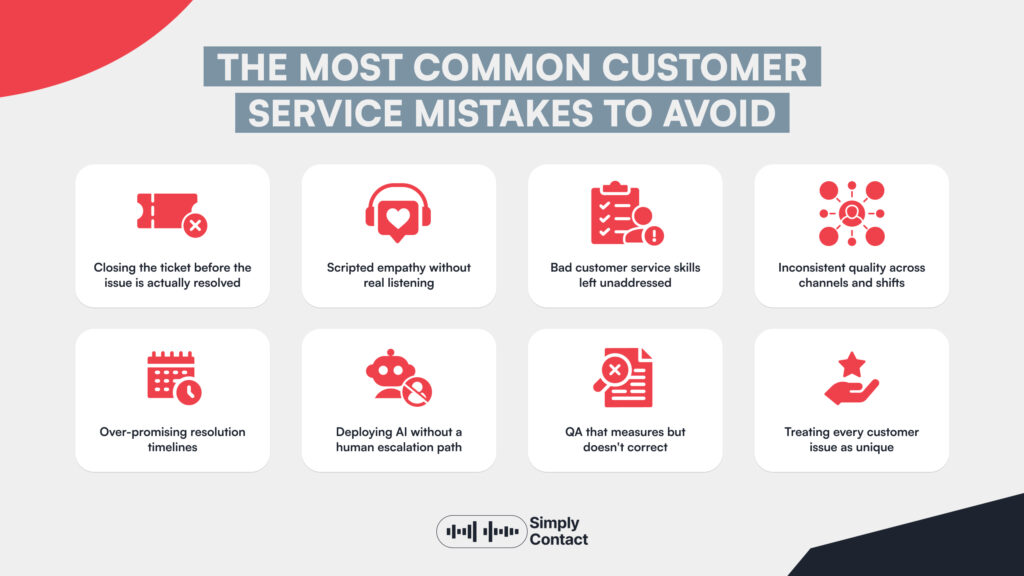
1. Closing the ticket before the issue is resolved
An agent marks a contact resolved after providing an answer. The customer's underlying problem is still there, the answer was technically correct but didn't fix the situation.
Why it happens: Resolution is measured by ticket closure, not by customer outcome. Agents optimising for AHT or closure rate have an incentive to close tickets at the answer stage.
The fix: Add a resolution confirmation step, a specific check on whether the original problem is solved. Measure repeat contact rate by agent, not just overall.
2. Scripted empathy without real listening
The agent says "I completely understand how frustrating that must be" while already typing the standard response. The customer feels processed, not heard. CSAT tanks despite a technically correct resolution.
Why it happens: Empathy is trained as a phrase list rather than a skill. Agents deliver the phrase at the right point in the script without adjusting the rest of the interaction to what the customer actually said.
The fix: Train agents to reflect the specific situation back before moving to resolution. "You've been waiting three weeks for this to be sorted" lands differently than "I understand your frustration." Review QA scoring criteria, empathy in customer service should be scored on specificity and timing, not just presence.
3. Bad customer service skills left unaddressed
A QA reviewer flags an agent's tone as consistently off-standard. The feedback goes into a report. The agent continues handling live contacts in the same way. The same flag appears the following month.
Why it happens: QA and coaching are disconnected. Scores are tracked; behaviour change is not. Bad customer service skills become entrenched when they're identified but not coached.
The fix: Each QA finding should have a named owner, a coaching action, and a re-evaluation date. Aggregate bad customer service skills data by agent to identify whether the problem is individual or systemic, the same error appearing across five agents points to a training gap, not five individual problems.
4. Inconsistent quality across channels and shifts
Phone contacts get a 4.3/5 CSAT average. Email contacts from the same team get 3.1/5. Overnight shift performance on complex contacts is significantly below day shift.
Why it happens: Channel-specific standards don't exist, or they exist but aren't enforced equally. Overnight and weekend shifts have less management oversight, so quality drift isn't caught until it shows up in aggregate data.
The fix: Define quality standards by channel and shift, not just for the operation overall. Run QA across all channels and all time windows. If the call center quality assurance programme covers 5% of phone contacts and no email contacts, it is a sample of one channel.
5. Over-promising resolution timelines
An agent tells a customer their issue will be resolved within 24 hours to close the interaction positively. The 24-hour window passes. The customer calls back angrier than when they first contacted.
Why it happens: Agents don't have real-time visibility into back-office resolution timelines, so they give plausible estimates rather than accurate ones. The short-term incentive (end the call on a positive note) outweighs the medium-term cost (a more difficult follow-up contact).
The fix: Define what agents can and cannot commit to without checking. Give agents access to realistic resolution windows per issue type. Train the skill of giving an honest, non-evasive answer when the timeline is genuinely uncertain: "I can't give you a specific time, but I'll flag this for priority follow-up and you'll hear from us by end of business tomorrow."
6. Deploying AI without a human escalation path
A chatbot or voice AI agent handles a tier-1 contact fine. Then a customer has a complex or emotionally charged issue. The AI produces a technically plausible response that misses the point entirely. There's no clear route to a human. The customer has to start over.
Why it happens: AI deployment is planned for the success case. The failure mode, where the AI can't resolve the contact, is underdesigned. No one owns the handoff.
The fix: Design the escalation path before deploying the AI, not after. Every AI contact handling flow needs a clearly marked human escalation option, a context transfer mechanism so the customer doesn't repeat themselves, and a monitoring system that flags contacts where the AI failed to resolve and why.
7. QA that measures but doesn't correct
The team produces a weekly QA report. Scores are discussed at the monthly review. The same failure patterns appear in next month's report.
Why it happens: QA is treated as a measurement exercise rather than a correction mechanism. Findings are documented but don't trigger specific actions. The report becomes something managers read.
The fix: Every QA finding that appears more than twice in a period should generate a corrective action: a training update, a script change, a coaching session, or a process amendment. The measure of a QA programme is whether the scores improve over time.
8. Treating every customer issue as unique
An agent handles a complex complaint and resolves it. No one records what worked. Three weeks later, a different agent handles the same complaint type from scratch.
Why it happens: Institutional knowledge stays with individual agents rather than being captured in shared resources. There is no mechanism to turn a well-handled contact into a replicable template.
The fix: Build a mistake taxonomy and a wins library alongside it. When an agent handles a difficult contact well, that interaction should be documented, discussed in team review, and turned into training material. The AI Knowledge Management case at Simply Contact demonstrates the scale of this: reducing supervisor questions by 50% and lifting CSAT by 8%, achieved not by changing agents, but by giving them better access to what the team already knew.
Bad customer service examples: what these mistakes look like in practice
Bad customer service examples from real operations follow recognisable patterns. The industry changes, the root cause usually doesn't.
Travel: over-promising during disruption
A passenger whose flight is cancelled calls the airline contact centre. The agent, under volume pressure, tells her the rebooking will be confirmed within two hours. It isn't. She calls back. The new agent has no record of the previous commitment. She's told to wait again.
- The mistake: Over-promising (mistake 5) combined with no record of the prior commitment, an escalation design failure. The customer has now had two bad interactions instead of one.
- The root cause: Agents didn't have real-time rebooking status visibility, so they gave estimates. The CRM didn't capture the commitment, so the second agent started from zero. Both are fixable system problems, not individual agent failures.
Fintech: chatbot with no exit
A customer contacts a payment app about a transaction dispute. The AI chatbot identifies the contact type and presents a standard dispute process. The customer's situation doesn't fit the standard process, the transaction involves a third party the chatbot wasn't trained to recognise. The bot loops. There's no human escalation button visible. The customer abandons the chat and disputes the charge with their bank instead.
- The mistake: AI deployed without an escalation path (mistake 6).
- The root cause: The deployment was planned for the 80% of dispute contacts that fit the standard process. The 20% that don't were left without a resolution route.
Retail: the ticket that was never really closed
A customer contacts a retailer about a missing order. The agent confirms the order is in transit and marks the ticket resolved. It wasn't in transit, the tracking data was stale. The customer receives no update and contacts again five days later.
- The mistake: Ticket closed before the issue was actually resolved (mistake 1).
- The root cause: Resolution was measured by agent action (confirming the tracking status) rather than customer outcome (the order arriving). The QA programme wasn't checking for repeat contacts on the same issue.
Customer service outsourcing mistakes: what companies get wrong when switching providers
Customer service outsourcing mistakes are a specific version of the same problems with the added complexity that two organisations now share responsibility for the outcome.
- Choosing on price rather than operational fit. A provider who is 20% cheaper but has no experience in your sector will spend the first three months learning what your current team already knows. The cost saving disappears in the ramp.
- Expecting the new provider to inherit a broken process and fix it automatically. If complaints handling is failing in-house because the escalation path is unclear, it will fail under outsourcing for the same reason. The provider can implement better execution, they cannot fix a process that was never designed.
- No shared governance model. The most common customer service outsourcing mistakes in live engagements involve governance gaps: the client assumes the provider is monitoring quality; the provider assumes the client has defined what quality means. Neither assumption is correct. Quality standards, QA methodology, escalation ownership, and performance review cadence all need to be agreed before the first contact is handled.
- SLAs defined on inputs. A response time SLA tells you how fast agents pick up contacts. It tells you nothing about whether customers' problems get solved, whether repeat contact rates are rising, or whether CSAT is moving in the right direction. Define outcome-based SLAs (resolution rate, repeat contact rate, CSAT by contact type) alongside the input metrics.
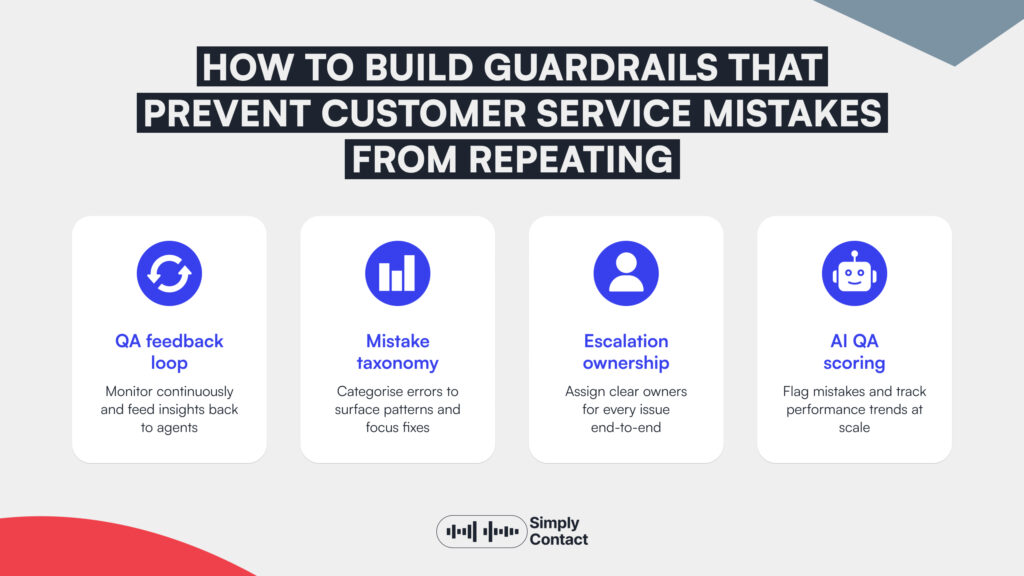
How to build guardrails that prevent customer service mistakes from repeating
Establish a QA feedback loop
Quality assurance that produces a report is better than nothing. Quality assurance where every flagged finding generates a named corrective action, tracked to completion, is what actually changes agent behaviour over time. The feedback loop has to close from observation to action to re-evaluation.
Build a mistake taxonomy
When the same customer service mistake appears more than twice, name it. Categorise it. Track its frequency. A mistake taxonomy turns anecdote into data and makes patterns visible that would otherwise stay hidden inside individual contact records. Teams that maintain a taxonomy know which failure modes are getting better and which are persisting and can direct coaching accordingly.
Create escalation ownership
The most dangerous moment in a customer interaction is the handoff. Contacts that move between agents, teams, or channels without clear ownership become nobody's problem. Define who owns an escalated contact from the point of escalation to resolution. If a contact changes hands, the new owner receives full context and takes responsibility for the outcome.
Use AI for QA scoring
AI-assisted quality scoring across 100% of interactions changes what's visible. A team reviewing 5% of contacts through manual sampling misses most of what's happening. Full-coverage automated scoring, with human review of flagged interactions, gives an accurate picture of where customer service mistakes are occurring, at what frequency, and in which contact types. That data is what makes targeted coaching possible.
Good customer service is governed, not just trained. The teams that outperform on customer satisfaction scores have better systems for catching mistakes before they compound.
Conclusion
A team that treats each customer service mistake as an isolated incident will solve it as an isolated incident and see it again next month. A team that treats mistakes as data will find the pattern, fix the underlying cause, and stop solving the same problem repeatedly.
That shift requires a QA loop, a mistake taxonomy, clear escalation ownership, and someone whose job it is to close the feedback cycle rather than file the report.
Talk to our team about how Simply Contact structures quality governance across managed support operations.

Newsletter
Subscribe
Subscribe to our newsletter to receive valuable industry insights and the latest research reports.