




Article
Phygital Customer Experience: What It Is and How Support Keeps It Connected
Phygital customer experience is the way a customer experiences a brand when its physical and digital touchpoints work as one continuous journey. The term blends “physical” and “digital”: a shopper researches online, checks stock in an app, buys in the store, and asks a question in chat afterwards, expecting the brand to remember every step.
Why phygital customer experience depends on support
Picture a customer who has read the reviews, compared options, and checked stock online. They walk into the store ready to buy. Then a small cross-channel problem appears: a shelf price that doesn't match the app, or a question about delivery terms. They contact support and expect it to know where they are in the process. Instead they get a scripted reply that ignores their purchase history. They stay quiet and stop buying.
The quote from Simply Contact's webinar on luxury ecommerce support applies to anyone who has had to chase a brand for an answer:
Luxury customers aren't just buying a product. They're buying a feeling of being taken care of. And the moment they have to chase you, the moment they have to exert effort, that feeling evaporates, and they remember.
— Nabil Kachour, Customer Service Operations Expert, ex-Zalando, ex-FREE NOW

In a case like this, the cause often sits in where support is located: outside the commerce systems. Every interaction starts from zero, and the customer pays for it. Support is where a customer who intended to buy either becomes a repeat customer or doesn't.
Phygital customer experience is already how your customers shop. The brands winning on retention are the companies with an invisible but contextual customer support layer. The continuous assistance across the physical-digital seam is what really buys customer trust and loyalty. In this article, we will review how to make it real through the 4 key moves that can completely upgrade your support system.
Phygital vs. omnichannel: what is the difference?
Omnichannel describes how a company organizes its channels: the customer can reach the brand by phone, chat, email, app, or in the store. Phygital describes what the customer actually lives through when those channels and the physical store merge into one experience. A brand can be omnichannel and still feel disconnected if context does not travel with the customer.
| Omnichannel | Phygital | |
|---|---|---|
| Focus | The channels the brand offers | The journey the customer takes across store and screen |
| Typical question | “Can customers reach us everywhere?” | “Does the customer have to start over when they switch?” |
| What support needs | Presence in every channel | Full context: purchase history, store visits, past conversations |
| How it is measured | Channel coverage, response time | Continuity, repeat purchases, retention |
Phygital customer experience examples
Most commerce brands already run phygital journeys, even if they don’t call them that. Here are five common examples and what each one asks of the support team:
- Click and collect. The customer orders online and picks up in the store. Support needs to see order status and store stock in one place to answer “Is it ready?” without a transfer.
- Buy online, return in store. The return starts in the app and ends at the counter. Agents and store staff need the same return policy and the same record of the order.
- QR codes and in-store apps. A shopper scans a shelf tag to read reviews or check sizes. If they open a chat from that screen, the agent should know which product they are looking at and which store they are in.
- Video or chat consultation before a store visit. A customer talks to an advisor online, then comes in to try the product. The store associate should see what was discussed and recommended.
- Clienteling for high-value customers. In luxury retail, an advisor follows the same customer across the boutique, messaging apps, and phone, with preferences and purchase history at hand.
Phygital CX strategy: 4 moves that make a difference
The commerce leaders are spending a bunch of time optimizing channels, trying to make the site faster and checkout smoother. But the truth is that phygital journeys fall apart at the seams: customers don’t experience channels; they experience transactions, and here is where the problem lies.
Move 1: Fix the seams where context gets lost
Phygital journeys have predictable friction points where channel switches, but context doesn’t:
Discovery → Store
Shoppers researched online before 61% of their shopping trips in 2023, according to 1WorldSync's 2023 Consumer Product Content Benchmark Report. In the 2024 edition, shoppers used their smartphones for product research on 54% of in-store trips on average. Customers are already phygital. The store associate and the support system often can't see any of that digital history, so the context resets and the moment is gone.
Post-purchase digital → Human
After the purchase, the customer may have a question. For instance, they could start with a chat or email and then get routed to a human agent. The common problem with this step is that the query transfer erases the conversation history, and the agent gets a ticket without understanding the situation. Sure, they can still find the resolution, but continuity is lost, and so is the positive impression from the interaction.
Returns/escalation cross-channel
A return started online and finished in the store can escalate if online and store policies aren't synchronized in real time. Staff and agents give different answers, work gets duplicated, and the customer loses trust.
High-value customer blind spot
Some of your customers may generate a large share of revenue, but when they contact support, they end up in the same queue as everyone else. High-value relationships are treated as usual tickets, and in some cases, this can also become a churn moment. Customers who spend more also want to feel valued and receive special treatment.
| Seam | What gets lost | What the agent needs |
|---|---|---|
| Discovery → Store | Online research, wishlist, viewed products | Visibility into the customer’s digital journey |
| Post-purchase digital → Human | Conversation history from chat or email | The full thread passed along with the ticket |
| Returns/escalation cross-channel | One consistent policy for online and store | Policies and order data synchronized in real time |
| High-value customer | Recognition of the customer’s value | Lifetime value and loyalty tier visible at first contact |
Omnichannel support operations can’t just mean multiple available channels for communication. The ability to contact the support team in a preferred way is the bare minimum, but it is not enough to keep customers loyal. They expect continuity across all the channels. If the context breaks, so does the trust, until the customer simply doesn’t return. Reliable infrastructure should guarantee an unbreakable information flow, where support agents receive more than just a ticket; they get the full history to provide personalized, relevant assistance with full context.
A unified database keeps everyone working from the same record: synchronized policies, purchase histories, and customers' interests. Giving agents AI-driven tools, such as a copilot that summarizes a customer's history, is a practical first step toward that.
Move 2: Measure support by retention, not cost per contact
Many companies run support on cost per contact. They track KPIs, work to shrink the queue, and push average handling time (AHT) down. That can leave churn untouched.
How customers are treated is a common reason they leave. They expect quality, personalization, and continuity, and they don't want to repeat themselves after a transfer. PwC research found that consumers say they would pay a 16% price premium for a good customer experience.
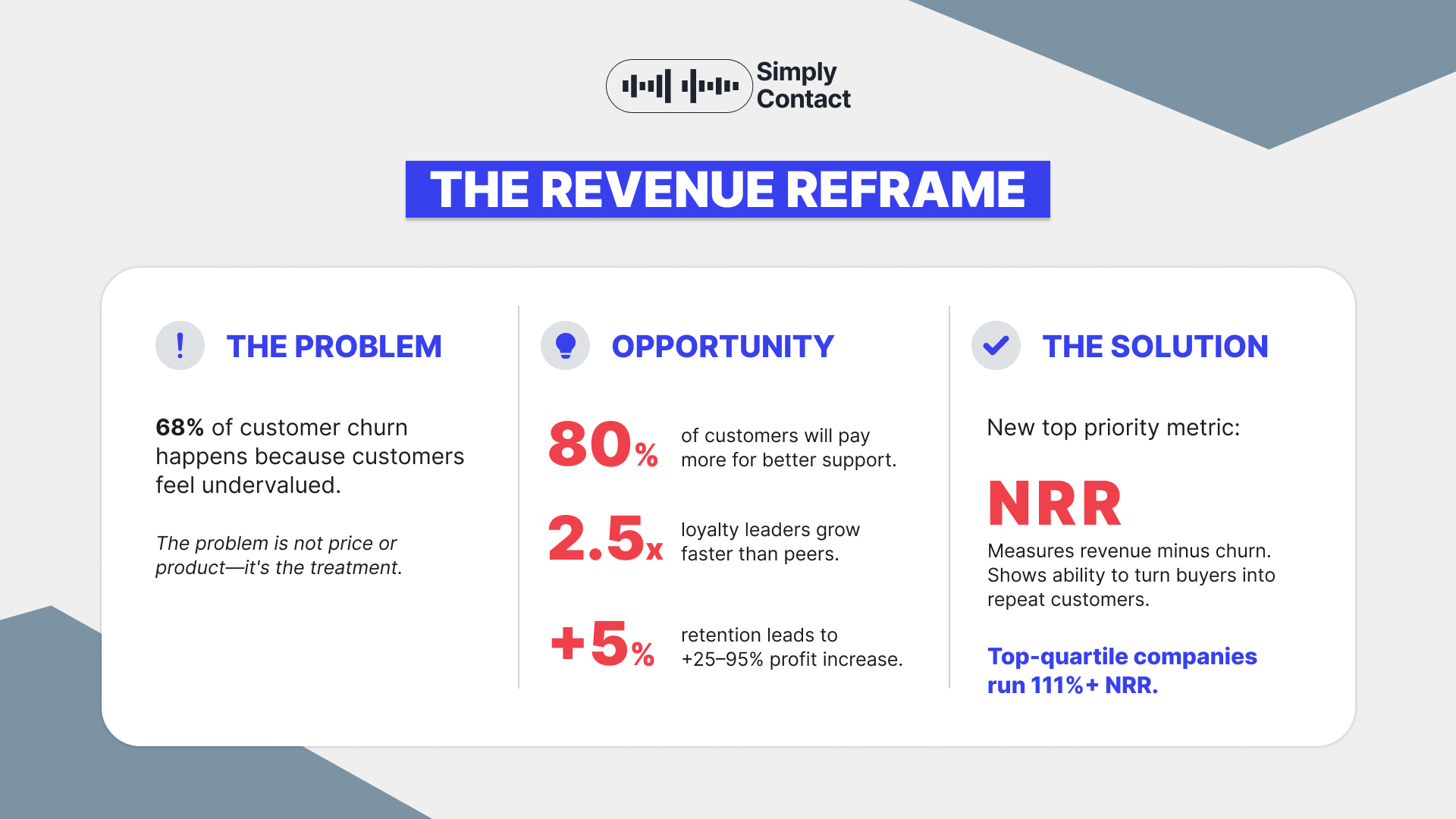
Loyalty leaders, companies that rank at the top of their industry on Net Promoter Score or satisfaction for three or more years, grow revenue more than twice as fast as their industry peers, according to Bain & Company. Research by Bain's Frederick Reichheld, cited by Harvard Business Review, also found that a 5% increase in retention can raise profit by 25% to 95%.
Our experts recommend measuring support by its effect on repeat purchase rate and customer lifetime value, alongside repeat-contact rate and first contact resolution. These show whether the post-purchase experience turns buyers into repeat customers. If you run a subscription model, add net revenue retention (NRR): starting revenue plus expansion, minus downgrades and churn, divided by starting revenue. Revenue from new customers isn't counted.
Support protects revenue and can grow it. When you take this to the board, change the framing from cost per ticket to support's contribution to repeat purchases, lifetime value, and churn.
Move 3: Treat support as a product, not a function
The brands that want to fix seam failures don’t treat support as a function or department; they consider it a product. They map customer journeys, instrument frictions, and ship iterations. Customer support service becomes an opportunity to sell experiences and to invest in the brand's future reputation.
According to Forrester’s 2024 US Customer Experience Index, customer-obsessed organizations report 41% faster revenue growth, 49% faster profit growth, and 51% better customer retention than other organizations.
How does this customer-centric strategy work in practice?
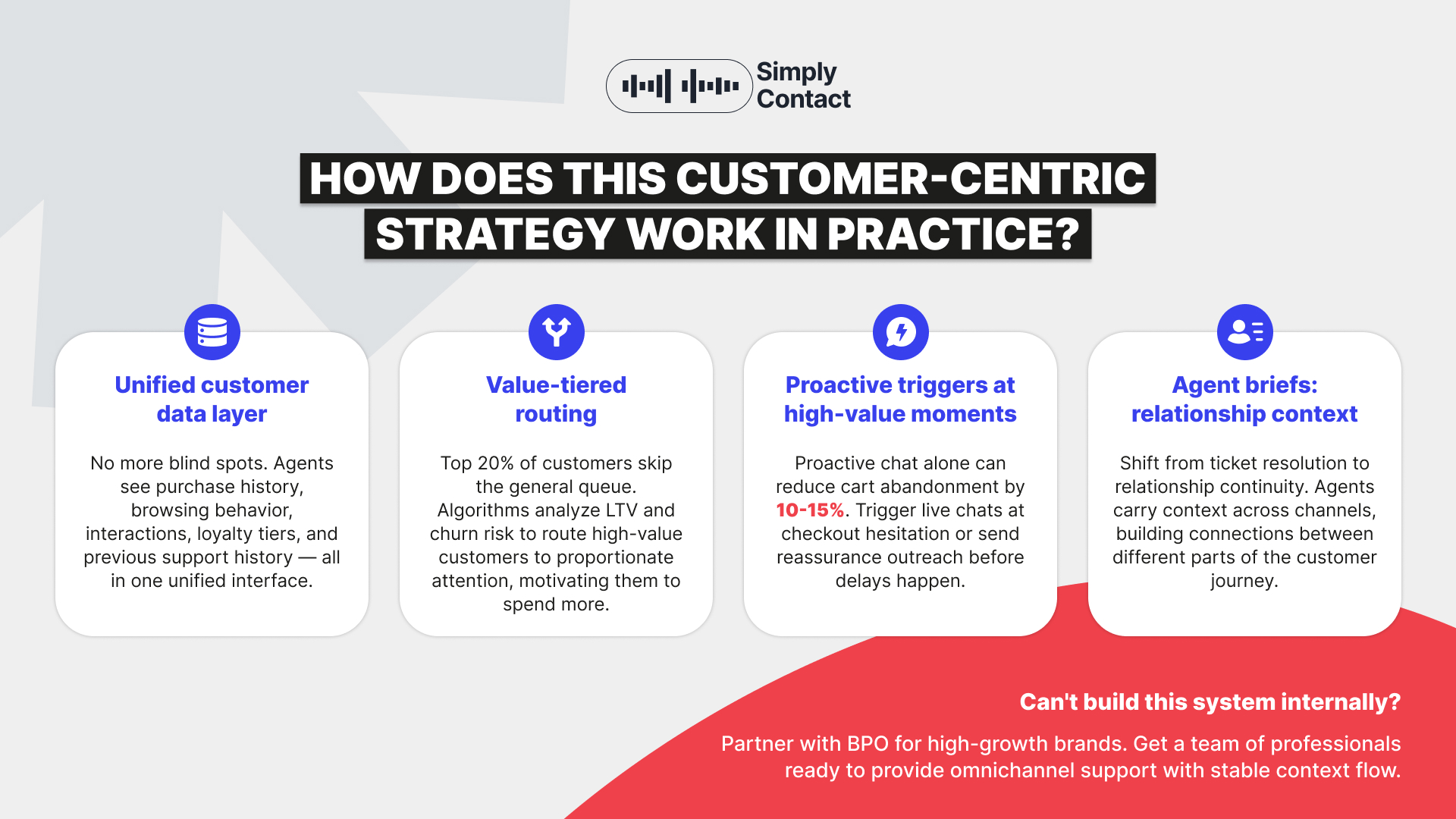
A unified customer data layer
No more blind spots when it comes to customer profiles. Agents can see purchase history and have insights into browsing behavior, interactions, and loyalty tiers. They have access to previous support history in the unified interface.
Value-tiered routing
Top 20% of customers don’t hit the general queue. You can make them feel valued and recognized by using smart routing. For instance, routing algorithms can analyze lifetime value and the likelihood of churn and draw an agent’s attention to sensitive or high-value cases. High-value customers receive proportionate attention and assistance and are motivated to spend more.
Proactive triggers at high-value moments
Proactive chat alone can reduce cart abandonment. The system may trigger live chats when checkout hesitates and suggest reassurance outreach if the shipment is delayed. The most effective teams don’t wait until something happens; they control the situation and reach customers in advance, demonstrating the brand’s care.
Agent briefs built around relationship context
The traditional support approach is fully focused on ticket resolution, but phygital briefs focus on relationship continuity. In this model, you have absolutely different talent implications: in a phygital environment, agents carry context across channels. Build connections between different parts of the customer journey, leading them to future intent.
If the company can’t build this system internally, it can always partner with a BPO provider to close the gap through customer support outsourcing. In this case, you get a team of professionals who are ready to provide omnichannel support operations based on a stable context flow.
When support is managed like a product, with a roadmap and tied to retention outcomes, it is no longer reactive; it creates solid ground for deeper customer connections and rapid growth.
Move 4: Close the infrastructure gap
Most support operations, as well as most BPO models, were designed for ticket deflection, rather than experience continuity. Teams are often focused on ticket reduction and shortening handle times. Everything was orchestrated to speed up the resolution, but the customer journey has already evolved and requires a different approach.
The global CX BPO market was valued at $113.0 billion in 2025 and is projected to reach $296.3 billion by 2033, according to Grand View Research. The same report expects the e-commerce segment to grow significantly because of the volume of order, delivery, and return queries it generates, and notes that e-commerce companies rely on CX BPO providers to manage omnichannel support.
A useful test for any VP of CX: is your current support model designed for the journey your customers actually take? If you're unsure, check your setup against these four requirements.
- Agent tooling and unified commerce data that work the same way in every channel, so every team sees purchase history and responds with context.
- A tiered human and AI model, where trained people and AI tools speed up search and surface useful insights.
- Proactive triggers for moments that need extra attention: hesitation at checkout, a new subscription, a delayed shipment, a new product arrival.
- Quality metrics tied to retention, not only CSAT. Knowing customers are satisfied is useful. Knowing whether they come back to buy again is better.
Many businesses keep running the support model they inherited. A model built for ticket deflection will struggle to keep a journey continuous, however well agents are trained.
Connected support in practice: results from Simply Contact projects
Simply Contact handles more than 10 million customer requests a year in 30+ languages. Three commerce projects show what continuity looks like in numbers:
- Volero, an e-commerce brand selling through Amazon, Kaufland, and Allegro. One blended team handles voice, written, and marketplace queries for Poland, France, and Germany, working directly inside the marketplaces. Average first response time stayed at about 2 hours and resolution time at about 1 day while monthly volume swung up to 4x between the summer low and the Black Friday peak. Read the Volero case study.
- A European electronics e-commerce platform. All chats run through one shared queue, with AI translation for German, Spanish, Dutch, and Norwegian. Language support costs fell by 34% within the first three months, first responses to non-English chats became 23% faster, and CSAT held at 91–94% across all languages. Read the AI translation case study.
- Yves Rocher, a cosmetics retailer. One team managed inbound and outbound calls together with order processing, which raised sales conversion by 10%. Read the Yves Rocher case study.
In each of these projects, one team handles the work end to end instead of splitting it by channel, language or workflow.
A delayed or damaged order very often becomes a logistics problem, and it shouldn't, because it's an emotional event. The right response is not a complicated apology email. It's a person on the phone within the hour who already knows the full context of the order, the history with the brand, and what went wrong.
— Nabil Kachour, Customer Service Operations Expert, ex-Zalando, ex-FREE NOW
Phygital customer experience FAQ
Phygital is a blend of the words “physical” and “digital”. It describes experiences where in-person and online touchpoints are connected, so the customer moves between a store, a website, an app, and support without starting over.
It is the experience a customer has when a brand’s physical and digital touchpoints work as one journey. Purchase history, preferences, and past conversations follow the customer across the store, the app, and customer support.
Click and collect is the most common example: the customer orders online and picks up in the store. Others include returning an online order at the counter, scanning a QR code on a shelf to read reviews, and booking a video consultation before a store visit.
Omnichannel is about the channels a brand offers. Phygital is about the single journey the customer experiences across physical and digital spaces. A brand can be present in every channel and still lose context when the customer switches between them.
Support is the point where broken handoffs become visible. To keep the journey continuous, agents need unified customer and order data, routing based on customer value, and proactive triggers at moments such as checkout hesitation or a delayed shipment.
Final words
Support results depend heavily on the architecture underneath the tooling and the agent training. The VP who wins the budget argument can show how support affects repeat purchases and retention, which a low cost per ticket alone can't.
Continuity can reduce churn. Routing by customer value protects lifetime value, and proactive outreach can prompt repeat purchases. Customers will move between channels whether or not you plan for it, so the useful question is whether the context reaches your agents when they do.
A practical place to start is one handoff, such as chatting on the phone or online return to the store. Check what the agent sees when it happens. If the answer is a ticket number and little else, that is the gap to close first.
If you'd like help, a customer support partner such as Simply Contact can work with you to redesign support around continuity and a measurable contribution to retention.

Newsletter
Subscribe
Subscribe to our newsletter to receive valuable industry insights and the latest research reports.