



Article
How to Use AI Simulation to Train Customer Support Agents Faster
The standard approach to training new customer support agents has a structural problem. Agents spend their first weeks in classrooms and shadowing sessions, then go live with partial knowledge and a supervisor watching over them. The real learning happens with actual customers, which means customers absorb the cost of every mistake made during the learning curve.
Call center simulation software changes that model. Instead of learning from live contacts, agents train against AI-generated conversations that replicate the interactions they'll actually face: billing disputes, escalations, angry customers, edge cases. They make mistakes, get feedback, and improve before they ever pick up a live call.
Key takeaways
- Call center simulation gives agents realistic practice on real contact types before going live, eliminating the period where customers absorb the learning curve.
- AI roleplay training for onboarding cuts ramp time, improves first contact resolution readiness, and produces more consistent quality across agent cohorts.
- Simulation works across 50+ languages, making it practical for multilingual operations that previously had to rely on native-speaker trainers for every language.
- The gap between passing a knowledge test and handling a live call is where most training programmes fail; simulation closes that gap.
- 100% scenario replay means QA teams can review every training interaction, not just the ones that happened to be observed.
Why traditional call center training falls short
Most call center training programmes are built around knowledge transfer: policies, scripts, product information, handling procedures. Agents learn what to say. What they don't get is practice at the thing that actually determines their performance, handling a real conversation with a real customer who isn't following the script.
The call center scripts approach has its place. A well-designed script gives agents a framework for common contact types and reduces the cognitive load of a first call. But scripts don't prepare agents for what happens when a customer goes off-script, which happens on most calls. Customer service simulation training exists to fill that gap.
| Traditional call center training | Why it falls short | Simulation-based training alternative |
| Classroom-heavy learning | Focuses on theory rather than live interaction skills | Immersive practice with realistic customer scenarios |
| Script memorisation | Agents struggle when customers go off-script | Trains adaptability and dynamic conversation handling |
| Limited roleplay sessions | Too little repetition to build confidence | Hundreds of AI-driven practice conversations |
| Shadowing experienced agents | Observation does not equal hands-on skill development | Active participation and real-time decision-making |
| Product and policy focus | Neglects emotional intelligence and tone recognition | Develops empathy, tone detection, and de-escalation |
| One-size-fits-all onboarding | Does not prepare agents for diverse customer personalities | Exposure to multiple customer behaviours and edge cases |
| Early transition to live calls | Agents face pressure before they are ready | Safe environment to fail, learn, and improve |
| Manual trainer feedback | Feedback is inconsistent and difficult to scale | Instant, data-driven performance analysis |
| Reactive learning after mistakes | Problems are corrected only after live failures | Skills are strengthened before customer exposure |
| Short onboarding windows | Insufficient practice time for skill retention | Continuous reinforcement through repeated simulations |
Traditional training gives agents two or three shadowing shifts and a week of classroom time, then puts them on live calls. Customer service simulation does something different: it gives agents 50, 100, or 200 repetitions against AI-generated conversations before they touch a live contact. The difference in readiness is measurable.
How AI roleplay training works
AI roleplay training uses conversational AI to simulate customer interactions. An agent logs into a simulation environment and handles a call or chat conversation with an AI playing the customer role. The AI responds dynamically based on what the agent says, following realistic customer behaviour patterns, including frustration, confusion, and escalation triggers.
The simulation can be configured for any contact type: billing queries, technical support, complaints, onboarding assistance, cancellation attempts. It can run in any language. It can be tuned to reflect the specific customer profiles and conversation patterns of a given client or product.
After each session, the agent gets feedback, where the conversation went well, where it broke down, what a better response would have looked like. The entire session is recorded and available for review. Unlike live call shadowing, where a supervisor can only observe a limited sample and feedback is retrospective, call center simulation software captures everything.
What simulation-trained agents look like
Simply Contact integrated AI call simulation into its agent training programmes across client operations. The outcomes are specific:
- 30% faster onboarding. Agents reach full productivity significantly faster when they've completed simulation training. The learning curve that normally plays out on live contacts, at the customer's expense, happens in the simulation environment instead.
- 2x higher first contact resolution readiness. Agents who go through simulation training resolve a higher proportion of contacts without escalation from day one. They've already handled versions of those conversations dozens of times.
- 100% scenario replay availability. Every simulation session is recorded and available for review. QA teams can examine how an agent handled a specific scenario type, identify patterns across a cohort, and feed findings back into the training programme.
- 50+ language coverage. The same simulation infrastructure covers the full language range of a multilingual operation. There's no degradation in training quality for less common languages.
Where simulation fits in the training programme
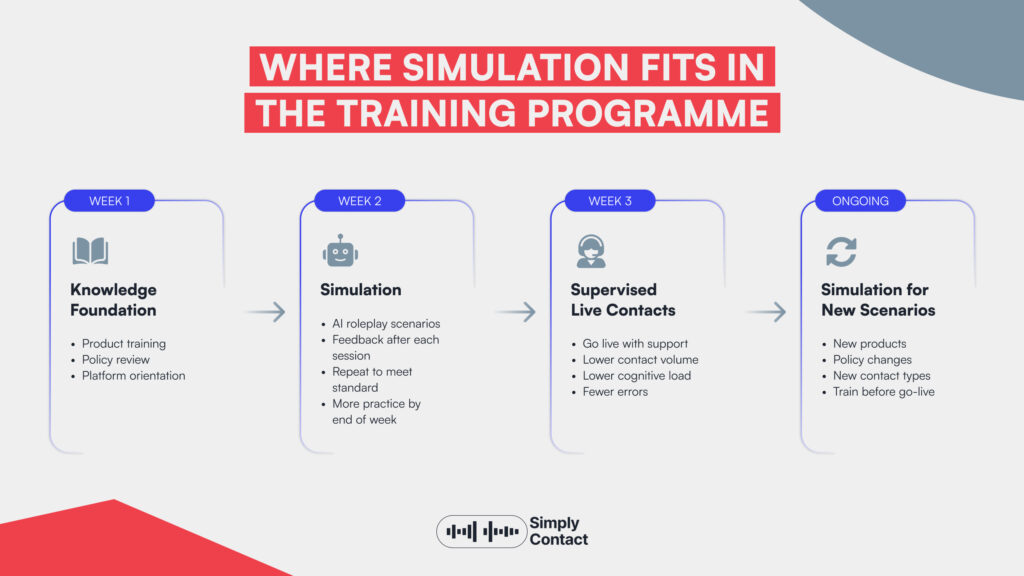
AI roleplay training sits at a specific point in the onboarding process: after agents have the knowledge foundation, before they handle live contacts. A typical sequence looks like this:
- Week 1: Knowledge foundation. Product training, policy review, platform orientation. Agents learn what they need to know.
- Week 2: Simulation. Agents work through a library of AI roleplay scenarios covering the contact types they'll actually handle. They get feedback after each session. They repeat scenarios where their performance didn't meet the standard. By the end of the week, they've had more practice conversations than most agents get in their first month on live calls.
- Week 3: Supervised live contacts. Agents go live, but with a supervisor available and a lower contact volume. Because they've already handled the common scenarios in simulation, the cognitive load is lower and errors are fewer.
- Ongoing: Simulation for new scenarios. When a new product launches, when a policy changes, when a new contact type emerges, simulation scenarios are updated and agents train before the change goes live. This keeps the training programme current without taking agents off the floor for extended periods.
The average handle time impact shows up quickly. Agents who've trained on realistic scenarios handle calls faster from the start because they've seen versions of it already.
What to look for in call center simulation software
Not all call center simulation software is built to the same standard. These are the criteria that matter for operational training use.
Realistic conversation dynamics
The AI needs to behave like a real customer, not a scripted decision tree. That means dynamic responses that change based on what the agent says, realistic emotional escalation patterns, and the ability to take conversations in unexpected directions. A simulation that follows a fixed path gives agents practice on the script, not on the actual skill of managing a conversation.
Feedback quality
Feedback after each session should be specific and actionable. "Good job" is useless. "You moved to the resolution too quickly before confirming the customer's underlying concern. Here's what that exchange should have looked like:" is useful. The feedback mechanism is where simulation training either develops agents or just gives them more repetitions of the same mistakes.
Coverage across contact types and languages
A simulation library that covers 20 scenarios in one language is being trained for 20 scenarios in one language. An operation handling 500+ contact type variations across ten languages needs a system that can match that breadth. Check specifically what the simulation covers, not just what the vendor claims it can theoretically support.
Integration with QA processes
Call center simulation software that operates as a standalone training tool is useful. Software that integrates with QA workflows, where training performance data informs live call monitoring priorities and live call findings feed back into simulation scenario design, is substantially more valuable. The quality assurance process becomes more effective when training and QA share data.
Scalability for rapid hiring
The value of simulation for onboarding comes partly from speed: when a client needs 30 new agents in three weeks, simulation training can run in parallel across all 30. Traditional training scales with trainer availability, which creates a bottleneck. Simulation scales with compute, which is a different constraint entirely.
Customer service simulation in practice: what changes operationally
The shift to simulation-based training has operational consequences beyond faster onboarding.
- Agent confidence on day one. An agent who has handled 100 simulated conversations arrives at live operations with a different psychological state than one who has shadowed three calls. Confidence under pressure is partly experience, and simulation creates experience at scale.
- More consistent cohort quality. Traditional training produces wide variance in agent readiness because individual supervisors apply different standards and cover different scenarios. Simulation gives every agent in a cohort the same practice scenarios, scored by the same criteria. The variance in readiness narrows.
- Empathy training at scale. Empathy in customer service is often treated as an innate trait, agents either have it or they don't. Simulation makes it trainable. Agents can practice reading emotional cues, adjusting their tone, and responding to escalating frustration in a low-stakes environment. Repetition builds the pattern recognition that makes empathetic responses feel natural rather than scripted.
- Reduced supervisor load. When agents arrive at live operations genuinely prepared, the need for intensive supervisor monitoring drops. Supervisors can focus on the genuinely complex situations rather than spending their time on errors that simulation training would have prevented.
Simulation is how you close the gap between training and live performance
The traditional training model asks agents to bridge the gap between knowing something and doing it in real time, under pressure, on their first live call. Some agents make that crossing without difficulty. Most take weeks to do it. Customers absorb the cost the whole time.
AI roleplay training moves the practice to before the live call. The gap closes in the simulation environment, not on customers. The agents who arrive at live operations are the ones who've already made the crossing.
Newsletter
Subscribe
Subscribe to our newsletter to receive valuable industry insights and the latest research reports.